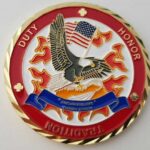
Fire department challenge coins come from more levels of an organization than almost any other category. A department orders one, and so does a single house, a shift, a recruit class, a union local, an auxiliary and sometimes a museum. Each of those wants a different coin, and knowing which one you are making answers most of the design questions before they come up.
Who Orders a Fire Coin
Six distinct buyers, and they are not interchangeable.
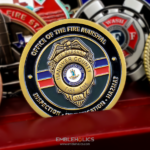
- The department. Carries the official badge or patch, goes to everyone, approved through the chief’s office. The most formal of the set. See a Chicago Fire Department coin.
- A station or house. Carries the station number and whatever that house calls itself. Station identity is strong in the fire service and a house coin is often more prized than the department’s.
- A crew or shift. Bought with their own money, which is why crew coins carry the imagery crews actually like rather than what a department would approve.
- A recruit academy class. Tied to a numbered class that stays a cohort for a whole career. See the Boise recruit class coin.
- A union local or association. Carries the local number and the association’s own emblem rather than the department’s. See an IAFF local coin.
- A volunteer organization or auxiliary. No payroll and no budget line, so the coin is funded by the members and often has to serve donors as well. See a volunteer fire rescue coin.
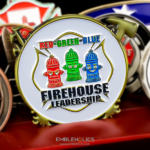
Occasions run alongside that list: a department anniversary, a memorial, a retirement, a promotion, a line-of-duty remembrance, a museum piece. See a 150th anniversary coin, a firefighter memorial coin and a firehouse leadership coin.
The Two Emblems, and Which One You Need
The fire service has its own device and so does EMS, and a combined organization has to decide between them.
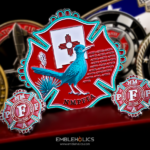
The cross, which the fire service calls a Maltese cross and which is technically a Cross of Saint Florian, is the fire device. The Star of Life, a blue six-pointed star with a Rod of Asclepius at its center, is the EMS device. Many departments now run more medical calls than fire calls, which is a real argument for leading with the Star of Life rather than defaulting to the cross.
The cleanest solution on a two-sided object is one emblem per face. Combining them rarely works, because both are geometric devices with fixed proportions and overlapping them damages each. The cross is covered in detail, including how it behaves as a coin outline and why its inside corners matter, on the Boise firefighters coin, and the Star of Life on the White Pine County coin.
Apparatus on a Coin
A fire engine is one of the most requested subjects in this category and one of the most awkward, for the same reason a ship is: it is a long horizontal object on a face that is usually round.
An engine in side profile is roughly three times longer than it is tall. Three approaches work.
Run it across the full diameter and fill the arcs above and below with a skyline, a station, smoke or lettering. This is the most common solution and it needs something planned for those arcs rather than left empty.
Turn it to a three-quarter view. Seen from forward of the cab, an engine occupies a shape much closer to square and fills a round coin far better. You lose some of the clean recognizable profile and you gain a lot of usable area.
Change the outline. A rectangle or an oval matches apparatus proportions far better than a circle does, and it also gives straight runs for the department name.
One detail worth getting right: draw the apparatus the department actually runs. Crews know their own rigs, and a generic engine on a coin for a department that operates a tiller or a quint is the thing people will comment on.
Matching a Coin’s Color to Your Apparatus
Departments frequently ask for the coin’s red to match their engines, and it is worth being straight about what is possible.
Coin enamels come from a range of standard colors. A close match to a specific apparatus paint is usually achievable, an exact match is not guaranteed, and red is the hardest color in the set to hold consistently because small shifts in a red read as a different red to the eye.
Three things help. Tell us the color reference you are working from rather than describing it in words, since one person’s fire engine red is another’s scarlet. Decide whether you need the match or merely a red that looks right next to the rig, because the second is easier and usually indistinguishable in the hand. And remember that departments running both older and newer apparatus often have two different reds in the fleet already, so there may be no single correct answer to match.
What Else Goes On a Fire Coin
Beyond the emblem and the apparatus, the elements that work are the ones specific to the department rather than generic to the service.
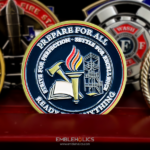
A station or firehouse building, which is often more recognizable locally than any badge. Tools, including axes, halligans, pike poles and nozzles, which read well because they are strong simple silhouettes. A helmet, which carries rank and department identity in its shield. A station number, which is the single most useful thing on a house coin. And a motto or a prayer, which brings its own constraints, since a prayer cannot be abridged and therefore sets the coin’s diameter rather than fitting into it. See a fireman’s prayer coin.
For the medical side of a combined service, see EMS challenge coins.
Approvals
A department badge and official insignia belong to the department, and reproducing them on merchandise is governed by its policy. If you are ordering as a house, a shift or a group of firefighters rather than through the department, confirm what is approved before the artwork stage. Departments also differ on what imagery they will allow on a public-facing item, which is a question for your command rather than for a manufacturer.
We produce from the artwork a customer supplies, we rely on the customer to hold the right to supply it, and we do not grant permission on anyone’s behalf.
Order Fire Department Coins
Send your badge, patch or station artwork, and tell us which level the coin is for, because a department coin, a house coin and a crew coin are three different designs. If apparatus or a color match matters, say so early.
Professional artwork is free with unlimited revisions, the minimum order is 50 coins, and nothing goes into production until you approve a digital proof. Standard production runs about 45 to 50 days after final artwork approval, rush production is available on many projects, and shipping within the continental United States is included. Embleholics is veteran-owned, SDVOSB and registered in SAM.gov. See more firefighter challenge coins, including projects for Hanover County Fire EMS, Spring Hill Fire Department and Walker Fire Protection District: Hanover County, Spring Hill, Walker Fire.
Frequently Asked Questions
What is a fire department challenge coin?
A fire department challenge coin is a coin carrying a department’s identity, given to firefighters, presented to visitors and partner agencies, and often exchanged between departments. They are ordered at many levels, from the department itself down to a single station, shift or recruit class, and the level decides what the design should carry.
Who orders fire department coins?
Departments, individual stations or houses, crews and shifts, recruit academy classes, union locals and associations, and volunteer organizations and auxiliaries. A department coin is approved through the chief’s office and stays close to the badge, while a crew or house coin is bought by its members and tends to carry imagery they choose themselves.
Should a fire coin use the Maltese cross or the Star of Life?
The cross is the fire service device and the Star of Life is the EMS device, so a combined organization should normally put one on each face rather than combining them. If the department runs more medical calls than fire calls, which many now do, leading with the Star of Life is the honest reflection of the work.
Can a fire engine be put on a challenge coin?
Yes, and the difficulty is proportion rather than detail. An engine in side profile is about three times longer than it is tall, so either run it across the full diameter and plan something for the arcs above and below, turn it to a three-quarter view which fills a round coin much better, or choose a rectangular or oval outline that matches apparatus proportions. Draw the rig the department actually runs, because crews will notice.
Can the coin’s red match our fire engines?
Usually closely, but not guaranteed exactly. Coin enamels come from a range of standard colors, and red is the hardest to hold consistently because small shifts read as a different red. Send a color reference rather than a description, and decide whether you need a true match or simply a red that looks right beside the rig, since the second is easier and usually indistinguishable in the hand.
What is the minimum order for fire department coins?
The minimum is 50 coins. That suits a department or a station comfortably and is more than most recruit classes or single crews, so smaller groups usually either order the minimum and hand out several each, or combine their order with a department run.
Who approves a fire department coin design?
The department. Badges and official insignia are departmental property and their use on merchandise is governed by department policy, and departments also differ on what imagery they will approve on something that may be photographed and shared. Settle both before the artwork stage rather than after a proof.
Can a prayer or a long passage go on a fire coin?
Yes, and it is a long tradition in the fire service. Because a prayer cannot be abridged, the length of the text sets the coin’s diameter rather than fitting into it, the lettering should be engraved rather than raised, and the other face needs to stay simple so the eye has somewhere to rest.
More Firefighters Projects