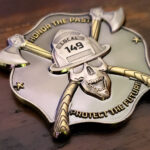
A Maltese cross challenge coin uses the fire service’s own shape as the outline of the coin rather than printing it on a disc, and that is a different kind of object. This one was made for a Boise Fire recruit academy class, cut to the cross with engraved crossed axes and a skull, which is a long way from a standard department coin. The shape brings its own rules, and one of them is a pleasant surprise.
The Fire Service’s Own Shape
The cross is to the fire service what crossed muskets are to the infantry and crossed keys are to corrections. It is the one device the whole profession shares.
The traditional account traces it to the Knights Hospitaller, the Knights of St John, whose cross design goes back to the First Crusade, and the eight points are said to stand for eight qualities: loyalty, piety, frankness, bravery, glory and honor, contempt of death, helpfulness towards the poor and the sick, and respect for the church.
There is a point of precision worth knowing, even though almost nobody uses it. The shape most fire departments actually wear is properly the Cross of Saint Florian, not the Maltese cross. A true Maltese cross has four V-shaped arms meeting at their tips with straight edges. The Florian cross has broad arms with large curved arcs between them, which is the splayed shape you see on fire department badges and apparatus. The fire service calls it a Maltese cross and that is what everyone will keep calling it, but the distinction matters for one practical reason, below.
Why the Fire Service Version Is the Stronger Coin
Here is the pleasant surprise. The shape departments use is the more durable of the two, and the reason is a detail most people never think about.
On any cross-shaped coin, the weak points are not the tips of the arms. The arms are broad and well supported. The weak points are the inside corners, where two arms meet, because a sharp inside corner is a stress concentrator. Force applied to an arm travels into that corner and has nowhere to spread, which is where a cross-shaped piece will crack if it ever does.
A true Maltese cross, with its arms joined at straight-edged points, has sharp inside corners. The Florian cross replaces each of them with a generous curved arc, which spreads load around the corner instead of concentrating it at a point. The shape the fire service adopted for heraldic reasons happens to be the better engineered one.
The rule generalizes to any cross, star or multi-armed outline: put a radius in every inside corner, even where the artwork shows a sharp angle. It is invisible at arm’s length and it is the difference between a coin that survives twenty years in a pocket and one that does not. See custom shaped challenge coins for how these outlines are tooled.
A Cross Has No Rim for Lettering
The cost of the shape is text, and it catches people out at the proof stage.
A round coin has a continuous rim, which is the natural home for a department name, a station number or a motto, running right around the outside where it collides with nothing. A cross has no such path. The outline goes in and out four times, so there is no ring to set type along.
That leaves three places for lettering, and you should decide which before the artwork starts.
- Across the arms. One or two words per arm, which works well for a short name or a four-part motto and badly for anything longer.
- In the center. Reliable, but the center is usually where the main device wants to be, so it is a direct trade.
- On a banner or scroll laid across the cross. This is the usual answer, and it is why so many fire badges have one. A scroll creates the straight run of space the outline refuses to give you.
A cross also encloses less area than a circle of the same overall width, so expect the usable design space to be smaller than the dimension suggests.
Who Pays Decides What Goes On It
The crossed axes and skull on this coin are a long way from standard department artwork, and that is not an accident. It is a consequence of who ordered it.
A coin issued by a department carries the department’s identity and is approved through the department, so it stays close to the badge. A coin bought by a recruit class, a crew, a shift or a station is bought with their own money and represents them, which is why those coins carry the imagery the people in them actually like. Skulls, axes, mottos and in-jokes appear on crew coins and almost never on departmental ones.
Both are legitimate, and knowing which one you are making answers most of the design questions before they come up. If the department’s badge or official insignia is going on it, that needs approval regardless of who is paying.
A Coin for One Academy Class
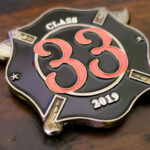
This coin was made for the department’s thirty-third recruit academy class, and class coins have a quantity problem worth planning around.
A recruit class is smaller than the 50-coin minimum, often by a lot. There are three normal ways through that. Order the minimum and let each recruit have several, which is what most classes do and which works because people give them away for years. Combine the class order with a department or station order so the run covers both. Or design the coin so it suits the whole academy rather than one class, with the class number on a small secondary element that can change between runs.
Fire academy classes are worth the trouble, because firefighters identify with their academy class for an entire career in a way graduates of most other programs do not. See academy graduation challenge coins.
About Boise Fire
The Boise Fire Department provides fire suppression for the city of Boise, Idaho, along with contract service to Garden City and Hidden Springs. It was founded on 24 January 1876 with 28 volunteers, working out of a blacksmith shop on Main Street, and it marked its 150th anniversary in January 2026.
A 150-year mark is exactly the occasion a commemorative coin exists for, and an anniversary coin is a separate piece from a class or crew coin rather than a replacement for one. See a fire department 150th anniversary coin, a Boise Fire station coin, and a Chicago Fire Department coin.
Order a Coin for Your Department or Class
Send your badge or patch artwork and tell us whether the coin is for the department, a station, a crew or an academy class, because that decides what the design can carry. If you want the coin cut to a cross, say so early, since the outline affects where lettering can go.
Professional artwork is free with unlimited revisions, the minimum order is 50 coins, and nothing goes into production until you approve a digital proof. Standard production runs about 45 to 50 days after final artwork approval, rush production is available on many projects, and shipping within the continental United States is included. Embleholics is veteran-owned, SDVOSB and registered in SAM.gov. See more firefighter challenge coins.
Finished Coin (Front)
Finished Coin (Back)
Frequently Asked Questions
What is a Maltese cross challenge coin?
A Maltese cross challenge coin is cut to the shape of the fire service cross rather than being a round coin with the cross printed on it. The outline itself identifies the piece as a fire service coin before any artwork is read, which is why it is the most common custom shape in the fire category.
Is the firefighter cross a Maltese cross or a Cross of Saint Florian?
Technically it is usually a Cross of Saint Florian. A true Maltese cross has four V-shaped arms meeting at straight-edged points, while the Florian cross has broad arms separated by large curved arcs, which is the shape on fire department badges and apparatus. The fire service calls it a Maltese cross, and that is the term almost everyone uses.
What do the eight points of the cross mean?
The traditional account associates the cross with the Knights Hospitaller, the Knights of St John, and holds that the eight points stand for eight qualities: loyalty, piety, frankness, bravery, glory and honor, contempt of death, helpfulness towards the poor and the sick, and respect for the church.
Is a cross-shaped challenge coin durable?
Yes, if the inside corners are right. The weak points on a cross are not the tips of the arms, which are broad and well supported, but the inside corners where two arms meet, because a sharp inside corner concentrates stress. Putting a radius in every inside corner spreads that load, and the curved arcs on the fire service version of the cross do exactly that.
Where does lettering go on a cross-shaped coin?
Not around the rim, because a cross has no continuous outer path to set type along. The three options are a word or two across each arm, text in the center, or a banner or scroll laid across the cross, which is the usual solution and the reason so many fire badges include one. Decide before the artwork starts, since it changes the layout.
Can a recruit class order its own challenge coin?
Yes, and class coins are common in the fire service because firefighters identify with their academy class for an entire career. A class coin is bought by the class rather than issued by the department, which is why crew and class coins carry imagery that departmental coins usually do not.
What is the minimum order for a class coin?
The minimum is 50 coins, which is more than most academy classes. The usual routes are to order the minimum and give each recruit several, to combine the class order with a department or station order, or to design a coin for the academy generally with the class number on a small element that changes between runs.
When was the Boise Fire Department founded?
The Boise Fire Department was founded on 24 January 1876 with 28 volunteers, housed in a blacksmith shop on Main Street. It marked its 150th anniversary in January 2026 and serves the city of Boise along with Garden City and Hidden Springs under contract.
More Firefighters Projects