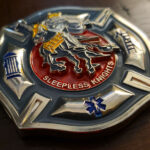
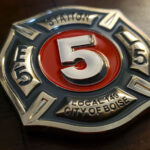
The design is built on the Maltese cross, the firefighter’s symbol. The front carries the station’s mascot, the Sleepless Knights, sculpted in relief. The back is inscribed with the number 5 and nothing else. The base metal was shaped using computerized design and machining, which is what allows the bulging areas across the surfaces. This fire station challenge coin was made for Boise Fire Station 5.
A Coin for One Station
A single station is a smaller unit than a department, and that scale is exactly why station coins work.
A station is a crew, not an organization. The people who work out of one building across the same shifts know each other in a way a department-wide workforce does not. A coin for that group means more than a department coin to the same people.
Stations have their own identities. Nicknames, mascots and rivalries between houses are part of fire service culture, and they are rarely documented anywhere official. A coin is one of the few places a station’s own identity gets made permanent.
The number is enough. Within a department, a station number is a complete identity. That is why the reverse here needs nothing but the 5, and why putting more on it would weaken it.
And a station coin can be a cheap commission. One crew covering a 50 piece minimum is straightforward, where a department-wide piece involves budgets and approvals.
See also fire department challenge coins and another fire station challenge coin.
Boise Fire Station 5
Station 5 is the oldest operating fire station in Boise, built in 1951. Its crews ran their final call from the current building on 30 January 2023, and the station is being rebuilt on the same site. The Boise Fire Department itself was founded in 1876.
That gives this coin a particular job. A crew leaving a building after seventy years is marking the end of something specific, and a coin is the right object for it because the building will not exist afterward. Photographs record what a place looked like; a coin is something people carry away from it.
The detail that matters is the rebuild on the same site. This is not a station closing, it is a station continuing in a new building, which means the coin marks a transition rather than an ending. That is an argument for a design built on the station’s permanent identity, the number and the mascot, rather than on an image of the building that is going away.
The Maltese Cross
The Maltese cross is the firefighter’s symbol and the most established shape in fire service design, with a history worth knowing.
The association traces back to the Knights of St John, who fought fires started by incendiary weapons during the Crusades and carried the cross as their emblem. The symbol passed into fire service use and has been the badge of the profession ever since, which is why it appears on helmets, patches and apparatus across the world.
That history makes a knight mascot on a Maltese cross unusually coherent, since the shape and the figure come from the same place. Most mascots sit on a symbol they have no relationship to, and this one does not.
As a coin shape the cross behaves well. Four broad arms give plenty of usable area, the points are wide rather than sharp in the standard fire service form, and the outline is recognized instantly in silhouette. The one design constraint is the center, which is where the arms converge and where the main element has to sit, since content placed out on an arm has far less room than it appears to.
See also a Maltese cross challenge coin and firefighter coin symbolism.
Machining Bulging Surfaces
The bulging areas across this coin’s faces are a specific capability, and they are different from ordinary relief.
Standard relief raises a defined shape off a flat field, with clear edges where the shape begins. A bulge is a gradual swelling of the surface itself, with no boundary line, which changes how light moves across the face as the coin is turned.
That is useful for two things. It gives a face depth without putting any additional element on it, which suits a minimal design. And it works well under a mascot or figure, because a swelling field lifts the subject without a hard edge competing with the sculpting on the figure itself.
It requires computerized machining rather than hand tooling, since a smooth continuous curve across a surface has to be computed rather than cut by eye. That is what the page is pointing at when it mentions the design and machining system, and it is why organic forms like this are more available now than they were.
Order a Fire Station Coin
Professional artwork is free with unlimited revisions, and nothing goes into production until you approve a digital proof. The challenge coin minimum is 50 pieces, standard production runs about 45 to 50 days after final artwork approval, rush production is available on many projects, and shipping within the continental United States is included. Embleholics is veteran-owned, SDVOSB and registered in SAM.gov.
Two suggestions for a station coin. Build it on what stays, the number and the mascot, rather than on the building, since stations get rebuilt and relocated and a coin outlives the structure. And keep the main element in the center if the shape is a cross, because the arms have far less usable room than they look like they do. Request a free quote to begin.
Finished Coin (Front)
Finished Coin (Back)
Frequently Asked Questions
Why order a coin for a single fire station?
Because a station is a crew rather than an organization. The people working out of one building across the same shifts know each other in a way a department-wide workforce does not.
Is a station number enough for a coin face?
Within a department, yes. A station number is a complete identity, which is why a reverse carrying only the number works and adding more would weaken it.
Can one station meet the minimum order?
Usually without difficulty. A single crew covering 50 pieces is straightforward, and it avoids the budget and approval process a department-wide coin involves.
Why is the Maltese cross the firefighter’s symbol?
It traces to the Knights of St John, who fought fires started by incendiary weapons during the Crusades and carried the cross as their emblem. It has marked the profession ever since.
Is a Maltese cross a good coin shape?
Yes. Four broad arms give usable area, the points are wide rather than sharp in the fire service form, and it is recognized instantly in silhouette.
Where should content sit on a cross shaped coin?
In the center, where the arms converge. Content placed out on an arm has much less room than it appears to, and it reads as detached from the design.
What is a bulging surface on a coin?
A gradual swelling of the face itself with no boundary line, unlike relief which raises a defined shape with clear edges. It changes how light moves across the coin as it turns.
Should a coin show the station building?
Usually not. Stations get rebuilt and relocated, and a coin built on the number and the mascot outlives the structure, while one built on the building dates the moment it changes.
More Firefighters Projects