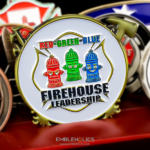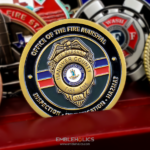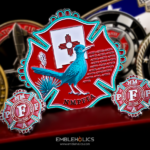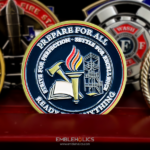
A firehouse challenge coin belongs to a single station, company or battalion rather than to a whole department. It carries that unit’s number and identity, and in a large department there are dozens of them, each ordering its own.
Why Fire Departments Order Coins by Company, Not by Department
A large fire department is not one buyer. It is dozens.
Take Chicago as the example. The Chicago Fire Department runs 96 stations and 25 battalions, with 96 engine companies, 61 truck companies, four squads and around 80 ambulances, alongside EMS, special operations, fire investigation and a training academy. That is not one organization ordering a coin. It is a great many small ones, each with a number and a house.
And the loyalty runs to the house, not to the department. A firefighter says Engine 42 or Truck 7 before they say the department’s name, because that is the crew they work a shift with, eat with, and go into buildings with. The department is who signs the paycheck. The house is who you belong to.
That is exactly why a firehouse coin works and a department-wide one often does not. A coin representing five thousand people represents nobody in particular. A coin with a company number on it belongs to the twenty or so people who ride that rig.
Practically, three things follow. Orders are company-sized rather than department-sized. They recur, because houses reorder as people transfer in and out and as designs get refreshed. And the person placing the order is usually a company officer or a senior firefighter doing it for their own crew, not a purchasing department.
Related work in the gallery includes IAFF local and industrial brigade coins and fire department training coins.
What Occasions Do Fire Departments Mark With Coins?
Firehouse and company identity. The most common reason of all, and it needs no occasion. A house wants a coin because it is a house.
Station and department anniversaries. Firehouses are old buildings with long histories, and a station marking its centenary is a genuine event in a neighbourhood.
Promotions. Making lieutenant, captain or battalion chief, usually marked within the house rather than at headquarters.
Retirements. Often the most personal coin a department orders, with years of service and the houses served on the reverse.
Academy graduation. Every recruit class, every year.
Mutual aid and large incident recognition. Coins exchanged between departments that worked an incident together, which is one of the main ways fire coins travel between cities.
Memorials. Coins are made to remember members lost in the line of duty, and we work with departments on those directly.
What Goes on a Firehouse Challenge Coin?
The Maltese cross is the anchor of most fire service designs, and it usually carries the department or company name around it.
Company and station numbers do the identifying work, and they matter more than anything else on the coin. Engine, truck, squad, ambulance and battalion designations are how the crew refers to itself, and the number is often the largest element on the face.
Apparatus. Houses are proud of their rigs, and a specific engine or truck rendered on a coin is common, sometimes right down to the year and model.
Department emblems where authorized, usually on the reverse where a seal would sit.
City skylines and landmarks. A firehouse serves a neighbourhood, and local landmarks are used more in fire coins than in almost any other category.
Mottos and dates. House mottos are frequently unofficial and frequently the best thing on the coin.
Finish runs toward red, gold and blackened treatments. Red is the obvious choice and works when it is used deliberately rather than everywhere, and blackened metal has become common on tactical and special operations pieces.
Fire Academy and Recruit Class Coins
Academy classes are one of the most reliable recurring orders in the fire service, and the reason is structural.
A recruit class is a defined group of people who go through one demanding experience together and then scatter across the department, often never working in the same house again. That is precisely the shape that makes a coin worth having: a fixed group, a shared experience, and a point at which everyone disperses.
Classes are numbered, so each one is a new design rather than a reprint, and they run on a schedule, which means the order recurs without anyone having to make a fresh case for it.
Classes usually organize the order themselves rather than going through the department, often with a class representative collecting from everyone. That makes the timeline tighter than a departmental order, because graduation is a fixed date that does not move.
About This Chicago Fire Department Coin
The Chicago Fire Department is one of the oldest major organized fire departments in the United States. Volunteer companies formed in the city as early as 1832, before Chicago was even incorporated as a town, and the paid department was established by ordinance on 2 August 1858. Today it is the second largest municipal fire department in the country after New York’s, responding to more than 800,000 calls a year.
The brief for this coin was something timeless.
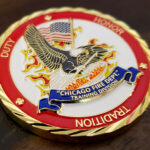
It is a round coin in gold-colored base metal. The department emblem is engraved on the reverse. The front carries a bald eagle holding the flag, set against a flame background worked in glossy bright red, with the remaining elements either painted or left as bare gold.
That last decision is the one worth pointing at, because it is what makes a two-color coin look like more than two colors. Leaving elements as bare metal against glossy paint creates depth: the painted areas sit flat and hold light evenly while the exposed gold catches it and moves. The eye reads that difference as dimension. It would have been easier to fill every recess with color, and the coin would have looked cheaper for it.
Can We Use Our Department’s Emblem on a Coin?
Municipal fire department emblems, seals and patches are usually restricted, and using one generally requires authorization from the department.
For most orders this is straightforward, because the coin is being ordered by people inside the department and approval runs through their own chain rather than an outside request. Where a design is being ordered by a class, an association or an individual, it is worth confirming before artwork starts.
We work from artwork the customer is authorized to supply, and we will raise it if a design appears to include a mark the customer may not control.
Design a Coin for Your House or Company
Artwork is free and revisions are unlimited, which matters when a design is being agreed by a whole crew rather than one person. You receive a digital proof and nothing goes into production until it is approved.
Orders start at 50 coins, shipping within the continental United States is included, and most orders are complete in 45 to 50 days after artwork approval. Rush production is available if you are working to a graduation, a retirement or an anniversary date.
Embleholics is veteran-owned, based in Port Orchard, Washington, and registered in SAM as a Service-Disabled Veteran-Owned Small Business under UEI F3AGRUW5RT53. You can see more custom firefighter challenge coins in the gallery, or request a quote and hear back within 24 hours.
Frequently Asked Questions
What is a firehouse challenge coin?
A firehouse challenge coin belongs to a single station, company or battalion rather than a whole department. It carries that unit’s number and identity, and in a large department dozens of houses each order their own.
Can a single engine or truck company order its own coins?
Yes, and it is the most common kind of fire service order. Companies order for their own crews, usually organized by a company officer or senior firefighter. The minimum order is 50 coins.
What goes on a firehouse challenge coin?
The Maltese cross, company and station numbers, apparatus, department emblems where authorized, city landmarks, house mottos and dates. Company numbers are usually the largest element, since that is how a crew identifies itself.
Do fire academy classes order challenge coins?
Frequently. A recruit class is a defined group that shares one experience and then disperses across the department, and classes are numbered so each is a new design. Classes usually organize the order themselves.
What is the Maltese cross on a fire coin?
The Maltese cross is the traditional emblem of the fire service and appears on most fire department insignia. On a coin it usually anchors the design, carrying the department or company name around it.
Do you make memorial coins for fire departments?
Yes. We work directly with departments on coins remembering members lost in the line of duty.
Can we use our department’s emblem on a coin?
Department emblems and patches are usually restricted, and use requires authorization. Most orders come from inside the department, so approval runs through the normal chain. We work from artwork the customer is authorized to supply.
How long does production take?
Most orders are complete in 45 to 50 days after artwork approval. Rush production is available if you are working to a fixed date such as an academy graduation or a retirement.
What is the minimum order?
The minimum order on coins is 50. Artwork with unlimited revisions is free, and shipping within the continental United States is included.
More Firefighters Projects