An American flag challenge coin is a custom coin built around the flag. This Hanover County Fire-EMS coin, presented for operational excellence by a battalion chief, sets department insignias over a waving flag on the front and the presenter’s name in gold on black on the reverse.
Using the Flag as a Background
A flag is a busy, high-contrast pattern, so anything placed on it has to compete for attention. The front of the Hanover coin is laid out this way:
- A waving flag in red, white and blue fills the face.
- Three insignias sit on top: a blue Fire-EMS shield, a red fire emblem and a battalion chief’s badge.
- A raised metal border outlines each insignia and can help it stay readable against the stripes.
- A black ring around the edge reads “Hanover County, Virginia” along the top and “Fire-EMS” along the bottom, both in gold.
Four habits can help when you design an American flag challenge coin:
- Decide which subject leads. Engraving or texturing the flag (cutting or patterning it into the metal, with little or no color) usually quiets it. A full-color flag, like the one on the Hanover coin, can work when each insignia has its own border.
- Keep the stripes behind the insignia. Stripes that cut through an insignia can make it harder to read.
- Prefer a waving or partial flag. A rippling flag tends to fill a round coin more naturally, since a flat rectangle leaves awkward corners.
- Keep the flag artwork clean. A flag is a serious symbol, and a distorted version can read as careless.
The US Flag Code sets out long-standing conventions for respectful use of the flag. It’s advisory, and many buyers choose to follow it. We’re not giving legal advice.
If a full flag is too much for your flag background coin design, a field of stars, a single star, or red, white and blue used only as accent colors can each refer to the flag and leave more room for the insignia. For the symbols themselves, see our guide to American national symbols.
A Coin With Someone’s Name On It
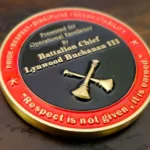
This coin works as an operational excellence award from one officer to one person. The reverse reads “Presented for Operational Excellence” above the presenter’s name and rank, with a pair of crossed bugles below.
A name on the coin changes a few things:
- Spelling and title. A mistake on metal is permanent and public, so the named person should check the spelling, rank and title themselves.
- Shelf life. The coin is tied to one person’s tenure, so it usually makes sense to order for the length of that assignment.
- Quantity. The count depends on how often one person gives coins out, which is usually far fewer than a department run.
- The giver. A recipient tends to keep the coin because of who handed it over.
A department coin says where you work, and a presented coin says what you did. Many organizations use both.
Gold on Black
Gold on black lettering gives strong contrast, which suits text that people need to read at a glance. The reverse of this coin has:
- Raised gold lettering on a black center field
- A red outer ring with the values Pride, Respect, Discipline and Accountability
- The motto “Respect is not given, it is earned.”
The black is usually an enamel fill (colored material set into the recessed, or lowered, areas of the metal) or a blackened finish (a dark treatment applied to those same areas). The lettering stays raised and plated (coated in a thin layer of metal), so it can catch light against the dark background.
This treatment suits a short block of text, and the Hanover reverse keeps its center to a name, a title and one emblem. On a crowded face, the same contrast can make nearby clutter more noticeable. You can read more about enamel, plating and engraving on our manufacturing page.
A Combination Department
This Hanover County Fire EMS coin comes from a combination department, meaning one staffed by both career and volunteer responders who train to the same standard. The department operates sixteen stations and serves Hanover County, Virginia, the birthplace of Patrick Henry. The same department also ordered a fire marshal challenge coin from us.
A coin for a combination department has to belong to both groups. The department mark usually leads, and nothing on the coin separates paid members from volunteers. If volunteer members are your focus, we also made a volunteer firefighter coin.
Official department insignias like these usually need the agency’s approval before they go on a coin, whatever the intent behind the design. If you’re ordering for a crew or station, confirm with your chain of command early. We work from artwork you’re authorized to supply, and when an official mark isn’t available, we can build a design around your crew’s identity.
Order a Coin for Your Department
If you’d like firefighter challenge coins for your own department, start with a free quote and send us your idea. Each fire and EMS challenge coin we make includes free professional artwork and unlimited revisions, and you’ll approve a digital proof before production begins.
Shipping is free within the continental US, and rush production is available when your event date is close. The minimum order is 50 coins. We’re a veteran-owned shop and an SDVOSB (Service-Disabled Veteran-Owned Small Business) registered in SAM.gov (the federal system where government vendors register).
If a name goes on the coin, have that person check the spelling and title before artwork starts. Also tell us whether you want the flag on your American flag challenge coin colored or engraved, since that choice shapes the whole composition.
Finished Coin (Front)

Finished Coin (Back)
Frequently Asked Questions
Can you put the American flag on a challenge coin?
Yes. An American flag challenge coin can use the flag as a full background or as a smaller device. If other artwork sits on top, outlining it can help it stay readable, and a clean, undistorted flag can help the design look respectful.
Should a flag background be colored or engraved?
Engraved or textured (cut or patterned into the metal) usually works better, because a full-color flag gives the coin two competing subjects and no clear focal point. Full color can still work when each insignia has its own border, as on the Hanover coin.
Are there rules about using the flag on a coin?
The US Flag Code sets out conventions for respectful use of the flag, and it’s advisory. We’re not giving legal advice, and many buyers choose to follow those conventions.
Can a person’s name go on a challenge coin?
Yes. A name, rank and title can all be added. Have the named person check each one on the digital proof. A spelling mistake on a finished coin is permanent.
What is a presented coin or an award coin?
A presented coin is handed over by one person to recognize one achievement, and the giver’s name often appears on it. Recipients often value it for the person who gave it and the achievement it marks.
How many coins should one officer order?
One officer usually needs fewer coins than a department does. Base the count on how often that officer gives coins out during an assignment, then add a few spares. The minimum order is 50 coins.
Why is gold lettering on black so common?
The contrast is strong, so short lines of text are easy to read quickly. Raised gold letters on a dark field also reflect light, which can make names and titles easier to pick out.
Can one coin represent career and volunteer members?
Yes. Putting the department mark first and leaving off anything that sorts members into paid and volunteer groups, such as separate labels, lets both groups see themselves on the coin.
More EMS Projects