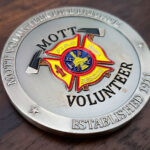
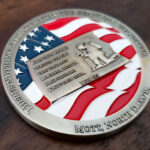
A volunteer brigade in a town of about eight hundred and fifty people is not the kind of organization most people picture ordering challenge coins. It should be. The front of this one carries the brigade’s insignia encircled by embossed lettering, and the reverse carries an American flag background with a scripture inscription engraved into it.
Why Small Departments Order Coins
The common assumption is that a coin order needs a large organization behind it. The opposite is closer to true.
A small brigade is a fixed, known group. Everybody on the roster knows everybody else. That is the condition under which a coin means something, and it is harder to achieve in a large department than a small one.
Volunteers are not paid, so recognition is the currency. A paid department has salary and promotion as ways of acknowledging people. A volunteer brigade has neither. What it has is the ability to give somebody something that says they are part of this, and a coin is one of the few objects that does that well.
Fifty pieces covers a small department several times over. A brigade of twenty has enough for the whole roster, for spares, for people who move on, for visiting departments, and for the next few years of new members, all in one order. For a small organization that is efficient rather than excessive.
And mutual aid means visitors. Rural departments work alongside neighboring brigades constantly. Having something to hand to a crew from the next town is a real use rather than a theoretical one.
See more firefighter challenge coins and another volunteer fire and rescue coin.
A Classic Layout, Done Properly
The brigade asked for a classic, respectable look: the insignia on one side, encircled with embossed lettering. No custom shape, no novelty feature.
That arrangement, a central device with text wrapped around it, is the oldest layout in coin design and it still works. But it depends on a few things being right, and they are the things people skip.
The ring of text needs breathing room. Lettering set too close to either the rim or the central device makes a coin look cramped. The gap on both sides of the text ring is what makes the layout feel composed.
The text has to be short enough to curve comfortably. Letters following a tight arc distort, and the longer the inscription the smaller it has to be to fit. If the words will not fit at a readable size, the answer is fewer words rather than smaller type.
Embossed lettering needs enough weight. Raised type loses a little definition at the edges when struck, so a face that looked right on screen often reads thin in metal. This is normally corrected during artwork.
And the device should be centered by eye, not by box. Insignia are rarely symmetrical, and centering the bounding box often leaves the device looking slightly high or low. On a round coin with a plain field, that is visible.
A Flag Background With Engraved Text
The reverse uses an American flag as the background with an inscription engraved over it, which is a combination worth examining because it is easy to get wrong.
The risk is legibility. A flag is a patterned field of stripes and stars, and text laid over a pattern competes with it. What makes it work is the difference in technique: the flag is the background relief, and the inscription is cut into the surface, so the two sit at different depths rather than fighting on the same plane.
Two things help further. Engraved text with a dark fill reads against a busy background where bare engraving would not. And placing the inscription over the flag’s plain field rather than across the stars gives it a calmer area to sit on.
The brigade chose a verse from Isaiah for the inscription, which is a common choice in the fire service and a natural fit for a reverse face. For more on fitting text onto a coin, see an engraved text challenge coin.
About Mott and the Brigade
Mott is a city in Hettinger County, North Dakota, and the county seat, with a population of around eight hundred and fifty. It is a Centennial City and marked that milestone in 2003.
The Mott Volunteer Fire Brigade provides fire suppression and related emergency services for the area, with members summoned to the station when they are needed. That arrangement, people leaving their own work to answer a call, is the thing the coin is actually about.
Order a Coin for Your Volunteer Department
Professional artwork is free with unlimited revisions, and nothing goes into production until you approve a digital proof. The challenge coin minimum is 50 pieces, standard production runs about 45 to 50 days after final artwork approval, rush production is available on many projects, and shipping within the continental United States is included. Embleholics is veteran-owned, SDVOSB and registered in SAM.gov.
Two practical notes for a small department. Send your insignia artwork if you have it, or a clear photograph of a patch, a door decal or a helmet shield if you do not; most volunteer departments have usable artwork somewhere even when nobody has the original file. And order a few more than your current roster, because the extra pieces cover new members and visiting crews for years and cost very little at the margin. Request a free quote to begin.
Finished Coin (Front)
Finished Coin (Back)
Frequently Asked Questions
What is a volunteer firefighter challenge coin?
It is a coin made for a volunteer fire department or brigade, usually carrying the department’s insignia and its town or county. Volunteer departments use them to recognize members, mark service milestones and exchange with neighboring crews on mutual aid calls.
Is a small department too small to order coins?
No. The 50 piece minimum covers a small brigade several times over, which means one order serves the whole roster plus spares, future members and visiting crews for years. A small, fixed group is also where a coin means the most.
Why do volunteer departments use coins for recognition?
Because volunteers are not paid, so a department has no salary or promotion to acknowledge people with. A coin is one of the few objects that says somebody is part of the group, which makes it do real work in a volunteer setting.
What if we do not have our logo as a file?
A clear photograph works. Most volunteer departments have the insignia on a patch, a door decal or a helmet shield even when nobody has the original artwork, and a good photo of any of those is enough to work from.
How much text fits around a coin’s edge?
Less than people expect, because letters following a tight arc distort and a longer inscription has to be set smaller to fit. If the wording will not fit at a readable size, use fewer words rather than smaller type.
Why does embossed lettering look thin on a finished coin?
Because striking softens the edges of raised type slightly, so a typeface that looked correct on screen can read light in metal. The weight is normally increased during the artwork stage to compensate.
Can text be placed over a flag background?
Yes, if the two are at different depths. Make the flag the background relief and cut the inscription into the surface, so they are not competing on the same plane. A dark fill in the engraving and placing the text over the flag’s plain area rather than the stars both help.
How many coins should a small department order?
More than the current roster. Fifty is the minimum, and the extra pieces cover new members, departures and visiting crews for several years. The cost sits in the die rather than the metal, so additional coins are inexpensive at the margin.
More Firefighters Projects