Every Fourth of July, Americans see flags, eagles, stars, stripes, and historic images everywhere. But which symbols are officially recognized by the United States, and how did they become part of the nation’s identity? Here is a closer look at America’s national symbols and the stories behind them.
The American Flag
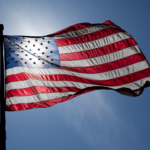
The American flag is the most recognizable symbol of the United States. Federal law defines it as thirteen red and white stripes with fifty white stars on a blue field. The stripes represent the 13 original colonies, and the stars represent the states.
The first official flag design was approved by the Continental Congress on June 14, 1777, which is why June 14 is now celebrated as Flag Day. As the country grew, new stars were added for new states, while the thirteen stripes remained. The modern fifty-star flag came after Hawaii became the 50th state in 1959.
The Great Seal of the United States
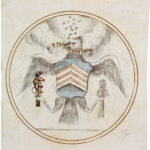
Charles Thomson's design for the Great Seal of the United States, 1782.
The Great Seal represents the authority and sovereignty of the United States and is used on official documents such as treaties, commissions, and proclamations.
It was adopted on June 20, 1782, after several committees worked on the design for six years. The final version was shaped by Charles Thomson, Secretary of the Continental Congress, with refinements from heraldry expert William Barton.
The seal includes a bald eagle, shield, olive branch, arrows, “E Pluribus Unum,” and a constellation of stars. Each element has meaning: the eagle represents the nation, the shield suggests defense, the olive branch symbolizes peace, the arrows show readiness, and the thirteen stars and stripes point back to the original states and colonies.
The Bald Eagle

The bald eagle has represented the United States since 1782, when it became part of the Great Seal. Since then, it has appeared on official documents, military insignia, coins, bills, and government emblems.
Native to North America, the bald eagle became a fitting symbol of strength, independence, freedom, and watchfulness. It had been used as a national emblem for centuries, but was only officially named as the national bird in 2024.
The eagle’s story also includes a major conservation comeback. Once endangered, the species recovered through habitat protection and other conservation efforts.
The National Motto: “In God We Trust”
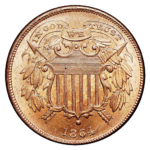
“In God We Trust” is the official national motto of the United States. The phrase first appeared on U.S. coins during the Civil War era (1861-1865), after Treasury Secretary Salmon P. Chase supported adding it to American coinage.
Congress officially adopted “In God We Trust” as the national motto in 1956, during the Cold War. Today, it remains visible on U.S. currency and in many public settings.
“E Pluribus Unum”
“E Pluribus Unum” means “Out of many, one.” It appears on the scroll in the eagle’s beak on the Great Seal of the United States. Although it is no longer the official national motto, it has been part of the Great Seal since 1782 and reflects the founding idea that thirteen separate colonies could form one united nation.
The National Anthem: “The Star-Spangled Banner”
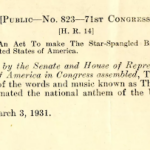
“The Star-Spangled Banner” became the national anthem of the United States in 1931. Its story begins during the War of 1812, when Francis Scott Key saw the American flag still flying over Fort McHenry after a 25-hour British bombardment.
Key wrote a poem called “Defense of Fort M’Henry,” which was later set to music and became known as “The Star-Spangled Banner.” Its lasting image is the flag still standing.
The Rose, the National Floral Emblem

The Congress, by Senate Joint Resolution 159, has designated the rose as the National Floral Emblem of the United States (...) Now, Therefore, I, Ronald Reagan, President of the United States of America, do hereby proclaim the rose as the National Floral Emblem of the United States of America.
The rose is the national floral emblem of the United States. Congress designated it in 1986, and President Ronald Reagan later proclaimed it as the official national floral emblem.
Although it is less obvious than the flag or eagle, the rose has long appeared in gardens, ceremonies, memorials, gifts, and celebrations. It represents life, love, devotion, beauty, remembrance, and honor.
The Oak Tree, the National Tree

The oak tree became the national tree of the United States in 2004. Federal law identifies the genus Quercus, commonly known as the oak, as the national tree.
Found across much of the country, the oak is associated with strength, endurance, deep roots, and longevity. Growing from a small acorn into a tree that can last for generations, it represents resilience, heritage, and growth.
The American Bison, the National Mammal
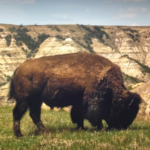
The American bison became the national mammal of the United States in 2016 through the National Bison Legacy Act.
The bison is closely tied to the Great Plains, Indigenous cultures, conservation history, and the American landscape. Once nearly driven to extinction in the 19th century, it became a symbol of survival, strength, and resilience after major conservation efforts helped restore its population.
What About the Statue of Liberty, Liberty Bell, and Uncle Sam?

Photo by William Warby. https://upload.wikimedia.org/wikipedia/commons/d/d3/Statue_of_Liberty%2C_NY.jpg
Some of the most familiar American symbols are not always “official national symbols” in the same legal sense as the flag or the national anthem. The Statue of Liberty, Liberty Bell, Uncle Sam, Mount Rushmore, the Declaration of Independence, and the Constitution are all powerful American icons, but they belong in a slightly different category.
They are better described as historic or patriotic icons rather than official national symbols.
Why National Symbols Still Matter
National symbols turn big ideas into images, words, and objects that give identity to a group of people. A flag can represent a country. An eagle can suggest strength. A rose can carry remembrance. A motto can hold a shared belief in only a few words. A tree can stand for endurance. A bison can tell a story of resilience.
That is also why national symbols work so well in custom challenge coin design. A coin gives those symbols a physical form, something a unit, department, or organization can pass down. Just as patriotic symbols can, a well-designed coin can turn shared identity into something lasting.
Planning a patriotic challenge coin for your military unit, first responder department, civic organization, nonprofit, or event? Embleholics can help turn your symbols, story, and mission into a custom coin design built with meaning and purpose. Request a quote today to start your custom coin design.
Recent Posts