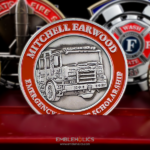
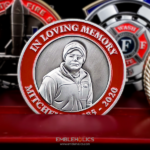
This coin belongs to a memorial scholarship. It carries a portrait of the firefighter it is named for on one face and a fire engine on the other, and it is the kind of piece where getting the design right matters more than usual, because the people holding it knew him.
A Portrait at Coin Size
A likeness is the hardest thing in this trade, and the reason is worth understanding before anyone commissions one.
A likeness lives in proportion, not in detail. What makes a face recognizable is the spacing between the eyes, the height of the brow, the width of the jaw, the set of the mouth. Those are relationships, not features. A portrait with every eyelash and no proportion looks like nobody. A portrait with the proportions right and almost no detail looks like the person.
That is good news at coin size, because detail is exactly what a coin cannot hold and proportion is exactly what it can.
Three things that follow:
Relief depth does more than line work. A face is read from shadow. Modelling the brow, the cheek and the jaw at real depth gives the strike something to cast shadows into, which is what makes a face read across a room rather than only in the hand.
The eyes and mouth are where it is won or lost. They are also the smallest features and the first to be flattened. They need more relief than they appear to need, and they belong on the lower planes of the sculpt rather than at the top of it, because the highest points take the most deformation.
A three-quarter view is more forgiving than full face. A face turned slightly gives the sculptor a jawline and a nose in profile to work with, both of which are strong recognizable forms. Straight on, everything depends on symmetry, and any error is doubled.
When a Portrait Is Not the Right Answer
This has to be said plainly, because it is the most useful advice on the page.
A poor likeness is worse than no likeness. On a memorial piece the family will hold it, and a portrait that is nearly right is harder to look at than a symbol. If the available photographs cannot support a likeness at coin size, a silhouette, a helmet, a badge number or a name set properly is the better choice, and nobody should feel it is a lesser one.
Two practical rules:
The photograph decides what is possible. A clear, well-lit image with the head at a usable angle gives a sculptor the proportions. A low-resolution snapshot, a group photo cropped in, or a shot in heavy shadow does not. Send the best image that exists, and if it is not good enough we will say so rather than guess.
The family approves the proof. Not the organization, not the committee. On a coin carrying a likeness, the people who knew him best are the only ones who can say whether it is him, and that approval happens before anything is struck rather than after.
A Brushed Field and a Quiet Design
The coin keeps a classic outline with no heavy patterning on the rims or the fields, and a brush effect across the surfaces.
Both choices are right for the subject.
A brushed field scatters light, which means the relief reads from every angle rather than competing with a reflection. On a portrait that matters more than on anything else, because a highlight falling across a face can change what the face looks like.
A plain rim keeps the attention where it belongs. A patterned or ornamental edge on a memorial piece pulls the eye outward and makes the coin look decorative. Leaving the rim plain is restraint doing real work.
The small inscriptions are etched rather than raised, which is also correct: a cut line holds its edge at small sizes where a raised edge rounds over, and recessed lettering reads cleanly against a brushed surface.
See antique and polished finishes for how the surface changes how relief reads.
The Engine on the Reverse
The second face carries a fire engine, and pairing a person with an apparatus is a sound structure for a memorial piece.
One face says who. The other says what he did. Neither has to carry both, which is what keeps the portrait face clear.
On drawing the apparatus: a fire engine is a long, low, detailed vehicle, which makes it one of the harder subjects. A three-quarter view shortens it and gives it depth where a side profile runs it off the edges. The body, the cab and the wheels are kept as solid forms, and the grille, the ladder rungs and the compartment latches are dropped deliberately rather than attempted and lost. A recognizable engine is a shape, not an inventory.
A Coin That Funds Something
A scholarship coin has two audiences, and it is worth knowing which one a particular run is for.
Supporters. Coins sold or given at events to raise funds. These go to people with no connection to the organization, so the scholarship’s full name has to be on the piece and legible, because that name is how somebody finds it afterwards.
Recipients. Coins presented to the students who receive the scholarship. A much smaller number, given personally, and the one case where the coin is marking an award rather than raising money.
Most programs want both and order one design that serves them. That works as long as the piece is not tied to a single year, because a scholarship runs annually and a dated coin cannot be reordered.
See commemorative challenge coins.
About the Scholarship
The Mitchell Earwood Emergency Services Scholarship is a memorial scholarship providing financial support to Georgia students studying firefighting, emergency medical services, law enforcement and other emergency services fields.
Mitchell Earwood was a firefighter with Walker County Fire Rescue in Georgia. He died on 16 April 2019 while fighting a house fire. The scholarship was established in his name.
See also a Walker Fire coin, a firefighter memorial coin and fire department challenge coins.
Order a Memorial Coin
Free professional artwork, unlimited revisions and a digital proof before anything is produced. Free shipping within the continental US, a 50-coin minimum, and most orders complete 45 to 50 days after artwork approval, with rush production available. Embleholics is veteran-owned, an SDVOSB, and registered in SAM.gov.
If the coin is to carry a likeness, send the best photograph that exists and tell us who will approve the proof. We will tell you honestly whether the image can support a portrait at coin size, and if it cannot we will propose something that will work instead.
See more first responder challenge coins.
Frequently Asked Questions
What is a memorial challenge coin?
A memorial challenge coin marks a person or an event and is usually given rather than issued, often by a family, a department or a scholarship program. It is kept rather than carried, which affects the finish and the design.
Can a photograph be turned into a challenge coin portrait?
Often yes, and the photograph decides what is possible. A clear, well-lit image with the head at a usable angle gives a sculptor the proportions a likeness depends on, while a low-resolution or heavily shadowed image does not.
What makes a portrait recognizable at coin size?
Proportion rather than detail. The spacing of the eyes, the height of the brow, the width of the jaw and the set of the mouth are what identify a face, and those relationships survive being small where fine detail does not.
Is a three-quarter view better than full face?
Usually, yes. A head turned slightly gives a jawline and a nose in profile, both strong recognizable forms, where a straight-on view depends entirely on symmetry and doubles any error.
What if a good likeness is not possible?
Use something else. A poor likeness is harder to look at than a symbol, so a silhouette, a helmet, a badge number or a name set properly is the better choice when the available photograph cannot support a portrait.
Who should approve a portrait proof?
The family, rather than the organization or a committee. They are the only people who can say whether the likeness is right, and that approval belongs before anything is struck.
Why use a brushed finish on a memorial coin?
A brushed surface scatters light so the relief reads from every angle rather than competing with a reflection. On a portrait that matters particularly, because a highlight falling across a face can change what the face appears to look like.
Can a fire engine be shown on a coin?
Yes, with simplification. A three-quarter view shortens a long vehicle and gives it depth, and the body, cab and wheels are kept as solid forms while the grille, ladder rungs and latches are dropped deliberately rather than lost in the strike.
Should a scholarship coin carry the year?
Better not, if the scholarship runs annually. An undated design can be reordered each year, where a dated one cannot, and the award itself supplies the occasion.
More EMS Projects