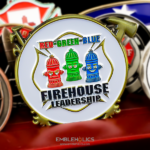
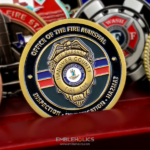
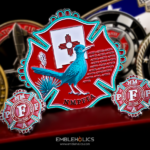
The front of this coin carries an engraved image of the department’s fire truck. The reverse carries a stylized scene of Yavapai County nature. The base is a gold colored metal and the edge is finished clean, with no pattern. It was made for Walker Fire Station 81 through the Walker Fire Protection Association.
Putting a Vehicle on a Coin
Apparatus is one of the most requested subjects in the fire service and one of the trickiest to execute, because a truck is a long horizontal object and a coin is a circle.
Three quarters beats side-on. A pure side view of an engine is a wide, flat rectangle that leaves big empty arcs at the top and bottom of a round face. Turning the vehicle to a three quarter angle gives it depth, fills the circle better and shows both the cab and the body, which is what makes it identifiable as that kind of apparatus.
Simplify the body, keep the profile. A fire engine is covered in compartments, handles, lights, hose beds and lettering. None of that detail survives at coin size, and attempting it produces a gray texture where a truck should be. What identifies apparatus is the overall profile: cab height, body length, the ladder or boom if there is one.
Keep two or three signature details and drop the rest. A light bar, the pump panel, the wheel arches. Three well chosen features read as a fire truck; thirty read as nothing.
Wheels need recessing, not drawing. Spoke detail disappears. A dark recessed circle with a lighter rim reads as a wheel at any size.
And engraving beats relief here. A vehicle is recognized from its outline and its lines, which is what recessed line work produces. Sculpting a truck in relief tends to look like a toy rather than a drawing of a machine.
The same approach applies to any apparatus or vehicle: ambulances, patrol cars, aircraft, boats, plant and equipment. See engraving and finish options.
A Landscape on the Reverse
The other face carries a stylized scene of the county’s natural landscape, and the word doing the work there is stylized.
Scenery at coin size cannot be rendered faithfully. What works is reduction to a small number of strong horizontal bands, a ridgeline, a treeline, a foreground, with one or two identifying features placed deliberately. A distinctive peak, a particular species of tree, a rock formation. Three elements, not thirty.
The reason a landscape is worth the trouble on a rural department’s coin is that it answers the question a badge cannot. A department insignia says who; the landscape says where, and for a volunteer department serving one specific community that is half the identity.
A Clean Edge
The edge of this coin is finished with no pattern, which is a choice rather than an omission.
A reeded, diamond or rope edge draws the eye outward and adds a decorative register to the piece. That works on a coin with a central device and a plain field. On a coin where both faces carry a full picture, an ornamented edge competes with the artwork and the piece starts to look busy at the rim while the images fight for the middle.
A clean edge keeps the frame quiet and lets the two pictures be the coin. Worth knowing that an edge treatment is a decision in both directions, and specifying none is as valid as specifying a pattern, provided it is deliberate.
Coins for a Volunteer Department
The Walker Fire Protection Association serves Walker, Arizona, a community near Prescott in Yavapai County. It was founded in 1863, and it is all-volunteer and donation-based, with members aiming to provide strong fire protection and emergency medical services to a community whose needs change over time.
Donation-funded is the detail that matters for a coin order, and it cuts two ways.
Budget is tight, so a two-sided coin with real design work on both faces needs to earn its keep.
But a coin can raise money. A department that sells coins at community events, pancake breakfasts and fundraisers turns the order into income rather than cost. For a donation-based department that is often the deciding argument, and it means ordering above the roster count rather than to it.
The 50 piece minimum also covers a small volunteer department several times over, which means one order serves the current members, future members, visiting crews and a stock to sell. See more firefighter challenge coins and a volunteer firefighter challenge coin.
Order a Coin With Your Apparatus on It
Professional artwork is free with unlimited revisions, and nothing goes into production until you approve a digital proof. The challenge coin minimum is 50 pieces, standard production runs about 45 to 50 days after final artwork approval, rush production is available on many projects, and shipping within the continental United States is included. Embleholics is veteran-owned, SDVOSB and registered in SAM.gov.
Two things that make an apparatus coin work. Send a photograph of your actual engine taken from a three quarter angle in good light, not straight on from the side, because the engraving is drawn from your photo and the angle decides how well it fills the face. And tell us if you intend to sell the coins, since larger quantities lower the cost per piece and that margin is what funds a volunteer department. Request a free quote to begin.
Frequently Asked Questions
What is a fire truck challenge coin?
It is a coin carrying an engraved image of a department’s apparatus, usually its own engine rather than a generic truck. Departments choose it because the apparatus is the most recognizable thing they own.
Can a fire engine be put on a challenge coin?
Yes, though it needs simplifying. The compartments, handles, lights and lettering all disappear at coin size, so what has to survive is the overall profile: cab height, body length, and the ladder or boom if there is one.
What angle should the truck be shown from?
Three quarters, not side on. A pure side view is a wide flat rectangle that leaves empty arcs at the top and bottom of a round coin, while a three quarter angle gives depth, fills the circle and shows both cab and body.
How are wheels handled at coin size?
As recessed circles rather than drawn detail. Spoke patterns disappear when reduced, but a dark recess with a lighter rim reads as a wheel at any size.
Should a vehicle be engraved or sculpted?
Engraved. A vehicle is recognized from its outline and its lines, which is what recessed line work produces. Sculpted relief tends to make a truck look like a toy rather than a drawing of a machine.
Can a landscape go on a coin?
Yes, stylized into a few strong horizontal bands with one or two identifying features placed deliberately. A faithful rendering of scenery becomes texture at coin size, so the detail has to be chosen rather than reproduced.
Should a coin have a patterned edge?
It depends on the faces. A reeded, diamond or rope edge suits a coin with a central device and a plain field, but on a coin where both faces carry a full picture an ornamented edge competes with the artwork. Specifying no pattern is a valid choice.
Can a volunteer department afford a coin order?
Often yes, and selling them is how. A donation-based department that sells coins at community events turns the order into income rather than cost, which usually means ordering above the roster count rather than to it.
More Firefighters Projects