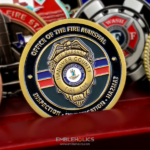
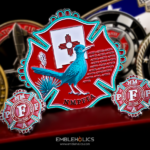
The department wanted something unique but elegant, so the coin was built on a rectangle rather than a disc. One face carries a photograph of the firefighter it honors, with the department’s logos and insignias arranged around it. The other carries a colorful illustration of a firefighter in action. It was made by Hanover Fire EMS Department to honor one of their own.
Putting a Photograph on a Coin
This is the request that makes a memorial coin a memorial coin, and it is worth being clear about how it works.
A photograph is printed, not struck. Enamel and engraving cannot reproduce the continuous tones of a photograph, so the image is printed onto the coin and sealed under a clear protective layer. That is a different process from the rest of the coin, and it is why a photo coin usually combines techniques: the photo printed, the insignias struck and filled around it.
Which means the photo needs resolution. Unlike artwork, a photograph cannot be redrawn at a larger size. A small or low resolution image will print soft, so the original file matters more here than anywhere else. A scan of a print beats a photograph of a photograph, and either beats a screenshot.
Crop tight, to the face. At coin size, a full-length or group photograph reduces the face to nothing. The image that works is a head and shoulders crop, which is also how people want to remember somebody.
And consider the background. A busy background competes with the face at small size. A plain or blurred background, or one the designer can clean up, produces a far better result.
See making a challenge coin from a photo for more on working from photographic sources.
Why a Rectangle
The department asked for something unique but elegant, and a rectangle delivers both for a reason that connects directly to the photograph.
Photographs are rectangular. A portrait put on a round coin has to be cropped into a circle or set inside a frame, and either way the image fights the shape. A rectangular coin lets the photograph fill the face at its own proportions, which is why this pairing works.
It reads as a frame rather than a coin. That is appropriate here. A memorial piece is closer to a photo frame than to a token, and the shape sets that expectation before anything is read.
And straight edges hold straight text. Names, dates and ranks sit on a straight baseline without curving, so they can be smaller and still legible than the same text wrapped around a disc.
Two production notes on any rectangle. The corners want a slight radius so they do not catch in a pocket or chip. And no standard packaging fits, so a capsule or box has to be specified separately. See custom shaped challenge coins.
A Photograph and an Illustration
The two faces use different image types, and the pairing is a good pattern for a memorial piece.
The photograph is the person. It is specific, documentary, and the reason the coin exists.
The illustration on the reverse, a firefighter in action, is the work. It is not a picture of that individual, which means it can be drawn rather than printed, and it can be the kind of image that reads well at coin size: bold shapes, clear outlines, strong color.
Splitting them that way means the photograph never has to compete with artwork, and the artwork never has to pretend to be documentary. One face remembers who; the other remembers what they did.
Ordering a Memorial Coin
A memorial coin is the one piece where the usual advice about keeping a design flexible does not apply, and a few things matter more than they do on any other order.
Involve the family. If the coin carries a photograph and a name, somebody close to that person should see the proof and approve the image before production. This is the most important point on this page and the one most often skipped.
Check every detail against a record. Spelling, rank, dates, the form of the name the family uses. These cannot be corrected after the strike.
Order generously. People outside the department will want one: family, academy classmates, crews from other departments, people who served with them years earlier. Departments routinely under-order memorial coins and find they cannot easily reproduce them later. This is the opposite of the advice on a dated event coin, and it is deliberate.
And allow time. Standard production runs about 45 to 50 days after final artwork approval, with artwork and proof rounds before that. If the coin is for a specific service or memorial event, work backward from that date.
See also a fallen officer challenge coin, a line of duty memorial coin and more firefighter challenge coins.
Order a Memorial Coin
Professional artwork is free with unlimited revisions, and nothing goes into production until you approve a digital proof. The challenge coin minimum is 50 pieces, standard production runs about 45 to 50 days after final artwork approval, rush production is available on many projects, and shipping within the continental United States is included. Embleholics is veteran-owned, SDVOSB and registered in SAM.gov.
Send us the highest resolution photograph you have, ideally a scan rather than a photograph of a print, cropped to head and shoulders or with a note about how you would like it cropped. And tell us if the coin is for a particular service or event so we can work the schedule backward from that date. Request a free quote to begin.
Finished Coin (Front)

Finished Coin (Back)

Frequently Asked Questions
What is a firefighter memorial challenge coin?
It is a coin made to honor a firefighter who has died, usually carrying their photograph or name alongside the department’s insignia. Departments order them for the family, the crews and everyone who served with the person.
Can a photograph be put on a challenge coin?
Yes. A photograph is printed onto the coin and sealed under a clear protective layer, since enamel and engraving cannot reproduce continuous tones. The rest of the coin can still be struck and filled around it.
What photograph should we send?
The highest resolution version you have, ideally a scan of a print rather than a photograph of one. Unlike artwork, a photo cannot be redrawn larger, so a small or low resolution file will print soft.
How should the photo be cropped?
To head and shoulders. A full-length or group photograph reduces the face to nothing at coin size, and a tight crop is also how people want to remember somebody. A plain or blurred background works far better than a busy one.
Why use a rectangular coin for a photograph?
Because photographs are rectangular. A portrait on a round coin has to be cropped into a circle or set in a frame, where a rectangle lets the image fill the face at its own proportions. Straight edges also hold straight text for names and dates.
Do rectangular coins need special handling?
Two things. The corners want a slight radius so they do not catch in a pocket or chip, and no standard capsule or display fits a rectangle, so packaging has to be specified separately.
Should the family be involved?
Yes, and this matters more than any design decision. Somebody close to the person should see the proof and approve the photograph before production, and the name, rank and dates should be checked against an official record.
How many memorial coins should we order?
More than your headcount. Family, former colleagues, academy classmates and crews from other departments will all want one, and departments routinely under-order these and find they cannot easily reproduce them later.
More Firefighters Projects