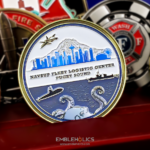
A submarine is the hardest subject in naval coin design, and not for the reason people expect. It is not that the detail is fine. It is that there is almost no detail at all. A surfaced boat is a long dark shape with a sail on top, and everything that makes it identifiable has been deliberately removed.
Drawing a Hull With Nothing on It
Every other vessel gives a designer something to work with. A destroyer has a superstructure, masts, mounts and antennas. A carrier has a flight deck and an island. A cutter has a deckhouse and a boat. A submarine has been smoothed on purpose, because anything protruding costs speed and makes noise.
So the whole subject is proportion and silhouette. Three things carry it:
The ratio of length to depth. A submarine reads as a submarine because it is extremely long relative to its height. Shorten it to fit a round coin and it stops being a submarine and becomes a shape. This is the single most common failure, and it is why a boat suits a wide format better than a circle.
The sail. The one feature on the whole hull. Its position along the length, its height and its proportions are what identify the boat, so it gets the relief depth and the sharp edges, and everything else stays simple.
The waterline. A surfaced submarine is mostly underwater, and the amount showing above the surface is a recognizable thing in itself. Draw too much hull above the water and it reads as a ship. Draw too little and it disappears.
One further note worth making: resist adding detail that is not there. A designer looking for something to engrave will reach for hatches, cleats and markings. Those are the features a submarine does not have, and putting them on produces something that looks wrong to anyone who has served on one.
Water Around a Low Hull
Because a submarine sits low, the sea does more of the work on this coin than it would on a surface ship design, and sea has no edges, which struck metal needs.
Two approaches, both valid. Render the water as a repeating pattern of raised wavecaps or parallel lines, coarse enough to survive the strike, which reads as sea at a glance. Or treat it as a single flat plane with a hard line at the surface, which reads as calm water and lets the hull be the only modelled thing on the face.
The second suits a submarine better, and the reason is the same as above: the subject is defined by its smoothness, so surrounding it with busy texture works against it.
For the general problem of drawing a hull on a coin, see our cutter coin page, and for a submarine unit coin, this squadron piece.
A Rope Edge and Inscribed Rims
The coin uses a rope-pattern edge with lettering inscribed around the rims, and that combination fits what is going on inside it.
A quiet face can carry a decorated edge. The usual warning is one textured element per face, because a busy field and a patterned rim compete. Here the face is a low hull on a simple sea with open space around it, so the rim has room to be ornamental without fighting anything.
A rope pattern is the obvious nautical choice and it earns its place. It is made entirely of repeating diagonal forms with hard edges, which is the kind of pattern that survives striking, and it reads as rope at any size as long as the lay is drawn coarse enough.
Lettering inside the rim keeps text off the artwork. With a long low subject across the middle of the face, there is nowhere inboard for text to go without crowding the hull. Running it around the rim solves that and frames the subject at the same time.
See plating options for what the base metal does under an engraved treatment.
An Organization That Builds Rather Than Operates
Several pages on this site argue that an organization should not put equipment on its coin when that equipment belongs to somebody else. A command does not own the aircraft its wings fly, and a headquarters coin built on an airframe ends up belonging to the wing instead.
NAVSEA is the clearest exception there is. Its work is designing, building, delivering and maintaining ships and submarines. The boat on the coin is not borrowed imagery, it is the output. For an engineering and acquisition organization the platform is the product, which puts it in the same position as a support team named for one airframe rather than a command sitting above one.
We cover the headquarters case on our Tenth Air Force page and the support case on our aviation support team page. The test across all three is the same: would the organization still exist if the platform did not.
About NAVSEA
Naval Sea Systems Command is the largest of the Navy’s systems commands, established in 1966 in place of the Bureau of Ships. Its work covers the design, construction, delivery and maintenance of the Navy’s ships, submarines and their systems.
This coin was made for Team Submarine, the part of that organization concerned with submarines.
See more Navy challenge coins and a named boat’s coin.
Order a Submarine or Ship Coin
Free professional artwork, unlimited revisions and a digital proof before anything is produced. Free shipping within the continental US, a 50-coin minimum, and most orders complete 45 to 50 days after artwork approval, with rush production available. Embleholics is veteran-owned, an SDVOSB, and registered in SAM.gov.
If the design is a boat, tell us the class and send a profile reference. Proportion is what makes a submarine recognizable, and that is decided at artwork rather than fixed on a proof.
Frequently Asked Questions
What is a submarine challenge coin?
A submarine challenge coin carries a boat, a submarine force unit or a submarine-related organization. The design problem is unusual, because a submarine has almost no surface detail and has to be recognized from proportion and silhouette alone.
Why is a submarine hard to draw on a coin?
Because the features other vessels provide have been deliberately removed. There is no superstructure, no masts and no mounts, so the only things identifying it are the length-to-depth ratio, the sail and the waterline.
What is the most common mistake on a submarine design?
Shortening the hull to fit a round coin. A submarine reads as a submarine because it is very long relative to its height, so compressing it turns it into an unidentifiable shape. A wide format suits it better than a circle.
Should extra detail be added to a submarine hull?
No. A designer looking for something to engrave will reach for hatches, cleats and markings, and those are exactly the features a submarine does not have. Adding them looks wrong to anyone who has served aboard one.
How should water be shown around a submarine?
Usually as a single flat plane with a hard line at the surface rather than as busy wave texture. The subject is defined by its smoothness, so surrounding it with pattern works against it.
Can a coin have both a patterned rim and engraved artwork?
Yes, when the face is quiet. A low hull on a simple sea leaves open space, so a rope edge has room to be decorative. A busy field and a patterned rim would compete.
Why does a rope pattern work well on a coin?
Because it is built from repeating diagonal forms with hard edges, which is the kind of pattern that survives striking. It reads as rope at any size provided the lay is drawn coarse rather than to scale.
Can an organization show equipment it does not operate?
It depends on whether it would exist without it. A command above a flying unit should not use that unit’s aircraft, but an engineering or acquisition organization that designs and builds the platform is showing its own output.
What is NAVSEA?
Naval Sea Systems Command is the largest of the Navy’s systems commands, established in 1966 in place of the Bureau of Ships, responsible for designing, building, delivering and maintaining the Navy’s ships, submarines and their systems.
More Navy Projects