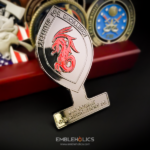
An Air Force Reserve challenge coin has a different working life from an active duty one. It goes home to a house rather than a barracks, it sits in a desk drawer at a civilian job, and the person holding it may still be in the same unit twenty years from now. Tenth Air Force is a numbered air force of Air Force Reserve Command, and its coin reflects both that and the other thing a headquarters has to work with, which is a shaped outline and a lineage rather than an aircraft.
Who a Reserve Coin Is Actually For
Reserve Citizen Airmen serve part-time and have civilian careers, which changes three things about a coin.
- It will be seen by civilians. A Reserve coin ends up on a desk at an office where nobody else serves, shown to colleagues with no military context at all. A design that needs an insider to decode it is wasted there.
- It has a much longer life. Active duty assignments turn over in two or three years. Reserve members commonly stay with the same unit for a decade or more, which means a Reserve coin is still current long after an active duty unit coin would have been superseded. Anything that dates it, a year, a commander, a current program name, costs more here than anywhere else.
- The unit is dispersed. People drill together and live apart, often across several states. That makes a coin one of the few physical things everybody in the unit actually shares, which is a bigger role than it plays in a unit whose members see each other daily.
Guard and Reserve Are Not the Same Thing
This matters because the two get treated as interchangeable and the difference shows up directly in a coin design.
Air National Guard units have a dual state and federal character. They serve under a governor through the state adjutant general and can be federalized, so their coins commonly carry a state outline, a state flag or a state symbol, and that identity is genuine rather than decorative.
Air Force Reserve units are federal only. There is no state, no governor and no state symbol to draw on. A Reserve coin therefore has a shorter list of available devices, and the ones it does have are the unit emblem, the lineage and the mission. See how the state angle works on the other side in the Air National Guard coin, and for the Army equivalent see an Army Reserve coin.
A Headquarters Has No Aircraft
A numbered air force is a command echelon. It supervises wings rather than flying anything itself, and that is the honest explanation for why this coin carries insignia and lettering and not much else.
A flying squadron has an airframe, a tail flash and usually a mascot. A headquarters has none of those. It cannot borrow a subordinate unit’s aircraft without implying it owns it, it has no flight line and no crew, and the thing it genuinely possesses is an emblem and a history.
That is not a limitation so much as a different brief. Headquarters coins work when they lean into formality: the emblem, correct and large, clean lettering, a good outline and a finish chosen with care. They fail when they borrow imagery from the units below them, which produces a coin that looks like a wing coin with the wrong name on it. More on what belongs on Air Force designs is in Air Force squadron coins and what goes on them.
Lineage Is the Asset
For a headquarters, history is the one thing no subordinate unit can claim and no other command shares, and Tenth Air Force has a good deal of it.
It was constituted on 4 February 1942 and activated ten days later at New Delhi, India, serving through the Second World War in the China Burma India theater, including operations over Burma. Today it is a numbered air force of Air Force Reserve Command, headquartered at Naval Air Station Fort Worth Joint Reserve Base in Texas.
A coin for a command like that has an obvious route available to it: a date, a theater, or a single reference to where the unit began. Those age well, they belong to the headquarters rather than to any wing beneath it, and they are the reason a heritage-styled design is the right instinct here rather than a dated one.
A Shaped Outline Doing the Work of Color
This coin uses a custom outline in a classic or vintage style, with the insignia and small inscriptions embossed and no painted color.
On a design that spare, the outline is not decoration, it is the only distinguishing feature the coin has. Strip out color, mascots and scenery and what the viewer is left with is an emblem and a silhouette, so the silhouette has to carry the register on its own.
That makes the choice of outline a content decision. A period-styled shape says heritage before a word is read, which is exactly right for a command whose strongest asset is its lineage. A sharp contemporary outline would have said the opposite and undercut the rest of the design. See custom shaped challenge coins for the options.
The trade-off is the one that applies to every spare design: with nothing else on the coin, the emblem and the lettering have to be struck well, because there is nothing to distract from either.
Order a Coin for Your Reserve Unit
Send your unit emblem and tell us whether the coin is for a headquarters or a flying unit, because that decides what imagery is legitimately available. If the unit has a lineage worth carrying, send the dates, since they are usually the strongest material a command has.
Professional artwork is free with unlimited revisions, the minimum order is 50 coins, and nothing goes into production until you approve a digital proof. Standard production runs about 45 to 50 days after final artwork approval, rush production is available on many projects, and shipping within the continental United States is included. Embleholics is veteran-owned, SDVOSB and registered in SAM.gov. See a USAF Reserve coin and more Air Force challenge coins.
Finished Coin (Front)
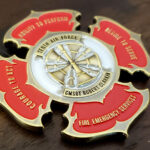
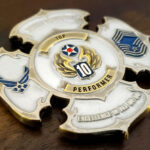
Finished Coin (Back)
Frequently Asked Questions
What is an Air Force Reserve challenge coin?
An Air Force Reserve challenge coin is a coin for a unit of Air Force Reserve Command, whose members are Reserve Citizen Airmen serving part-time alongside civilian careers. Because those members often stay with the same unit for a decade or more, these coins are usually designed to avoid dating, and they are built on the unit emblem, lineage and mission rather than on a current commander or program.
What is the difference between a Guard coin and a Reserve coin?
Air National Guard units have a dual state and federal identity, serving under a governor through the state adjutant general, so their coins commonly use a state outline, flag or symbol. Air Force Reserve units are federal only, with no state dimension, so a Reserve coin draws on the unit emblem, its lineage and its mission instead.
What is a numbered air force?
A numbered air force is a command echelon that supervises wings rather than operating aircraft itself. Tenth Air Force is a numbered air force of Air Force Reserve Command, headquartered at Naval Air Station Fort Worth Joint Reserve Base in Texas.
How do you design a coin for a headquarters with no aircraft?
Lean into formality rather than borrowing imagery from subordinate units. A headquarters has an emblem and a history, so the coin works with the emblem rendered correctly and large, clean lettering, a well-chosen outline and a considered finish. Putting a wing’s aircraft on a headquarters coin implies ownership and produces a coin that looks like a wing coin with the wrong name on it.
Why does the outline matter more on a coin with no color?
Because it becomes the only distinguishing feature. With no paint, no mascot and no scenery, the viewer sees an emblem and a silhouette, so the silhouette carries the whole register. A period-styled outline reads as heritage, a sharp geometric one reads as contemporary, and on a spare design that difference is the design.
What was Tenth Air Force’s role in the Second World War?
Tenth Air Force was constituted on 4 February 1942 and activated ten days later at New Delhi, India. It served through the Second World War in the China Burma India theater, including operations over Burma.
Should a date or a lineage go on a unit coin?
For a headquarters, usually yes. A founding date or a theater belongs to the command itself rather than to any unit beneath it, and unlike a current program name or a commander’s tour it does not go out of date. For a unit whose members serve for decades, that durability is worth more than it is elsewhere.
Who orders coins for a Reserve unit?
Commonly the headquarters staff, a section, or the senior enlisted leadership, and sometimes the members themselves. Because Reserve units are geographically dispersed and people drill together but live apart, the coin is often one of the few objects everyone in the unit physically shares, which is worth bearing in mind when deciding quantity.
More Air Force Projects