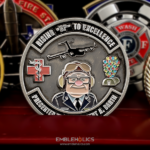
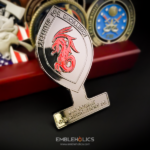
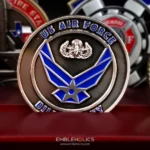
An Air Force EOD challenge coin is a career field coin before it is a unit coin. Explosive Ordnance Disposal is the only occupational specialty in the Department of Defense whose badge is awarded identically by the Army, Navy, Air Force and Marine Corps, and every technician in all four services trains at the same school, so an EOD coin is read first by other EOD technicians and only second by the rest of the Air Force. This one is built on that: black metal with straight edges, the Air Force emblem on the front and the community’s unicorn on the reverse.
Why an EOD Coin Is a Career Field Coin First
Most military coins work from the outside in. The service, then the wing, then the squadron, then the individual. EOD inverts that, and anyone designing a coin for an EOD flight should understand why before they decide what goes on it.
The reason is the pipeline. All four services send their EOD candidates to the Naval School Explosive Ordnance Disposal at Eglin Air Force Base in Florida, and all four award the same badge at the end of it. An Air Force technician and a Navy technician wear the same device on different uniforms. That shared qualification produces a community that identifies across service lines more strongly than almost any other specialty.
The practical consequence for a coin is that community devices carry more weight than unit devices. A flight number on an EOD coin means something to the flight. The badge and the community’s own symbols mean something to every technician who sees it, in any uniform, for the rest of their career.
The Badge Every EOD Technician Wears
The Explosive Ordnance Disposal Badge, known throughout the community as the crab, is the only occupational badge awarded to all four services with an identical design. Its four elements each carry a stated meaning, which makes it unusually useful on a coin because nothing on it is decorative.
- The wreath stands for achievement in reducing the potential for accidents through ingenuity and devotion to duty.
- The bomb represents unexploded ordnance. Its three fins stand for the nuclear, conventional, and chemical and biological areas of the mission.
- The lightning bolts stand for the destructive power of the bomb and for the courage and professionalism of the people who go to it.
- The shield stands for the mission itself, which is to prevent a detonation and protect everything around it.
The badge is awarded at three levels, Basic, Senior and Master, earned over a career rather than at graduation. That matters at the design stage, because a coin showing a particular level is a coin that only suits part of a flight. Coins intended for everyone usually show the badge at Basic level or show the bomb and bolts without the full device.
The Unicorn
The unicorn on the reverse is a community device rather than an official one, and it is the single most recognizable informal symbol EOD has. At the EOD school the word carries a specific meaning: a unicorn is a student who gets through the course without failing a single test, which the Air Force publicly describes as distinguished graduate status in what the school’s own people call the hardest academic course in the Department of Defense.
That is why the unicorn works on this coin and why it belongs on the reverse rather than the front. The front is the service. The reverse is the part only the community reads correctly, and an outsider seeing a unicorn on a bomb disposal coin has to ask, which is exactly the effect the people who ordered it wanted.
Straight Edges Around Curved Devices
The coin uses clean straight-edge lines rather than a conventional round outline, and the reason is not just that it looks modern.
Every significant device in EOD iconography is curved. The wreath is a circle. The bomb is a cylinder with rounded fins. The bolts are diagonal. Put all of that inside a round coin and the outline competes with the artwork, because the eye reads the strongest circle on the coin, which is the edge. Set the same devices inside a straight-edged outline and they become the only curved shapes present, so they dominate by contrast instead of fighting for attention.
Straight edges also give you flat runs for lettering. Inscriptions on a curved rim have to be set along an arc, which limits how long they can be before they become hard to read. A straight edge takes a line of text at normal spacing. If you want to see how outlines like this are quoted and tooled, see custom shaped challenge coins.
Black Metal With Two Accent Colors
The base is black metal, with Air Force blue and red used only as accents, and the detail work is embossed rather than filled with enamel.
This is the right structure for a coin with this much fine detail in it, for three reasons.
Embossed relief survives at coin size. The badge devices and the unicorn both contain thin internal lines. Enamel fill needs a recess wide enough to hold paint without bleeding into the next one, and at coin scale those recesses are often narrower than the process allows. Relief has no minimum width in the same way, so detail that would be lost under color stays visible in metal.
Black metal makes relief read. A polished silver or gold coin reflects light in every direction, which flattens shallow relief. A black antiqued or plated finish holds shadow in the low areas and keeps highlight on the high ones, so the embossing has contrast without any paint at all.
Two accents are enough to carry meaning. Blue for the service and red for the hazard, placed on small areas only. Spread the same two colors across large fields and the coin starts to look like a souvenir. Keep them as accents and they function as highlighting, which directs the eye to the two or three places on the coin that matter.
Order an EOD Coin for Your Flight
Send your flight or unit emblem, the badge level you want shown, and any inscription. If you want the design to suit everyone in the flight rather than one level of badge, say so, because it changes which devices go on it.
Professional artwork is free with unlimited revisions, the minimum order is 50 coins, and nothing goes into production until you approve a digital proof. Standard production runs about 45 to 50 days after final artwork approval, rush production is available on many projects, and shipping within the continental United States is included. Embleholics is veteran-owned, SDVOSB and registered in SAM.gov. See a numbered EOD unit coin, a bomb task force coin, or more Air Force challenge coins.
Finished Coin (Front)
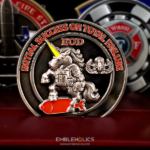
Finished Coin (Back)
Frequently Asked Questions
What is an Air Force EOD challenge coin?
An Air Force EOD challenge coin is a coin made for an Air Force Explosive Ordnance Disposal flight or for individual technicians in that career field. Because the EOD badge and the training pipeline are shared across all four services, these coins usually lead with community symbols such as the badge or the unicorn rather than with unit identifiers.
Is the EOD badge the same in every branch of the US military?
Yes. The Explosive Ordnance Disposal Badge is the only occupational badge awarded with an identical design by the Army, Navy, Air Force and Marine Corps, which makes it unique among US military occupational badges. All four services also train their technicians at the Naval School Explosive Ordnance Disposal at Eglin Air Force Base in Florida.
What do the parts of the EOD badge mean?
The wreath stands for achievement in reducing accident potential through ingenuity and devotion to duty. The bomb represents unexploded ordnance, and its three fins stand for the nuclear, conventional, and chemical and biological areas of the mission. The lightning bolts stand for the destructive power of the bomb and the courage of EOD personnel, and the shield stands for the mission of preventing a detonation and protecting the surrounding area.
Why is the unicorn associated with EOD?
At the EOD school a unicorn is a student who completes the course without failing a single test, a distinction the Air Force publicly describes as unicorn status for its distinguished graduates. The figure has since become an informal community symbol, which is why it appears on EOD unit artwork and coins alongside the official badge.
Which EOD badge level should go on a unit coin?
If the coin is for everyone in the flight, show the Basic badge or use the bomb and lightning bolts without the full device, because the three levels are earned over a career and a Senior or Master badge on the coin excludes anyone who has not reached it. Coins intended specifically for senior technicians or for a retirement are the exception.
Does a black coin show detail better than a silver one?
For fine relief, usually yes. A polished bright finish reflects light in all directions and flattens shallow detail, while a black antiqued or plated finish keeps shadow in the recesses and highlight on the raised areas, so embossed artwork reads without any paint. Bright finishes work better on bold, simple designs.
Should a coin with fine detail use enamel color?
Only in the wider areas. Enamel needs a recess broad enough to hold paint without bleeding into the next one, and thin internal lines at coin size are often narrower than that, so filling them loses the detail you were trying to show. The usual approach is relief for the fine work and color as an accent on two or three larger areas.
What is the minimum order for Air Force EOD coins?
The minimum is 50 coins, which suits the size of a typical EOD flight. Larger quantities lower the cost per coin, and because community devices such as the badge and the unicorn do not date, a larger run stays usable as people rotate through the flight.
More Air Force Projects