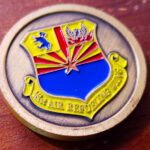
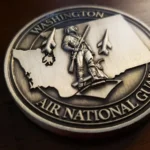
An Air National Guard commander’s coin belongs to a person rather than to a unit. It is given at the commander’s discretion, it reflects that commander’s choices, and it stops being current the day they hand over the wing. That makes it the one coin in military use that is deliberately temporary, and it changes almost every decision behind it. This one was made for the Washington Air National Guard, with sections of the coin hollowed out so the shield at the center of both faces reads bolder.
A Coin That Belongs to a Person, Not a Unit
Almost every piece of advice about unit coins points the same way: leave off dates, leave off the current roster, build something that will still be correct under the next commander. A commander’s coin is the deliberate exception, and it is worth understanding why before you order one.
A commander’s coin is an instrument of the office. It is handed over personally, usually with a handshake, at moments the commander chooses rather than ones a policy specifies. The recipient knows exactly who gave it to them, and that is the entire point. A coin that could have come from anyone in the chain of command does not do this job.
Three consequences follow.
- The commander’s own choices are the content. If a commander wants a particular motto, mascot or device, that is not a deviation from the unit’s identity, it is the coin working as intended.
- Order for the tour, not for the unit. The quantity is the number of coins one officer expects to present before they change command, not the headcount of the wing. That is usually a few hundred rather than a few thousand.
- It becomes a historical object immediately. At change of command the coin stops being issued and starts being a keepsake from a particular period. Successors order their own. Nobody reprints a predecessor’s coin.
It is worth drawing the line against the coin it most resembles. An award coin or coin of excellence is earned, carries general wording so it suits any recipient, and belongs to the organization. A commander’s coin is given at discretion, carries the office-holder’s character, and belongs to the office. A command can reasonably want both, and they are two orders, not one.
Cutouts Make the Center Bolder
The design works by removing metal. Sections of the coin between the rim and the central shield are hollowed through, which is a cutout coin rather than a shaped one, and the effect on the shield is larger than people expect.
Two things cause it. The first is simple subtraction: with the surrounding field gone there is nothing else at that level for the eye to rest on, so attention has nowhere to go but the middle. The second is more interesting. A solid coin outlines its central device with the device’s own edge, against a field of the same metal. A cutout coin outlines it with whatever is behind the coin, which is a hand, a sleeve, a desk or daylight. The shield is no longer drawn against metal, it is drawn against the world, and that is far higher contrast than any plating choice can produce.
If you are deciding between this and a custom outline, the difference is explained in custom shaped coin versus cutout coin, and there are more examples in custom shaped challenge coins and on this sword cutout coin.
The Only Device That Works on Both Faces
A cutout has a property no other coin technique has, and it is the reason this design puts a shield at the center of both surfaces.
Every other decision on a coin is one-sided. Plating, color, relief, engraving, lettering: each applies to the face it is on, and the reverse needs its own version. A hole is not like that. It is visible from both sides, identically, so one decision improves the front and the back at the same time.
That makes cutouts unusually efficient on a coin where both faces matter equally, which is exactly the case here. The shield is the constant element and the cutouts frame it twice for the price of once.
The constraint that comes with it is that the cutouts have to suit both faces, because you cannot have a hole on one side only. Any element on the reverse has to live inside the same remaining metal as the front. In practice that means designing both sides together from the start rather than finishing one and then fitting the other around it.
Why a Shield Survives Aggressive Cutouts
Cutting away a significant amount of a coin raises an obvious question about strength, and the answer is in the shape at the center.
Once metal is removed, the remaining material carries all of the structure. The rim becomes a ring, the central element becomes a hub, and the solid sections between them become the spokes that hold the two together. A coin fails at the spokes, not at the rim and not at the hub.
Three rules follow, all decided before tooling.
Keep the spokes wide enough and spread them evenly. Three or four broad connections distribute load far better than six narrow ones, and placing them symmetrically keeps the coin from flexing unevenly when it is squeezed.
Never leave a long unsupported span. A thin strip of metal with a cutout on each side of it is the weak point of any cutout design. Either widen it or move the cutout.
Use a closed shape at the center. This is why a shield works so well. A shield has a continuous border, so it is a rigid closed form and it protects the artwork inside it from the cutouts outside. An open device such as an eagle in flight has no such border, and aggressive cutouts around it leave fragile extremities. Putting the eagle inside the shield, as this coin does, gets the character of the one and the structure of the other.
The Washington Air National Guard
The Washington Air National Guard is the state’s air component, serving under the governor through the state Adjutant General and available as a reserve of the United States Air Force when federalized.
One date on the current page needs correcting. The Air National Guard did not exist in the early 1900s. The Washington Air National Guard received federal recognition on 18 September 1947, the same day the Air Force became a separate service. Its flying lineage, though, does run further back: the 116th Observation Squadron was federally recognized on 6 August 1924, as one of twenty-nine original National Guard observation squadrons formed before the Second World War, and it exists because business leaders in Spokane raised ten thousand dollars to secure it.
That is a better story than a round number, and it is the kind of detail a commander’s coin can carry when a unit coin cannot. Today the Guard’s units include an air refueling wing at Fairchild Air Force Base near Spokane, a non-flying wing at Camp Murray working in cyberspace operations and air support, and an air defense sector at Joint Base Lewis-McChord supporting the aerospace warning mission.
Embleholics is based in Port Orchard, so this is a coin for a neighbor. See more challenge coins in Washington State and more National Guard challenge coins.
Design a Commander’s Coin
Send your unit insignia and tell us what you want at the center, along with any motto or device that is yours rather than the unit’s. If you want cutouts, say so at the start, because they have to be designed into both faces together.
Professional artwork is free with unlimited revisions, and nothing goes into production until you approve a digital proof. Standard production runs about 45 to 50 days after final artwork approval, rush production is available on many projects, and shipping within the continental United States is included. Embleholics is veteran-owned, SDVOSB and registered in SAM.gov.
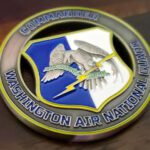
Finished Coin (Front)
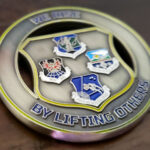
Finished Coin (Back)
Frequently Asked Questions
What is a commander’s challenge coin?
A commander’s challenge coin is a coin belonging to a command position rather than to a unit. It is presented personally by the commander, at moments they choose rather than ones a policy specifies, and it reflects that officer’s own choices of motto, mascot or device. It stops being issued when they hand over command, and a successor orders their own.
How is a commander’s coin different from an award coin?
An award coin is earned, carries general wording so it suits any recipient, and belongs to the organization. A commander’s coin is given at the commander’s discretion, carries the character of the office-holder, and belongs to the office. A command can want both, but they are two separate designs and two separate orders.
How many commander’s coins should be ordered?
Enough for one tour, not for the whole unit. The useful figure is the number of coins the commander expects to present before changing command, which is usually a few hundred rather than a few thousand. Because the coin is tied to one tenure, there is no benefit in ordering a quantity that will outlive it.
What is a cutout challenge coin?
A cutout challenge coin keeps a conventional outline but has areas removed from inside the design, so you can see through parts of it. That is different from a custom shaped coin, which has a non-standard outer outline. The two are quoted differently, so it is worth being specific about which one you want.
Why do cutouts make a central design look bolder?
For two reasons. With the surrounding field removed there is nothing else at that level for the eye to settle on, and the central element is no longer outlined against metal of the same color but against whatever is behind the coin, such as a hand, a sleeve or daylight. That is far higher contrast than any plating or paint choice can achieve.
Do cutouts weaken a challenge coin?
They can, if the remaining metal is not planned. Once material is removed, the solid sections between the rim and the central element carry all of the structure, so keep those connections wide, spread them evenly around the coin, and never leave a long thin span with a cutout on both sides of it. Those decisions are made before tooling.
What shape works best at the center of a cutout coin?
A closed shape with a continuous border, such as a shield or a disc. A closed form is rigid and it protects the artwork inside it from the cutouts around it. An open device such as an eagle in flight has no border to protect it, so aggressive cutouts leave fragile extremities. Placing the open device inside a shield gives you both the character and the strength.
When was the Washington Air National Guard established?
The Washington Air National Guard received federal recognition on 18 September 1947, the same day the United States Air Force became a separate service. Its flying lineage goes back to 6 August 1924, when the 116th Observation Squadron was federally recognized as one of twenty-nine original National Guard observation squadrons formed before the Second World War.
More Air National Guard Projects