A cut out challenge coin has metal removed from inside the design, leaving open space you can see through. It differs from a custom shaped coin, where only the outer edge changes and the face of the coin stays solid.
What Is a Cut Out Challenge Coin?
On most coins, the design sits on a solid metal face. Raised areas catch light, recessed areas hold color, and the disc itself is unbroken. A cut out removes metal from within that face entirely, so what you are looking at in places is not metal at all but whatever is behind the coin.
This is a different thing from a custom shaped coin, and the two get confused constantly. A shaped coin changes the outline: the edge follows a badge, a silhouette or an object instead of a circle, while the face stays solid. A cut out leaves the outline alone and opens up the interior. You can do both on the same coin, and plenty of designs do.
What makes cut outs worth the trouble is distance. A flat engraving needs to be held and angled to read properly. Negative space reads instantly, from arm’s length, because the eye registers a hole differently from a shadow. A crossed sword design with the surrounding metal cut away announces itself across a room in a way the same design engraved flat never will.
There is a structural cost, and it is the thing customers do not anticipate. Every void has to be bridged by metal somewhere, and those bridges are where a coin fails. A thin strip of metal spanning two open areas will bend before anything else on the coin does, and a coin lives in a pocket alongside keys for years. Most cut out designs need adjusting before they can be produced: bridges thickened, voids reshaped, or two openings merged into one. That happens at the artwork stage, and it is normal rather than a sign the design was wrong.
What Do Crossed Swords Mean on a Military Coin?
Crossed swords and sabers turn up on military insignia, ceremonial dress and unit heraldry across services and across centuries. They read as authority, tradition and ceremony rather than as anything literal, which is why they suit a coin given as a mark of recognition.
They also happen to be close to a perfect cut out subject, and that is not a coincidence so much as good luck.
Two long diagonals crossing at the center create four open areas around a strong central junction. The swords themselves are continuous strips of metal running edge to edge, so the design carries its own structure without needing artificial bridges. The point where they cross is naturally the thickest part of the piece. A design that would be fragile as an abstract pattern is robust as crossed swords, because the geometry is doing the structural work.
Anything can sit at the crossing point. A shield is the most common choice and it is what this coin uses, but a round center, a unit device or a crest all work the same way. The center element also reinforces the junction, which is the one place a crossed sword coin would otherwise be under stress.
What Designs Work as Cut Outs?
The subjects that work best share a property: bold shapes with continuous lines, and open areas large enough to read as deliberate.
Crossed swords and sabers, shields and crests, anchors, wings, stars, letters and numerals, unit devices, and silhouettes set within a round field all cut well. So do simple geometric frames, where the cut out is the space around a central emblem rather than inside it.
What does not cut well is fine detail. Thin strokes, small lettering, delicate scrollwork and intricate interior patterns are better engraved than cut, because at that scale the metal between the voids becomes too fragile to survive handling. The usual answer is to combine the two: cut the bold outer shapes and engrave the fine detail within the solid areas.
The center of a crossed sword design is fully open to choice. A shield, a round medallion, a crest or a unit emblem all sit naturally at the junction. A scroll can run along the bottom between the sword handles, which gives you a place for a name, a date or a motto. The swords themselves can be drawn toward a particular style rather than left generic, which matters to anyone who knows what the sword they carry actually looks like.
Finished Coin (Front)
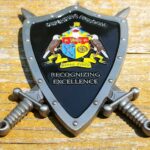
Finished Coin (Back)
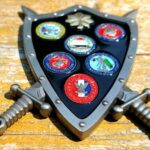
About This Crossed Sword Coin
This coin was commissioned by an officer who wanted something memorable to hand out as informal awards, given personally rather than through any formal process.
The design is crossed swords with a shield at the center and the surrounding metal cut away. The front carries mottos and an emblem over a black painted backdrop, which is a deliberate contrast choice: black behind the raised elements makes the cut out edges read as edges rather than dissolving into the metal around them. The shield carries rivets, a small piece of detail that most designs would leave out and which gives the center something to look at up close.
The reverse is the harder piece of work. It carries the emblems of six separate commands, reproduced in a small area, along with the officer’s rank insignia.
Six distinct devices in that space is a genuine problem, because none of them can be simplified. Every one of those emblems belongs to a command full of people who know exactly what it looks like, and an emblem that has been cleaned up to fit is an emblem that is wrong. The work is finding the depth and line weight at which each device stays legible at that scale while remaining recognizably itself. It is the sort of thing that either works completely or fails obviously, with very little ground in between.
The design artwork shown alongside the finished coin is what the officer approved before any metal was cut. On a cut out design that stage carries more weight than usual, because the voids cannot be adjusted once the die exists.
Coins as Informal Awards
The occasion this coin was made for is a real category and a large one.
Commanders and senior officers hand coins out personally for work that does not warrant a formal award: an assignment handled well, an inspection passed, a problem solved quietly, a person who went further than the job required. The coin is a way of recognizing something at the moment it happens, rather than months later through a process.
That immediacy is the whole value, and it explains the buying pattern. Officers order coins in advance and in quantity, then carry them and give them out over a tour. The coin has to exist before the occasion does, because the point is being able to reach into a pocket at the right moment.
It also explains why these coins tend to be more distinctive than unit coins. A unit coin represents an organization and tends toward the official. A coin an officer gives personally represents them, and the ones people keep are the ones that looked like nothing else in the drawer. You can see similar thinking on our custom-shaped award coins and across military challenge coins generally.
Design a Cut Out Coin
Artwork is free and revisions are unlimited, and that includes the adjustment work a cut out design usually needs. Cut outs and custom shapes cost nothing extra in artwork, and the reshaping that makes a design structurally sound is part of the process rather than a change order.
You receive a digital proof and production begins only after you approve it, which matters more on cut out work than on a flat design, since the voids are cut into the tooling and cannot be adjusted afterward. If you are weighing a cut out against custom shaped challenge coins or sculpted challenge coins, say so and we will show you the same design treated each way.
Orders start at 50 coins, shipping within the continental United States is included, and most orders are complete in 45 to 50 days after artwork approval. Rush production is available.
Embleholics is veteran-owned, based in Port Orchard, Washington, and registered in SAM as a Service-Disabled Veteran-Owned Small Business under UEI F3AGRUW5RT53. Request a quote and you will hear back within 24 hours.
Frequently Asked Questions
What is a cut out challenge coin?
A cut out challenge coin has metal removed from inside the design, leaving open space you can see through. The voids become part of the design, which makes the coin read clearly from a distance rather than only in the hand.
What is the difference between a cut out and a custom shaped coin?
A custom shaped coin changes the outer edge, following a badge or silhouette instead of a circle, while the face stays solid. A cut out leaves the outline alone and removes metal from within the design. Both can be used on the same coin.
What designs work well as cut outs?
Bold shapes with continuous lines: crossed swords and sabers, shields, anchors, wings, stars, letters, numerals and unit devices. Fine detail, thin strokes and small lettering are better engraved than cut, because the metal between voids becomes fragile at that scale.
Do cut outs make a coin more fragile?
They can if the design is not adjusted. Thin bridges of metal between voids are the weak point on any cut out coin, so designs are usually reworked at the artwork stage to thicken bridges or reshape openings before production.
What do crossed swords mean on a military coin?
Crossed swords and sabers appear across military insignia, ceremonial dress and unit heraldry, reading as authority and tradition rather than anything literal. They also suit cut out work, because two crossing diagonals create open space around a strong central junction.
Can a cut out be combined with a custom shape?
Yes. A coin can have both a shaped outline and cut outs within the design. Combining them is common, and it is usually how a design gets both a distinctive silhouette and open interior space.
Does a cut out design cost more?
Artwork is free and unlimited revisions are included, so the design and adjustment work costs nothing extra. Pricing depends on the specification of the finished coin, which is set out in your quote.
What is the minimum order?
The minimum order on coins is 50. Most orders are complete in 45 to 50 days after artwork approval, and rush production is available if you are working to a date.
More Marine Corps Projects