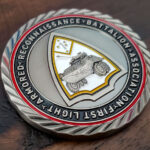
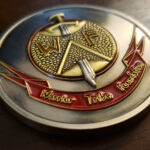
A Marine intelligence challenge coin has to establish who the unit is without saying what the unit does. Counterintelligence and human intelligence elements cannot put their mission, their location or their methods on a coin that will be handed to outsiders, so the identity has to come from shape, symbol and finish instead. This coin solves it with a hooded cloak outline, a gold skull and crossbones on glossy black, and nothing written on it beyond a motto and a career field designation.
Designing for a Unit That Cannot Describe Itself
Most unit coins do a lot of the work with words. A number, a base, a campaign, a function. That whole toolkit is unavailable to an intelligence element, and what is left over is usually a round coin with an emblem on it that could belong to anyone.
The alternative is to make the coin carry meaning through form. This one does it three ways, and each of them replaces a sentence the unit is not able to write.
- The silhouette states the attitude. The coin is cut to the shape of a hooded cloak rather than struck as a circle, so it reads as something before a single word is read.
- The symbols state the trade. A skull and crossbones and a reaper are not literal, and that is the point. They signal a line of work without describing it.
- The anchor states the parent service. A unit that cannot name itself can still claim the Marine Corps and the naval service it belongs to, and the anchor does that on the reverse in one device.
What ends up inscribed is a motto and the CI/HUMINT designation. That is the right amount. The designation tells a recipient which community the coin came from, and the motto carries the character of the unit without being a statement about operations.
A Shaped Coin, Not a Round One With a Cloak On It
The cloak is the outline of the coin itself, which is a different and more expensive decision than putting a cloak design inside a circle. It is worth the difference here for a specific reason: a shaped coin is instantly identifiable in a pocket or on a desk among a stack of round ones, and a unit whose work is deliberately low profile often wants its coin to be the opposite.
Two practical points come with a shape like this one.
Shaped coins need their weak points designed out. A cloak silhouette has a narrow hood and a wider base, and the places where the outline pinches are where a coin can bend or snap if the thickness is not right. That is a design decision made before production, not something discovered afterwards.
A shaped coin is not the same as a cutout coin. People use the terms interchangeably and get quoted for the wrong thing. The difference is explained in custom shaped coin versus cutout coin, and more examples are in custom shaped challenge coins.
Why Glossy Black and Gold Is the Only Pair Here
The finish is gold plating with glossy black paint, and no other colors. That restriction is doing more work than it looks like.
Gold plating sits on the raised relief. Black paint fills the recesses around it. The result is that the skull, the crossbones and the anchor appear to be made of metal floating on a dark field, with maximum separation between the subject and everything behind it. At coin size, which is smaller than people picture when they are looking at artwork on a monitor, that separation is what decides whether a design reads or turns into texture.
Add a third and fourth color to this coin and two things happen. The contrast drops, because color next to color is always less separated than metal next to black. And the coin starts to look like a souvenir rather than something issued. Restraint in the palette is part of what makes a coin from a unit like this one look serious.
Glossy black is also the more durable choice of the two black finishes for a coin that gets carried. A matte or sandblasted black field shows finger oil and scuffs within weeks. Glossy enamel in the recesses is protected by the raised metal on either side of it.
What to Leave Off an Intelligence Unit Coin
A coin leaves the unit the moment it is given away. It goes into a pocket, onto a shelf, into a display case in someone’s house, and eventually into a photograph on the internet. Design it on that assumption.
Customers in this community usually choose to leave off:
- The specific unit designation, keeping only the broad career field
- Any base, station or geographic location
- Deployment names, operation names and dates
- Any reference to capability, equipment or method
- Personal names and billet titles
- Headcounts or structure
We produce from the artwork a customer supplies and we do not make determinations about what a unit may release. Run the design past your own security manager or the appropriate review authority before you approve the proof, because approval is the point at which the artwork becomes a physical object in circulation.
Design a Coin for Your Element
Send a sketch, a description or existing artwork, along with the motto and designation you want inscribed. If the shape is unusual, say so early, because the outline affects the thickness and the tooling.
Professional artwork is free with unlimited revisions, and nothing goes into production until you approve a digital proof. Standard production runs about 45 to 50 days after final artwork approval, rush production is available on many projects, and shipping within the continental United States is included. Embleholics is veteran-owned, SDVOSB and registered in SAM.gov. See more Marine Corps challenge coins, a USMC acquisition security coin or an intelligence operations division coin.
Finished Coin (Front)
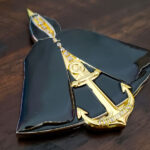
Finished Coin (Back)
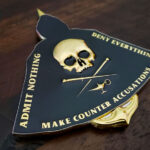
Frequently Asked Questions
What is a Marine CI/HUMINT challenge coin?
A Marine CI/HUMINT challenge coin is a unit coin made for a Marine Corps counterintelligence and human intelligence element. Because these units do not publish their mission details, the coins typically carry symbolic imagery, a motto and the career field designation rather than a unit number, location or any description of what the element does.
Can an intelligence unit order a custom challenge coin?
Yes. Intelligence and security elements order coins routinely, and the usual approach is to keep the design symbolic and leave off anything specific. Clear the artwork through your own security manager or review authority before approving the proof, since a coin circulates outside the unit once it is handed out.
What should be left off a coin for a sensitive unit?
Most customers in this community leave off the specific unit designation, any base or geographic location, operation names and dates, references to capability or equipment, personal names and billet titles, and any indication of unit size or structure. What usually stays is a motto, the broad career field, and the parent service device such as an anchor or eagle, globe and anchor.
Why do intelligence unit coins use skulls and reapers?
Because symbolic imagery conveys the character of a unit without disclosing anything about it. A skull and crossbones or a reaper figure is understood instantly and says nothing factual, which suits a unit that cannot put its function into words on a coin that outsiders will handle.
Can a challenge coin be made in a custom shape like a cloak?
Yes. The coin is cut to the outline you want rather than struck as a circle, so the silhouette becomes part of the design. Shapes with narrow sections need the thickness planned so the coin does not flex or snap at the pinch points, which is handled at the design stage before tooling.
What is the difference between a shaped coin and a cutout coin?
A shaped coin has a custom outer outline, so the whole coin is the shape. A cutout coin keeps a conventional outline but removes areas from inside the design, so you can see through parts of it. They are quoted differently, so it is worth being clear about which one you want when you request a price.
Does glossy black paint hold up better than matte black?
For a coin that gets carried, yes. Glossy enamel sits in the recesses below the raised metal, which protects it, and it does not hold finger oil the way a matte or sandblasted black field does. Matte finishes look excellent in photographs and show handling marks faster in a pocket.
How many colors should a unit coin use?
Fewer than most people expect. Metal relief against a single dark enamel gives the strongest separation at actual coin size, and each additional color reduces contrast rather than adding detail. Designs with many colors tend to read as commemorative or souvenir pieces, which is the opposite of what a unit coin is usually trying to be.
More Marine Corps Projects