An ROTC coin is one of the few objects that has to carry two licensed marks at once. The university owns one and the service owns the other, and both of them care. That makes the approval route more involved than for almost any other unit coin, and it is worth knowing before artwork starts rather than after.
Two Owners, Two Approvals
Every ROTC unit sits in two organizations. It is part of a university and it is part of a service, and its coin usually wants both identities on it.
Universities license their marks actively. Names, seals, logos, mascots and colors are managed through a licensing office or an outside licensing agent, and collegiate licensing is among the more carefully policed areas there is. A university mark on merchandise normally goes through that office.
The services license theirs too. Service names, emblems and insignia are protected marks, and use of them runs through the service’s own program. We cover that side in more detail on our military appreciation coin page.
So the practical sequence for an ROTC coin is: settle both approvals, then draw artwork. Not the other way round. A unit that designs first and asks second can end up with a proof it likes and cannot use.
We are a coin manufacturer and not a licensing office, so the request goes to the university and the service rather than to us. What we need is the approved artwork and a note on what may and may not be altered.
What an ROTC Coin Is Actually For
Worth separating, because an ROTC unit has more distinct occasions than most units its size.
Commissioning. The obvious one, and the most significant. A coin given at commissioning marks the start of a career and is kept for decades.
Staff coins. This coin is one. It was made for the Assistant Professor of Naval Science, an officer assigned to teach rather than to a fleet unit. Staff tours in an ROTC unit are short, so a coin is often how a departing officer is recognized or how an arriving one presents.
Midshipman recognition. Awards within the battalion, during the academic year rather than at the end of it.
Visitors. ROTC units host a lot of them: alumni, senior officers, speakers, other units. That is a steady, year-round reason to have coins on hand.
The last two matter for quantity. A unit that gives coins to visitors and at awards through the year gets through them steadily, which argues for a design that is not tied to one academic year or one class.
Matte Gold With Enamel Accents
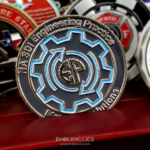
The base here is a matte gold tone, with enamel on the logo and small embossed insignia on both faces, and plain rims with no pattern.
That combination is doing three things:
A matte base makes the enamel the brightest thing on the coin. A matte surface scatters light rather than reflecting it, so the field holds an even tone from every angle and the enameled logo reads immediately without needing an outline or a border around it.
Gold tone suits an institutional subject. It reads as ceremonial rather than tactical, which is right for a university program and would be wrong for an operational unit.
Plain rims keep the two faces related. A single consistent unpatterned edge is enough to tie an enameled logo face and a finely detailed insignia face together as one object. A patterned rim would have been a third thing competing with both.
See plating options for what each base metal does under enamel.
Fine Detail and Where Its Limit Is
The reverse carries small embossed insignia and fine lettering, which is the hardest thing on this coin.
Two rules decide whether detail at that size works:
Recessed detail holds better than raised detail. A cut line keeps its edge where a raised edge rounds over in the strike, so fine lettering and fine line work survive better engraved than embossed. Where detail must be raised, it needs more weight than the original artwork suggests.
There is a floor, and the fix is not smaller type. Below a certain letter height the counters in letters like a, e and o fill in and a line of text becomes a band. The answer is fewer words or a larger diameter. On a coin carrying a university name, a program name and a rank or title, the text usually needs cutting before it needs shrinking.
About Notre Dame Naval ROTC
The Naval ROTC unit at the University of Notre Dame is a partnership between the university, Holy Cross College and the Navy and Marine Corps, established in 1941. Midshipmen take Naval Science courses alongside their degree programs and commission into the Navy or the Marine Corps.
The Assistant Professor of Naval Science is a commissioned officer assigned to the unit to teach those courses. It is a teaching billet rather than an operational one, which is part of why a coin suits it: there is no ship, squadron or vehicle to put on a piece for an instructor, so the identity comes from the program and the institution.
See more Navy challenge coins and Marine Corps coins.
Order an ROTC Coin
Free professional artwork, unlimited revisions and a digital proof before anything is produced. Free shipping within the continental US, a 50-coin minimum, and most orders complete 45 to 50 days after artwork approval, with rush production available. Embleholics is veteran-owned, an SDVOSB, and registered in SAM.gov.
Two things to have in hand before you ask for a quote. Approval from your university’s licensing office for its marks, and the approved artwork files for both the university and the service elements. With those settled the rest moves quickly.
Coin Front
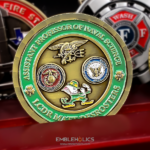
Coin Back

Frequently Asked Questions
What is an ROTC challenge coin?
An ROTC challenge coin is made for a Reserve Officers’ Training Corps unit at a college or university, and it usually carries both the institution’s identity and the service’s. It is given at commissioning, at awards, to staff and to visitors.
Can a university logo be used on a challenge coin?
University names, seals, logos and mascots are licensed marks, managed through the institution’s licensing office or an outside licensing agent. Use on merchandise normally goes through that office, so approval should be obtained before artwork begins.
Do you need two approvals for an ROTC coin?
Usually yes. The university owns its marks and the service owns its emblems and insignia, so both sides approve their own elements. Settling both before artwork avoids ending up with a proof that cannot be used.
Who approves military insignia on an ROTC coin?
The service concerned, through its own licensing or public affairs channel, rather than the coin manufacturer. What a vendor needs is the approved artwork and a note on which elements may not be altered.
What occasions do ROTC units give coins for?
Commissioning is the main one, along with midshipman awards during the academic year, recognition of staff officers arriving or departing, and presentations to visitors and alumni. The last two are year-round, which is why units get through coins steadily.
Why use a matte base instead of a polished one?
A matte surface scatters light so the field stays an even tone from every angle, which makes enameled or painted areas the brightest things on the coin without needing an outline. A polished base competes with its own reflection.
Should fine detail be raised or recessed?
Recessed, where there is a choice. A cut line holds its edge at small sizes while a raised edge rounds over in the strike, so fine lettering and line work survive better engraved than embossed.
How much text fits on an ROTC coin?
Less than most units expect, because a university name, a program name and a title add up quickly. Struck lettering has a minimum readable height, so the answer is fewer words or a larger diameter rather than smaller type.
What is an Assistant Professor of Naval Science?
An Assistant Professor of Naval Science is a commissioned officer assigned to an NROTC unit to teach Naval Science courses to midshipmen. It is a teaching billet rather than an operational one.
More Corporate Projects