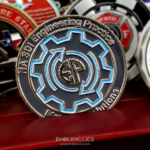
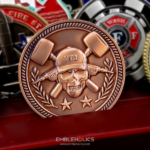
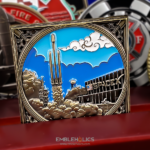
A square challenge coin is not a round coin with the edges cut off. The four straight sides and four corners change what you can put on it, and the biggest difference is that a square gives you a frame. This SpaceX coin uses that: an engraved ornamental border runs around both faces, with a falcon on one side and a rocket launch on the other sitting inside it at full size.
Why a Square Instead of a Round Coin
The first thing a square does is change the register of the object.
A round coin is read against the template everyone carries for money. That is useful when you want the thing to feel like a coin, which is most of the time, and it is a limitation when you do not. A square reads as a plaque, a medallion, a tile or a stamp. It announces that someone made a decision about the shape, which matters for a company coin where there is no uniform or tradition doing that work for you.
The second thing is purely practical. A square has more usable area than a circle of the same width, and all of it is reachable. On a round coin the edges of the design curve away from any straight element you put there, which is why text on round coins arcs and why rectangular subjects fit badly. On a square, a horizontal line stays horizontal all the way to the edge.
SpaceX itself is an American aerospace manufacturer and space transportation company founded in 2002, best known for developing reusable launch vehicles. For the broader project, see the SpaceX challenge coin page, and for milestone pieces see the 400th Merlin D Vacuum engine coin and the Crew Dragon Demo-2 coin.
A Square Gives You a Frame
This is the real reason to choose a square, and it is the reason ornamental borders appear on square coins and almost never on round ones.
A border on a circle is a ring. A ring has no beginning and no end, so any ornament on it has to be a continuous repeating pattern, and if the repeat does not divide evenly into the circumference there is a visible seam where it meets itself.
A border on a square is four separate runs joined by four corners. Each side is a finite length with two ends, so a motif can start, run and stop. The corners are natural places for a different element, which is exactly how framing works in architecture, in printing and in picture frames. A square is the shape that lets a coin borrow all of that.
What an Ornamental Frame Is For
A decorative border looks like pure decoration and it is actually solving a layout problem.
Most coin designs are overcrowded because the designer is trying to fill the face. A single subject at a large size looks empty on a bare coin, so more elements get added around it, and then everything shrinks until nothing reads.
A frame breaks that cycle. It occupies the perimeter, so the face no longer looks empty, and it does it with pattern rather than with content. That leaves the center free to hold one subject at full size. On this coin the falcon and the launch scene are each able to be the only thing in the middle, which is why both read clearly despite how much is going on at the edges.
The rule behind it is worth stating plainly. Fill space with pattern, not with more subjects. Pattern is read as texture and is forgiven at any size. A second subject competes with the first and both lose.
Corners Need a Small Radius
Two things go wrong with a true ninety degree corner on a struck coin, and both are fixed the same way.
Sharp corners are hard to fill. Metal flows under pressure, and the furthest extremity of a die is the last place it reaches. A perfectly sharp corner tends to come out slightly soft or inconsistent from one strike to the next.
Corners are the first thing damaged. They are the points furthest from the center, so they take the impact when a coin is dropped on edge, and they are what catches on a pocket.
A small radius on each corner solves both. It is not enough to make the coin look rounded, and the shape still reads unmistakably as a square, but it gives the metal somewhere to go and removes the point that would otherwise blunt or burr. If you are comparing outlines, see custom shaped challenge coins.
Ornament on Both Faces
This coin carries dense engraved decoration on both sides, which goes against the usual advice to let one face be the quiet one.
It works here for a specific reason, and the reason is the distinction between framing and subject. The advice about a quiet face exists because two competing subjects on two faces leave the viewer with no sense of where to start. Ornament is not a subject. It is a border doing the same job on each side, which makes the two faces read as a matched pair rather than as rivals, and the centers still differ.
The test is simple. If both faces have detail at the perimeter and one clear subject in the middle, dense engraving on both sides is fine. If both faces have a busy middle, one of them needs to give way regardless of what the edges are doing.
Using a Company Logo
A corporate coin runs into one practical problem that a military coin does not, and it is almost always discovered late.
Company logos are governed by brand guidelines, and those guidelines are written for screens and print. They rarely cover metal. The questions that come up are whether a one-color version exists, what the minimum reproduction size is, whether the logo may be rendered in relief rather than in its brand colors, and who inside the company signs that off. An employee ordering coins for their own team is usually not that person.
Settle it before the artwork stage. We produce from the artwork a customer supplies and rely on the customer to hold the right to supply it, so getting brand approval early saves a round of proofs. There is more on this in putting a company logo on a challenge coin.
Design a Coin for Your Team
Send your logo or artwork and tell us what you want in the center of each face. If you want a square or another non-round outline, say so at the start, because the shape decides how the borders and the lettering are laid out.
Professional artwork is free with unlimited revisions, the minimum order is 50 coins, and nothing goes into production until you approve a digital proof. Standard production runs about 45 to 50 days after final artwork approval, rush production is available on many projects, and shipping within the continental United States is included. Embleholics is veteran-owned, SDVOSB and registered in SAM.gov.
Coin Back
Coin Front

Frequently Asked Questions
Can a challenge coin be square?
Yes. A square is one of the most common alternatives to a round coin and it is straightforward to tool. It changes how the design is laid out, because straight sides let horizontal elements and lines of text run to the edge without curving, and because four sides and four corners give you a natural border structure.
What are the advantages of a square challenge coin?
A square has more usable area than a circle of the same width and all of it is reachable, it suits rectangular subjects and straight lines of text, and it reads as a plaque or medallion rather than as currency. It also makes an ornamental frame possible, which a circular border cannot easily support.
Why do ornamental borders appear on square coins but not round ones?
Because a round border is a ring with no beginning or end, so ornament on it must be a continuous repeating pattern and shows a seam where the repeat meets itself. A square border is four finite runs joined by four corners, so a motif can start, run and stop, and the corners give you somewhere to place a separate element.
Do square coins have weak corners?
They can, so corners are normally given a small radius. A true ninety degree corner is the last part of a die that metal reaches, so it strikes inconsistently, and it is the point furthest from the center, so it takes the impact if the coin is dropped and catches in a pocket. A slight radius fixes both and is small enough that the shape still reads as a square.
What is an ornamental or vintage frame on a coin for?
It fills the perimeter with pattern so the face does not look empty, which lets the center hold a single subject at full size. Most crowded coin designs are crowded because the designer added more subjects to fill space. Pattern is read as texture and forgiven at any size, where a second subject competes with the first and both lose.
Should both sides of a coin carry ornament?
It is fine when the ornament is a border rather than a subject. A matching frame on each face reads as a pair and leaves both centers clear. What does not work is a busy middle on both faces, because the viewer has no sense of which side is the front, and that is true whatever the edges are doing.
Can a company put its logo on a challenge coin?
Yes, with internal approval. Brand guidelines are usually written for screen and print rather than metal, so check whether a one-color version exists, what the minimum reproduction size is, whether the logo may be rendered in relief instead of brand colors, and who inside the company signs that off. A manufacturer produces from the artwork the customer supplies and relies on the customer to hold the right to supply it.
What is the minimum order for a corporate challenge coin?
The minimum is 50 coins, and professional artwork with unlimited revisions is included. Larger quantities lower the cost per coin, which is worth considering for a company coin built on a logo and a subject rather than on a date or a specific event, since that design stays usable for years.
More Corporate Projects