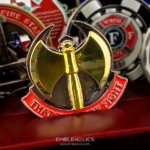
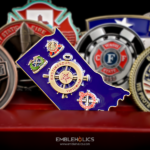
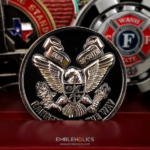
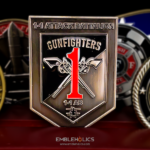
This Army Reserve challenge coin carries the insignia of several subordinate organizations across both of its faces, every one of them in color. It is the hardest kind of coin to produce, because the face area is fixed and every mark added takes space away from the rest.
When a Command Wants Every Unit On It
Every headquarters makes this request eventually. The list arrives with six crests, four logos, a seal and a motto, and the expectation is that they will all fit.
What actually happens is worth setting out honestly, because nobody does.
Every mark added shrinks every other mark. The face of a coin is a fixed area. Eight insignia is not eight times the work, it is each insignia at a fraction of the size, and below a certain size the detail inside a crest stops resolving into anything.
Color multiplies the problem. Each colored area needs a recessed cell with a raised metal wall around it, and that wall is what stops two colors running together. The wall has a minimum workable width that does not shrink as the artwork shrinks. So as a mark gets smaller, the walls take up a larger and larger share of it until the colored areas disappear altogether.
Marks are not equally complex. One crest might be a plain shield and another a dense heraldic device with six elements inside it. Sizing them all the same makes the complex one illegible while the simple one sits in too much space.
There is a real limit, and naming it is the service. Telling a customer before production that two of their marks will not read is more useful than delivering a coin where they do not.
The useful half is what to do instead, and there are five approaches that work:
- Ring the subordinate marks around one dominant central device rather than laying them out in a grid. A ring gives each mark its own space and establishes a hierarchy at the same time
- Simplify each subordinate mark to its distinctive element instead of reproducing it whole. Most crests have one feature that identifies them
- Keep color for the primary mark and drop it on the secondaries, which lets the small ones work as engraved detail where they would fail as enamel
- Split across both faces, which is what this coin does
- Use names rather than crests for the subordinate units, which almost nobody considers and which is often the most readable answer of all
This coin took the fourth route and kept everything in color, and the painting was the difficult part. That is an honest account of a hard job, and it is more informative than any claim about the result.
Painting Small Detail
It helps to know how color actually gets onto a struck coin, because it explains the limit.
Color is enamel, and enamel sits in a recess. The design is struck so that each colored area becomes a shallow well with a raised metal wall around its edge, and the enamel is filled into the well. The wall is structural: without it, two adjacent colors would flow into each other before they cured.
That wall has a minimum width. It is set by what the metal will hold, not by what the artwork asks for. So when a mark is reduced, the colored wells shrink and the walls do not, and at some point the walls meet.
Three consequences follow, and they are the practical ones:
The smallest colors go first. In a mark with five colors, the one occupying the least area will be the first to disappear, which is usually a highlight or an outline detail.
Similar tones merge. Two adjacent colors close together on the spectrum will read as one at small size even when the walls hold, because the eye stops distinguishing them before the metal does.
A physical proof is essential. A screen renders color separations that metal cannot hold, at any size you like. On a coin with small colored detail, the digital proof confirms the layout and a physical sample confirms the color. Our page on enamel and color separation sets out the finishes this applies to.
What the 76th Does
The 76th Operational Response Command is an Army Reserve command with an unusual mission, and it is worth understanding because the design problem comes directly from it.
The command prepares Army Reserve forces for chemical, biological, radiological and nuclear events, and it acts as the Army Reserve’s coordinator for Defense Support of Civil Authorities, which is the military’s support to civilian agencies during a domestic emergency.
In March 2020 a task force under the command was activated for the pandemic response, running Department of Defense operations across several FEMA regions.
The connection to the coin is direct. A command whose job is to coordinate across many organizations is exactly the command whose coin ends up carrying many insignia. The design problem is not a failure of restraint, it is an accurate reflection of what the organization does. Our sustainment brigade headquarters coin faces a version of the same thing.
Coins in the Army Reserve
Reserve coins differ from active duty coins in ways that affect both the design and the order.
Soldiers serve part-time alongside civilian careers, units are spread across a region rather than concentrated on one post, and the drill calendar means a coin is handed over on a particular weekend rather than whenever the commander chooses.
And a Reserve coin goes home into civilian life. It ends up in a desk drawer at a civilian workplace and gets seen by people with no military background far more often than an active duty unit coin does. That is an argument for a coin that is legible to an outsider: a readable command name and a recognizable device do more than a dense arrangement of acronyms.
Reserve and National Guard are separate components and the coins are not interchangeable. If you are looking for the Guard side, see National Guard challenge coins. For the Army Reserve side, see our Army Reserve Challenge Coin.
Order a Coin for Your Command
Professional artwork is free with unlimited revisions, and nothing goes into production until you approve a digital proof. The challenge coin minimum is 50 pieces, standard production runs about 45 to 50 days after final artwork approval, rush production is available on many projects, and shipping within the continental United States is included. Embleholics is veteran-owned, SDVOSB and registered in SAM.gov.
Two things make a multi-unit coin go smoothly. Send the full list of organizations at the start and we will tell you honestly how many will fit at a readable size, rather than discovering it at the proof. And ask for a physical proof if the design carries small colored detail, because that is the one thing a screen will not show you accurately. See more Army challenge coins or request a free quote.
Finished Coin (Front)

Finished Coin (Back)

Frequently Asked Questions
What is an Army Reserve challenge coin?
An Army Reserve challenge coin is made for a Reserve unit or command, whose soldiers serve part-time alongside civilian careers and are usually spread across a region rather than based on one post. This one was made for the 76th Operational Response Command and carries the insignia of several subordinate organizations.
How many logos can fit on one challenge coin?
Fewer than most people want, and the honest number depends on how complex each one is. The face area is fixed, so every mark added reduces the size of all the others, and a dense crest fails at a size where a simple shield still reads. Ringing the subordinate marks around one dominant central device is usually the best way to fit more of them legibly.
What happens when you add more insignia to a coin?
Each one gets smaller, because the available area does not change. Detail inside the marks stops resolving first, then small colored areas disappear as the metal walls between colors take up more of the space. The practical result is that a coin with too many marks communicates less than one with fewer.
How do you fit several subordinate units on one coin?
Ring them around a central device rather than gridding them, simplify each one to its distinctive element, keep color for the primary mark and leave the secondaries as engraved detail, split them across both faces, or use unit names instead of crests. Most successful multi-unit coins use two or three of those together.
Why does small colored detail disappear on a coin?
Because enamel sits in a recessed cell with a raised metal wall around it, and that wall has a minimum width regardless of how small the artwork is. As a mark shrinks, the wells shrink and the walls do not, so the colored areas get squeezed until they vanish.
Should subordinate units be shown as crests or as names?
Names are often the better answer and almost nobody asks for them. A unit name set in clean lettering stays readable at a size where its crest would turn to mush, and it takes less area. Crests are worth the space when there are only two or three of them.
Do I need a physical proof for a detailed coin?
If the design carries small colored detail, yes. A digital proof confirms the layout and the arrangement, but a screen will render color separations at any size, including separations that metal cannot physically hold. A physical sample is the only way to confirm the color behaves as expected.
What is the difference between Reserve and National Guard coins?
They are different components of the Army with different chains of command, so the insignia, the command names and the devices are not interchangeable. The design considerations are similar, since both are part-time forces spread across a region, but a Reserve coin and a Guard coin should not share artwork.
More Army Projects