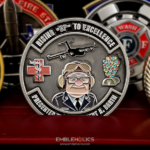
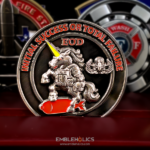
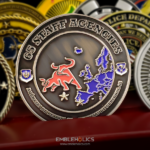
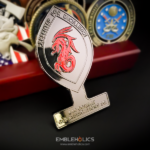
A non-standard shape rather than a round blank, with fine engraving and lettering carrying the detail. It was made for an Air Force Reserve electrical power production element, a specialty that keeps power running at fixed bases, mobile sites and temporary locations.
Coins for a Specialty Rather Than a Unit
Most coins represent a place: a squadron, a wing, a station. A career field coin represents a job, and that changes what goes on it.
The audience moves. People in the same specialty are spread across every base, and they transfer. A unit coin is an object you hold from one assignment; a career field coin stays relevant for a whole career.
The imagery is equipment and function, not heraldry. A unit has a crest. A specialty has tools, and the recognizable things are the generator, the switchgear, the cable, the task. That is a harder design problem and usually a more interesting one.
It travels further than a unit coin. Hand a specialty coin to someone in the same field from a different wing and it lands immediately. That is exactly the exchange coins exist for.
And it is the support fields that benefit most. Operational units get coins as a matter of course. Fields that keep the base running are frequently the ones with nothing to hand out, which is why a coin means more there.
See also military challenge coins and an Air Force challenge coin.
Electrical Power Production
Electrical power production specialists make sure electrical capacity exists wherever the Air Force needs it. At a fixed installation that means the systems behind the base. Away from one it means generating power from nothing, starting portable generators and operating power stations at mobile and temporary sites, including disaster relief centers.
That last part is the whole argument for a coin here. Power production is invisible when it works. Nobody notices the lights, the radios or the medical equipment until they stop. The specialty’s entire measure of success is that no one had cause to think about it, which makes internal recognition the only recognition there is.
It also travels. Power is among the first things set up at a new site and among the last things taken down, which means the specialty shows up everywhere the service goes, including humanitarian responses that have nothing to do with combat.
The Air Force Reserve
The Air Force Reserve performs around 20 percent of the work of the Air Force, including weather reconnaissance, aerial firefighting and personnel recovery. Its specialized units include the Hurricane Hunters, who fly into tropical storms to collect data, and Pararescuemen, who recover personnel in hostile or inaccessible places.
Reserve service shapes a coin in a way worth naming. A reservist holds a civilian job alongside the uniform, which means the coin ends up somewhere a full-time member’s would not: on a desk at a civilian workplace, among colleagues who do not know the organization. Something durable, well machined and legible on its own serves that better than a piece that only makes sense to someone who already knows the unit.
See also an Air Force Reserve challenge coin.
Custom Shape and Fine Engraving
Two decisions carry this coin, and each has a trade-off worth understanding before you commit.
A custom shape is recognizable before it is read. A round coin in a pocket is a coin. A shaped one is immediately a particular thing, and that works best when the outline means something, an item of equipment or a form tied to the specialty, rather than being unusual for its own sake. The cost is a custom die and a shape that may not sit in a standard coin holder or stack cleanly, so it is worth deciding early whether the piece is meant to be displayed or carried.
Fine engraved lettering is where detail lives on a plain metal coin. Without color, the readable content is line work, and that puts the quality of the die and the strike on full display. Engraving reads by shadow, so it shows better on an antique finish than on a high polish, where the shine competes with the shallow detail. There is also a floor on text size: lettering below roughly 4 points fills in and stops being legible. If a piece of text matters, it needs space rather than a smaller font.
See custom shaped challenge coins and antique vs polished finishes.
Order a Career Field Coin
Professional artwork is free with unlimited revisions, and nothing goes into production until you approve a digital proof. The challenge coin minimum is 50 pieces, standard production runs about 45 to 50 days after final artwork approval, rush production is available on many projects, and shipping within the continental United States is included. Embleholics is veteran-owned, SDVOSB and registered in SAM.gov.
Two things to settle up front. Decide whether the coin is for a specialty or for a specific unit, because a specialty coin stays useful across every assignment while a unit coin dates the moment someone transfers. And if the design relies on engraved text, check the text size on the proof rather than on screen, since fine lettering that looks clean in artwork can fill in when struck. Request a free quote to begin.
Frequently Asked Questions
What is a career field challenge coin?
It is a coin that represents a job specialty rather than a unit or a base. People in the same field recognize it anywhere in the service, and it stays relevant through transfers in a way a unit coin does not.
How does a career field coin differ from a unit coin?
The imagery is equipment and function rather than heraldry, because a specialty has tools where a unit has a crest. The audience is also spread across every installation rather than concentrated in one place.
What does Air Force electrical power production do?
The specialty makes sure electrical capacity exists wherever it is needed, from the systems behind a fixed base to portable generators and power stations at mobile and temporary sites, including disaster relief centers.
Why order a coin for a support specialty?
Because support work is invisible when it succeeds. Operational units receive coins as a matter of course, while the fields that keep a base running often have nothing to hand out, so the recognition has to come from inside the field.
Does Reserve service change the design?
It can. A reservist’s coin often ends up on a desk at a civilian workplace among people who do not know the organization, so a durable, well machined piece that reads on its own serves better than one that needs the unit explained.
When is a custom shape worth the cost?
When the outline means something, such as an item of equipment tied to the work. A shape chosen for novelty adds cost without adding recognition, and it may not sit in a standard holder or stack.
How small can engraved lettering be?
Text below roughly 4 points tends to fill in during striking and stops being legible. If a line of text matters, give it space rather than reducing the size to fit.
What finish suits fine engraving?
An antique finish. Engraving reads through shadow, and the darkened recesses in an antique plating give that contrast, while a high polish reflects light across the shallow detail and flattens it.
More Air Force Projects