An Air Force challenge coin is almost never ordered by the Air Force. It is ordered by a squadron, a flight, a shop, a career field, a commander or a chief, and which of those is buying decides nearly everything about the design.
Who the Coin Is Actually For
This is the question that comes before all the others, and the answer changes the run size, the budget, the approval route and the artwork.
A wing or a group. One design for a large organization, the unit emblem leading, a big run and the lowest cost per coin. It has to suit every squadron underneath it equally, which means it stays general.
A squadron. The most common Air Force coin. The squadron emblem is the subject, the run is moderate, and the design can be specific in a way a wing coin cannot.
A flight or a shop. Small, internal, and the most likely to carry something the wing would not put on its own coin. This is where unit humor and unofficial devices live.
A commander. Presented by hand to people the commander selects rather than issued to everyone. Small run, and it belongs to the post rather than the person, so it should survive a change of command.
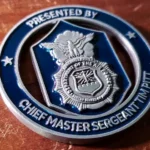
A chief. The senior enlisted equivalent, and this coin is one. Presented by a Chief Master Sergeant on their own authority, which makes it a different object from the commander’s coin even when it looks similar.
A career field. Coins built around an Air Force Specialty Code rather than a unit, which follow an airman from assignment to assignment and tend to outlast every unit coin they own.
A recognition program. Airman of the Quarter and similar awards, which are given repeatedly against a fixed standard, so the design is a template that gets reissued. See recognition coins.
Whoever is ordering needs to be the one who approves the proof. A group design with nobody named as approver is the single most common reason an order stalls.
Four Things to Put on an Air Force Coin
The Air Force symbol. The service’s own mark, and the element that says Air Force without any lettering. It is fixed artwork, so it is reproduced from source rather than redrawn, and it should come to us as artwork rather than as an image found online.
The unit emblem. Air Force unit emblems are approved heraldic designs with specific devices and colors. Same rule: reproduced, not reinterpreted. This is the most specific thing a unit can put on a coin and the least flexible.
The aircraft. The obvious choice for a flying unit and the hardest subject on the list. An airframe is a long, thin shape with fine detail, and the fixes are a three-quarter view rather than a side profile, a simplified planform, and no attempt at panel lines or antennas. It is also the wrong choice for a headquarters, because the aircraft belongs to the unit that flies it rather than to the command above it.
Rank or career field insignia. Chevrons, a specialty badge, an occupational device. These are the most personal elements available and they suit a chief’s coin or a career field coin far better than a unit coin.
Most good coins carry two of these, one per face. Four on one coin is how an Air Force design ends up crowded.
Cutting the Field Away
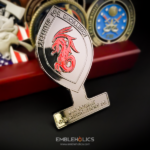
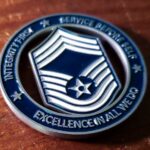
This coin does something worth explaining. The elements, a circle, the Air Force symbol and the rank insignia, are arranged around the coin, and the field between them is cut away rather than filled.
That is the opposite of the usual instinct. The normal move when a design leaves empty space is to add something: a pattern, a texture, a motto. Here the empty space was removed instead, which is why the brief described the result as light as air.
What it gives you. A cutout isolates whatever sits beside it. With nothing behind the symbol and the insignia, neither has to compete with a background, so both read immediately without being made larger. It also reduces the weight, which on a coin meant to feel light is the point rather than a side effect.
What it costs you. Every cutout has to be paid for by the metal that remains. The narrow spans between openings become the weak points, so fewer and larger openings are stronger than many small ones. Anything sitting inside an opening needs bridges of metal connecting it to the rim, and those bridges are part of the design rather than an afterthought. And an open field reads as whatever is behind the coin, a sleeve, a table, a hand, so the artwork has to work against an unpredictable background.
For the difference between cutting through a coin and cutting its outline, see custom shapes and cutouts.
Matte Silver and Two Colors
The base is matte silver and the only applied colors are blue and white, taken from the Air Force symbol.
A matte field is what makes two colors enough. A matte surface scatters light rather than reflecting it, so the field stays an even tone from every angle and the painted areas become the brightest things on the coin without needing an outline or a border. On a polished base the same two colors would be competing with the reflection.
Two colors each have a job. With a limited palette, one is the subject and one is the accent. Add four more and none of them is emphasis any more, which is the most common way a coin ends up looking busy even when every element is well drawn.
Bold lettering suits a matte field. Raised letters on a scattering surface read at arm’s length. Fine lettering on the same surface does not, which is why this coin’s text is heavy rather than delicate.
See plating options for what each base metal does to color sitting on it.
A Chief’s Coin Is Not a Commander’s Coin
This coin was made to be presented by a Chief Master Sergeant, and that is worth separating from the commander’s coin it resembles.
A Chief Master Sergeant is an E-9, the top enlisted grade in the Air Force. A coin presented by a chief comes from the senior enlisted side of the organization rather than from the officer who signs the awards, and in practice that means it is given for different things and carries differently.
Three consequences. The run is small, because the point is that not everyone has one. It is presented by hand, usually in a handshake, so the moment matters more than the quantity. And it tends to lean on enlisted identity, chevrons, a specialty badge, the unit, rather than on aircraft or command devices.
For the command side of the same question, and for a headquarters that owns no aircraft, see Air Force Reserve and headquarters coins.
Order an Air Force Coin
Free professional artwork, unlimited revisions and a digital proof before anything is produced. Free shipping within the continental US, a 50-coin minimum, and most orders complete 45 to 50 days after artwork approval, with rush production available. Embleholics is veteran-owned, an SDVOSB, and registered in SAM.gov.
Two things worth sending with a quote request. Who the coin is for, a squadron, a flight, a career field or a chief, because that answers most of the design questions at once. And your unit emblem as source artwork rather than as a photograph of a patch.
See more Air Force challenge coins.
More Air Force Projects
Finished Coin (Front)
Finished Coin (Back)
Frequently Asked Questions
What is an Air Force challenge coin?
An Air Force challenge coin is a struck metal coin carrying the identity of an Air Force unit, career field or leader, given by hand rather than issued. In practice they are ordered by squadrons, flights, career fields, commanders and chiefs rather than by the service itself.
Who usually orders Air Force challenge coins?
Squadrons and flights order the most, followed by commanders and senior enlisted leaders who present coins personally. Wings and groups order larger runs that have to suit every squadron beneath them, and career field coins are ordered by communities rather than by units.
What should go on an Air Force challenge coin?
Most good designs carry two elements, one per face, from four options: the Air Force symbol, the unit emblem, an aircraft, and rank or career field insignia. Putting all four on one coin is the usual cause of a crowded design.
Can the Air Force symbol be used on a challenge coin?
It is used on unit coins routinely, and it should be reproduced from source artwork rather than redrawn, because it is fixed artwork with a correct form. The service holds its own marks, so a unit or organization should confirm its permissions through its own channel rather than through a vendor.
Can an aircraft be shown on a challenge coin?
Yes, and it is the hardest of the common subjects. An airframe is long and thin with fine detail, so a three-quarter view works better than a side profile, the planform has to be simplified, and panel lines and antennas are dropped rather than attempted.
What is a cutout on a challenge coin?
A cutout is an opening through the body of the coin, which removes the field around an element so nothing competes with it. It also reduces weight, and its cost is that the narrow spans of metal left between openings become the weak points.
Do cutouts make a coin weaker?
They can, and the fix is design rather than hope. Fewer and larger openings are stronger than many small ones, anything inside an opening needs bridges of metal holding it to the rim, and those bridges are placed where the artwork already has a line.
How many colors should an Air Force coin use?
Two or three against a metal field will usually beat a fully painted face. With a limited palette each color has a job, one as the subject and one as the accent, and a matte base makes those colors the brightest things on the coin without needing outlines.
What rank is a Chief Master Sergeant?
A Chief Master Sergeant is an E-9, the top enlisted grade in the Air Force. A coin presented by a chief comes from the senior enlisted side of the organization rather than from the commander, which is why it is given for different reasons even when it looks similar.
What is the minimum order for an Air Force coin?
The minimum is 50 coins, which suits a flight, a shop or a chief presenting over a year. Squadrons and wings ordering for everyone pay less per coin, though the difference is smaller than most people expect and it does not change any of the design decisions.
More Air Force Projects