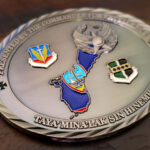
A Guam USAF challenge coin makes distance the subject. This one carries the island of Guam engraved on one side and a world map on the other, which is a device that only earns its place on a coin for an overseas base: the island says where the unit is, the world map says how far that is from everywhere else, and anyone stationed there reads both at once.
Why Two Maps on One Coin
A world map on a stateside unit coin is decoration. On a coin for a base in the western Pacific it is the whole argument.
People who have served at a remote overseas base describe the posting in terms of distance more than anything else, and a coin that reflects that is a coin they keep. Two maps at different scales do it in one object without a word of text. The island outline is the identity, the thing that is theirs. The world map is the context, and it works because the island is almost invisible on it.
That contrast is the design. A coin showing only Guam is a coin about a place. A coin showing Guam and then showing you how small Guam is on a world map is a coin about being a long way from home, which is what the people receiving it actually have in common.
Three things follow if you want to use the same device.
- Keep the two maps at genuinely different scales. If the island is drawn large on both sides the point disappears. The world map should make the viewer look for it.
- Mark the location on the world map. A dot, a star or a small raised marker. Without it the world map is wallpaper.
- Give each map its own side. Putting both on one face halves the size of each and neither survives reduction.
Engraving a World Map at Coin Size
A world map is one of the harder things to put on a coin, and it is worth knowing why before you ask for one.
A coin face is smaller than people picture when they are looking at artwork on a monitor. At that size, accurate coastlines turn into noise. Every inlet, peninsula and island chain becomes a wobble in a line, and the eye stops reading continents and starts reading texture. The map becomes less recognizable than a simplified one would have been.
The approaches that work are all forms of deliberate simplification.
Simplify the coastlines on purpose. Reduce each continent to its recognizable silhouette and drop the detail that does not contribute to it. A viewer identifies continents by overall shape, not by accuracy.
Use a graticule. Longitude and latitude lines give the eye structure to read the shapes against, and they are clean straight or evenly curved lines that engrave well. They also make a marked position look intentional.
Treat it as a globe rather than a flat projection. A sphere with a visible curve and one hemisphere showing carries fewer shapes at a larger size, and it reads instantly.
The same logic applies to the island itself. Guam is small and its outline is distinctive, so it survives at size, but the inland detail does not. Outline, a marker for the base location and nothing else is the version that works.
A Polished Finish With Engraved Detail
The client asked for a shiny finish with engraved insignia, which is a combination that needs care, because the two work against each other.
A polished surface reflects light in every direction. Shallow engraved lines rely on shadow for contrast, and on a bright reflective field there is less shadow to work with, so fine engraving can disappear at certain angles. An antiqued finish does the opposite, settling into the lines and darkening them.
Polished and engraved works when two conditions hold, and they hold on this coin.
Few lines, cut deeper. Simplified map outlines and insignia contours are a small number of lines rather than dense hatching, so each one can be cut deep enough to hold shadow even on a bright surface.
The finish is doing a job. A polished coin reads as formal and new, which is the right register for a coin given to people on an operational tour, and it photographs well in a display case. Antiquing would have made a coin about a current posting look like a historical piece.
If you are weighing the two, see antique versus polished challenge coin finish and challenge coin plating options.
Andersen Air Force Base and the 36th Wing
Andersen Air Force Base sits at the northern end of Guam, near Yigo. The 36th Wing is the host unit, and its stated mission is to project airpower, build combat capability and strengthen partnerships from the forward edge of the Indo-Pacific.
For coin design purposes, the word that matters in all of that is forward. A base described by its own wing as being at a forward edge is a base where the people stationed there are conscious of where they are, and that is the sentiment a coin like this one is built around.
Ordering Coins for an Overseas Base
Two things are different about an order for a unit stationed outside the continental United States.
Shipping is quoted separately. Shipping within the continental United States is included in our pricing. Delivery to Guam, to an overseas address or to an APO or FPO address is quoted on its own, so confirm the destination when you request the quote rather than at the end.
Build in more time than you think you need. Standard production runs about 45 to 50 days from final artwork approval, and transit to an overseas destination is added to that. Units working to a change of command, a deployment homecoming or a wing anniversary should start the artwork earlier than a stateside unit would.
It is also worth ordering more than the current headcount. Overseas tours are short and turnover is constant, so a coin that was correct for the unit when it was ordered is handing out its last pieces to people who arrived after the order was placed. Since a base coin built around maps and the host wing’s insignia does not carry a date, a larger run stays usable for years and costs less per piece.
Design a Coin for Your Base
Send your unit insignia and tell us what you want on each side. If you want a map, say which level of detail matters to you, because that decides whether it is engraved as an outline, built in relief or drawn as a globe.
Professional artwork is free with unlimited revisions, and nothing goes into production until you approve a digital proof. Standard production runs about 45 to 50 days after final artwork approval, rush production is available on many projects, and shipping within the continental United States is included. Embleholics is veteran-owned, SDVOSB and registered in SAM.gov. See more Air Force challenge coins, other Air Force coin projects, or custom shaped challenge coins.
Frequently Asked Questions
What is a Guam USAF challenge coin?
A Guam USAF challenge coin is a coin made for a United States Air Force unit stationed on Guam, usually at Andersen Air Force Base at the north end of the island. Designs for overseas bases commonly use maps, because the location itself is the thing the people stationed there have in common.
Which Air Force unit is the host at Andersen Air Force Base?
The 36th Wing is the host unit at Andersen Air Force Base on Guam. Its stated mission is to project airpower, build combat capability and strengthen partnerships from the forward edge of the Indo-Pacific.
Why do coins for overseas bases use maps?
Because distance is what the people stationed there share. A map of the local island or country establishes identity, and a world map alongside it places that location relative to everywhere else, which is the experience of an overseas tour expressed without any text. On a stateside coin the same device reads as decoration.
Can a world map be engraved on a challenge coin?
Yes, provided it is simplified. Accurate coastlines break down at coin size and read as texture rather than as continents, so the versions that work reduce each landmass to its recognizable silhouette, add longitude and latitude lines for structure, or show a globe with one hemisphere visible rather than a flat projection.
Does a polished finish work with engraved detail?
It can, if the engraving is cut deep and the design uses relatively few lines. A polished surface reflects light in all directions and gives shallow engraving less shadow to read against, while an antiqued finish settles into the lines and darkens them. Dense fine engraving is better suited to an antiqued finish.
Can challenge coins be shipped to Guam or an APO address?
Yes. Shipping within the continental United States is included in our pricing, and delivery to Guam, to an overseas address or to an APO or FPO address is quoted separately, so confirm the destination when you request a quote. Allow transit time on top of the 45 to 50 day production window.
How many coins should an overseas unit order?
More than the current headcount. Overseas tours are short and personnel turn over constantly, so a run sized to the unit on the day of the order runs out while people who arrived later are still waiting. A base coin built around maps and the host wing’s insignia carries no date, so a larger run stays usable for years and lowers the cost per coin.
Can a challenge coin be cut to the shape of an island?
Sometimes, but it depends on the outline. Long, narrow shapes make a fragile coin, because the thin sections flex and can break. Islands with a compact outline work as a shaped coin, and narrow ones are better rendered as a map on a conventional coin face, which is the approach taken here.
More Navy Projects