A historical challenge coin commemorates a ship, event or person from before living memory. The USS Maine coin honors the 266 sailors lost aboard the battleship in 1898 and makes no claim about the explosion, because its cause has never been established.
The Ship and What Happened to Her
The USS Maine was a second-class pre-dreadnought battleship (a style of battleship built before 1906), commissioned on 17 September 1895. She was among the first battleships in the US Navy. In January 1898, she was sent to Havana Harbor, Cuba, to protect American interests during the Cuban War of Independence from Spain.
On the evening of 15 February 1898, an internal explosion sank her in the harbor, and 266 of her officers and crew died.
The cause has never been established. In 1898, a US Navy court of inquiry concluded that an external mine had set off the forward magazines (the ship’s ammunition storerooms). A Spanish inquiry pointed to spontaneous combustion in a coal bunker. Admiral Hyman Rickover led a Navy review, published in 1976, that favored a bunker fire. In 1998, a National Geographic study couldn’t settle the question.
American newspapers blamed Spain within days, before any evidence existed. “Remember the Maine! To Hell with Spain!” was a slogan of the press and public at the time, and no inquiry produced it.
The United States was at war with Spain two months after the sinking. That conflict is known as the Spanish-American War. Readers who want the wider record can browse famous US military units on our site.
Designing Around Unsettled History
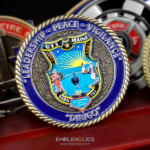
The USS Maine challenge coin shows no sinking and makes no claim about the cause of the loss. Its design includes these details:
- Front shield. Inside the shield, a farmer and a sailor from the Maine state seal stand on either side of a lighthouse and a rising sun, with a submarine in the water below.
- Shield lettering. The shield reads USS MAINE and SSBN 741, with 1895 and 1902 at its sides. Those are the years two earlier ships named Maine were commissioned.
- Rim lettering. “Leadership, Peace, Vigilance,” the submarine’s own motto, runs across the top. “Dirigo” runs along the bottom.
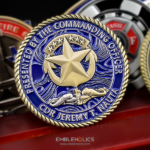
- Back. “Presented by the Commanding Officer” runs around the rim. A raised star over an anchor sits at the center, with an arc of small stars above it and a pair of dolphins below.
- Rim and color. A bold gold rope pattern runs around the rim, framing deep blue enamel (the glossy colored fill set into the metal).
- Style. The look is classic with a vintage feel. Fine wave lines texture the background on both sides.
- SSBN 741. This is the current USS Maine, an Ohio-class submarine based at Naval Base Kitsap in Bangor, Washington.
Four guidelines shape how we design a historical challenge coin:
- Honor the people. A design built around the crew can hold up whatever historians conclude.
- Leave the disputed cause off. A coin outlives any argument, so the cause of loss usually stays out of the design.
- Work from primary sources. Ship plans and photographs from the period can give accurate rigging and fittings (the ropes, lines and hardware). Later artists’ impressions often get both wrong. With no original artwork to copy, our artists build the image from those plans and photographs.
- Expect careful readers. Descendants and historical societies tend to check the details closely.
A memorial challenge coin for a recent loss can be reviewed by the families involved. For a subject more than a century old, nobody alive can approve the likeness, so the research does that work. We keep the design descriptive and leave conclusions to the historians.
Dirigo, and Naming a Coin for a Place
Dirigo is the Maine state motto. It’s Latin for “I lead” or “I direct,” and it appears on the state seal adopted in 1820. A ship named for Maine can use that motto. It gives the coin a short line of text that fits the subject.
Any unit, ship or department named for a place can draw on that place’s motto, seal or founding date. Many never do. A motto like Dirigo is often among the easiest distinctive details to find, because the place has already written it.
The Rope Edge and the Vintage Look
A rope edge challenge coin has a twisted-cord pattern around its rim. Rope is part of how ships look, so the pattern suits a maritime subject.
A vintage style coin design usually comes from a few choices:
- A warm gold or brass tone instead of bright, silver-colored nickel.
- An antiqued finish, which darkens the recessed areas so the raised detail looks aged.
- Light color, or none at all, when the history is the main interest.
- Lettering that suits the period.
Lettering often matters most. A modern sans-serif face (clean letters without small decorative strokes) on a nineteenth-century subject can undo the other choices.
You can review the antique finishes and edge patterns we offer.
Order a Historical or Heritage Coin
Send the best primary sources you have, such as photographs, plans or period engravings. Tell us what’s disputed about your subject, and we’ll design around it.
We make museum and historical society coins, and we can help shape a heritage challenge coin around a collection. For anniversaries and milestones, we also build commemorative coins.
We’re veteran-owned and registered in SAM.gov, the federal contractor registry, as a service-disabled veteran-owned small business (SDVOSB). We also design Navy challenge coins for ships and crews.
The artwork is free, and revisions are unlimited before production. You’ll see a digital proof before anything is made. Orders start at 50 coins, shipping within the continental US is free, and rush production is available on request. Request a free quote to get started.
Coin Front
Coin Back
Frequently Asked Questions
What is a historical challenge coin?
It’s a coin made for a ship, event or person that history records but nobody alive remembers. The artwork draws on period photographs, plans and engravings.
Can you make a coin about a ship that no longer exists?
Yes. A historic ship challenge coin can be designed for a vessel that survives only in records. Send plans, photographs or period engravings, and our artists will build the artwork from them.
What reference material do you need for a historical design?
Primary sources work best: ship plans, period photographs, engravings and documents that confirm names, dates and markings. Modern illustrations can help with layout but may repeat older mistakes.
How do you design a coin when the history is disputed?
Commemorate the people, not the contested event. A coin built around the crew can hold up whichever explanation historians favor. On the USS Maine coin, no sinking appears and no cause is claimed.
What does Dirigo mean?
Dirigo is the Maine state motto and means “I lead” or “I direct” in Latin. That’s why it appears on a coin for a ship named for Maine.
What is a rope edge on a challenge coin?
A rope edge is a twisted-cord pattern around the rim of a challenge coin. It often suits nautical subjects because cordage is a familiar sight on ships.
What makes a coin look vintage?
A vintage look usually comes from a warm gold or brass tone, an antiqued finish (a darkened, aged-looking surface) and lettering that suits the period. Deep enamel can still work, as the USS Maine coin shows.
Do museums and historical societies order challenge coins?
Yes. Museums and historical societies can order coins for a ship or an anniversary in their collection. We provide free artwork and a digital proof before anything is produced.
More Military Projects