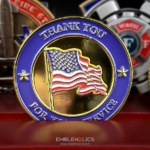
This is a coin with no unit on it. The front carries an engraved United States flag, the reverse carries the insignias of all branches of the Department of Defense, and the whole point is that it can be given to anyone who served.
A Coin Without a Unit
Nearly every coin in this gallery belongs to a specific organization. This one deliberately does not, and that changes the design problem entirely.
The recipient is unknown at the time of ordering. Which rules out anything specific: no unit insignia, no rank, no dates, no branch. Whatever goes on the coin has to be correct for an Army veteran, a Navy chief, a Marine, an airman, a Coast Guardsman and a first responder alike.
So the symbols have to be universal. The flag works because it belongs to everyone who served under it. All the branch emblems together work because nobody is left out. Either approach solves the problem; picking one branch would not.
And it is given by civilians as often as by the military. A unit coin is handed over by someone inside the organization. An appreciation coin is frequently given by a business, a community group, a church, a school or an individual who wants to do something more substantial than say the words. That audience does not have artwork of its own, which is why these designs are built from national symbols rather than organizational ones.
It also means stock rather than a batch. A unit orders coins, distributes them and is done. An appreciation coin is given one at a time over years, so one order lasts a long time and nothing on it should date.
See also a military appreciation coin and commemorative challenge coins.
An Engraved Flag
The flag is the most used symbol in this category and the most frequently botched, so it is worth setting out what makes one work in metal.
Stripes are a gift to a coin. Alternating bands of equal width, high contrast, no fine detail. They reproduce cleanly at any size and they fill a face without needing anything added.
The stars are the problem. Fifty five-pointed stars at coin size is far beyond what striking can hold. They become a gray haze. The working approaches are to reduce the count deliberately, to render the canton as a textured field rather than as individual stars, or to enlarge the canton relative to the stripes so the stars have room.
A waving flag beats a flat one. Folds give the stripes curvature, which means the engraving follows varying lines rather than straight parallel ones, and that reads as cloth rather than as a striped panel. It also lets the flag fill a circular face, where a flat rectangle leaves empty arcs.
And engraving suits it better than enamel. A fully painted flag needs red, white and blue fills across a large area, which puts three colors into the quote and leaves little bare metal. An engraved flag reads from its line work and relief, which is both cheaper and more restrained. For a coin given in gratitude, restraint is usually the right register.
All Branch Emblems on One Face
The reverse carries the insignias of every Department of Defense branch, which is the other way to make a coin universal.
The arithmetic is demanding. Each branch emblem is a complete design built to stand alone at a readable size, and putting all of them on one face means each gets a fraction of the space it was drawn for. Three things make it work: arranging them in a ring so every branch has equal prominence and no ordering question arises, scaling them to equal visual weight rather than equal bounding boxes, and simplifying the internal detail of each one so the silhouette survives even though the fine elements do not.
For a fuller treatment of that problem, see an all branches challenge coin.
One note specific to this coin type. Because the recipient could be from any branch, the emblems have to be accurate. Somebody receiving a coin as thanks for their service will look for their own branch’s device on it, and will notice if it is wrong.
Other Symbols That Work
Beyond the flag and the branch emblems, the symbols commonly used on appreciation coins are a folded funeral flag, a bald eagle, a battle cross and soldier silhouettes.
Two of those carry weight worth being deliberate about. A folded flag and a battle cross are both funeral and memorial imagery, so a coin using them reads as remembrance rather than as thanks. That is a different object and a valid one, but it is not interchangeable with an appreciation piece, and giving a memorial coin to a living veteran as a gesture of gratitude lands wrong.
An eagle and a silhouetted figure are the safer choices for a general appreciation coin. Both are strong coin subjects: an eagle has a bold outline and natural relief, and a silhouette is recognized by posture, which survives reduction where facial or uniform detail does not.
Who Gives These Coins
A veteran is anyone who served in the active military, naval or air service and was discharged under conditions other than dishonorable.
Appreciation coins are ordered by businesses with veteran customers or staff, community and civic organizations, churches, schools, veterans service organizations, and people who simply want something to hand over. The common factor is that the giver is usually not the one who served, and the coin is a tangible gesture rather than a unit artifact.
See more military challenge coins.
Order an Appreciation Coin
Professional artwork is free with unlimited revisions, and nothing goes into production until you approve a digital proof. The challenge coin minimum is 50 pieces, standard production runs about 45 to 50 days after final artwork approval, rush production is available on many projects, and shipping within the continental United States is included. Embleholics is veteran-owned, SDVOSB and registered in SAM.gov.
Two suggestions. Keep dates and names off entirely, because these are given one at a time over years and a single order should last; anything time-specific shortens its life for no gain. And decide early whether you want an appreciation coin or a memorial one, since the symbols differ and a folded flag or battle cross reads as remembrance rather than as thanks. Request a free quote to begin.
Coin Front
Coin Back

Frequently Asked Questions
What is a thank you for your service coin?
It is an appreciation coin with no unit on it, given to any veteran, service member or first responder as a gesture of gratitude. Because the recipient is unknown when it is ordered, the design uses universal symbols rather than organizational ones.
Who orders appreciation coins?
Businesses with veteran customers or staff, civic and community organizations, churches, schools, veterans service organizations and individuals. The giver is usually not the person who served, which is why these designs are built from national rather than unit symbols.
Should an appreciation coin carry a date?
No. These are given one at a time over several years, so a single order should last. Anything time-specific shortens the coin’s usable life without adding anything.
How do you put a flag on a coin?
Stripes reproduce beautifully, since they are alternating bands of equal width with no fine detail. A waving flag works better than a flat one, because the folds give the stripes curvature that reads as cloth and fills a circular face.
What happens to the stars on a flag design?
Fifty five-pointed stars is beyond what striking can hold at coin size, so they become a gray haze. The options are reducing the count deliberately, rendering the canton as a textured field, or enlarging the canton relative to the stripes.
Should a flag be engraved or enameled?
Engraved, usually. A painted flag needs red, white and blue fills across a large area, which adds cost and leaves little bare metal, where an engraved flag reads from line work and relief and holds a more restrained register.
Can all the service branch emblems fit on one face?
Yes, arranged in a ring so each has equal prominence and no ordering question arises. Each one has to be scaled to equal visual weight and simplified so its silhouette survives, since the fine internal detail will not.
Is a folded flag or battle cross suitable?
Those are memorial symbols rather than appreciation ones, so a coin using them reads as remembrance. That is a valid object but not interchangeable, and giving it to a living veteran as thanks lands wrong. An eagle or a silhouetted figure is safer.
More Military Projects