Plenty of civilian companies have military roots, and when they order a coin they face a question a unit never has to answer: how much military form can you borrow when you are not a military organization? This one was made for Veteran Ventures Capital, a venture capital firm that invests in veteran-founded companies and national security technology. It is shaped like a dog tag rather than a coin, with the firm’s bald eagle logo engraved on a deliberately gritty textured surface and the American flag on the reverse.
Borrowing the form without claiming the identity
The line is between shape and insignia, and it is clearer than most people expect. Forms are open to anyone: a dog tag outline, a shield, a sunburst, an antique finish, a serif motto around a rim. These are design conventions, and a company founded and staffed by veterans can use any of them without misrepresenting anything.
Insignia are not open. Official unit crests, service seals, rank devices, warfare badges, campaign ribbons and command emblems belong to the organizations that issue them. A civilian company putting a service seal on its coin is claiming an affiliation it does not have, regardless of how many veterans work there, and the services do act on misuse of their marks.
The workable approach is the one this coin takes: the firm’s own logo does the identifying, and the military feeling comes from the format. The dog tag shape, the texture and the flag all read as military without a single borrowed emblem. Nobody could mistake it for a unit coin, and nobody would mistake it for a bank’s.
If a veteran-owned business wants to show its service connection directly, the honest routes are its own founders’ service, named in words rather than insignia, or a published certification such as a Service-Disabled Veteran-Owned Small Business designation, which is a real credential a company has actually earned.
A note on the flag
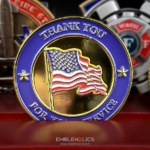
The reverse carries the American flag, and it is worth being precise about the name. The Star-Spangled Banner is the national anthem, and it is also the specific flag that flew over Fort McHenry in 1814, now held by the Smithsonian. A current fifty-star flag on a coin is the American flag or the United States flag, not the Star-Spangled Banner. It is a small distinction, and the audience for a coin like this is exactly the audience that notices it.
Engraved and painted is the right treatment for a flag at coin size. Stripes rendered only in relief tend to merge under indoor light, and a printed flag looks flat. Cutting the stripes and filling them with color gives you both the edge definition and the contrast, which is why flags on coins are almost always done this way.
Dog tag shapes, and what they cost
A dog tag is a rounded rectangle, which makes it one of the easier custom outlines to cut. There are no points, no narrow extremities and nothing fragile, so it sits at the affordable end of shape work while still being unmistakably not a circle. It also gives a long axis, which suits a company name far better than a round field does.
The trade-off is the loss of a rim. A round coin has a circular band for a motto; a dog tag does not. On this coin the motto is lettered into the spaces around the flag, which is the usual solution and needs planning from the first drawing rather than being added at the end. Decide what text is essential before the outline is finalized.
One practical point if the tag will be worn or carried on a chain: tell us at the quote stage, because a hole has to be placed where it will not cut through artwork or weaken the edge, and that affects the layout.
Texture as a finish choice
The gritty surface on this coin is a deliberate specification, not a side effect. A machined texture across the field gives a raw, worked look that a polished or satin finish cannot, and it suits an organization that wants to feel practical rather than corporate. It also does something useful: a textured field makes engraved artwork sitting on top of it read more clearly, because the smooth engraved areas contrast against the rough ground.
Texture is one of the cheapest ways to change a coin’s character. It lives in the die, so it is paid for once and reproduced across the whole run at no extra cost per coin, unlike enamel or additional plating. For a company weighing how to make a modest coin feel substantial, field texture is usually a better investment than more color.
Ordering a coin for a business
Bring your logo and tell us what the coin is for and who receives it. A coin for staff, a coin for investors and a coin for clients are three different briefs, and the answer changes the finish more than the artwork. If your company has a service connection you want reflected, say so and we will show you how to do it through form rather than through borrowed insignia. You can see more corporate challenge coins we have produced, including the WaFd Bank coin, or send your artwork through the free quote form.
Coin Front

Coin Back

Frequently Asked Questions
Can a civilian company use military imagery on a challenge coin?
Forms yes, insignia no. Dog tag shapes, shields, antique finishes and military-style layouts are open design conventions available to anyone. Official unit crests, service seals, rank devices, warfare badges and command emblems belong to the organizations that issue them, and a civilian company using one is claiming an affiliation it does not have. The services do act on misuse of their marks.
How can a veteran-owned business show its service connection on a coin?
Through its own logo and through format rather than borrowed emblems. A dog tag outline, a flag, a textured finish and a military-style layout all communicate the connection without using anyone’s insignia. Where a direct statement is wanted, the founders’ service described in words, or a published credential such as a Service-Disabled Veteran-Owned Small Business designation, are the honest routes.
Is the American flag the same as the Star-Spangled Banner?
No. The Star-Spangled Banner is the national anthem, and it is also the specific flag that flew over Fort McHenry in 1814, which is held by the Smithsonian. A current fifty-star flag on a coin is correctly called the American flag or the United States flag. It is a small distinction, but the audience for military-adjacent coins tends to notice it.
How should a flag be rendered on a coin?
Engraved and color-filled. Stripes carried only in relief tend to merge together under indoor light, and printed artwork looks flat and wears off. Cutting the stripes into the die and filling them with enamel or paint gives both edge definition and contrast, which is why nearly every successful flag coin is made this way.
Is a dog tag shape expensive?
No, it is one of the cheaper custom outlines. A rounded rectangle has no points or narrow extremities, so it carries none of the fragility that drives up cost on irregular shapes, while still being clearly not a circle. The main consideration is that you lose the rim, so any motto has to find space within the face.
What does a textured field do for a coin?
It changes the character and improves legibility at the same time. A machined texture gives a raw, worked look, and smooth engraved artwork sitting on a rough ground reads more clearly than it would on a polished field. Because texture lives in the die, it is paid for once rather than per coin, which makes it one of the most cost-effective ways to make a modest coin feel substantial.
Should a business coin be different for staff, clients and investors?
Usually in finish rather than in artwork. A coin given to staff will be carried and benefits from a durable finish; a coin presented to clients or investors is more likely to be displayed and can take a brighter one, and is the rare case where packaging earns its cost. Tell us who receives it and we will specify accordingly.
More Military Projects