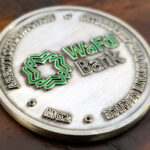
This coin was made for a company rather than a unit, to mark the remodel of a headquarters floor, and it carries the organization’s values on the reverse. Values on a coin are the most commonly requested and most commonly mishandled thing in corporate work, so it is worth saying exactly when they fit.
Values on a Coin, and When They Work
Almost every corporate buyer asks for them. Most of the time it goes wrong, and the reason is mechanical rather than a matter of taste.
Values fit on a coin as single words. They do not fit as statements. A value expressed as a word, integrity, service, stewardship, is three or four characters per syllable and can be set at a size that reads. The same value expressed as a sentence about what the organization believes is forty words, and forty words on a coin face means type below the height struck metal can hold.
Three rules that follow:
One word each, or two at most. If a value cannot be reduced to that, it is a statement and it belongs in a document rather than on a coin.
Four to six of them, not ten. There is a hard limit set by the circumference or the face area and the minimum legible letter height. Past it the fix is fewer values, never smaller type, and deciding which to drop is a conversation for the client rather than the vendor.
Set them as a list, not as prose. A ring around the rim, a column, or evenly spaced around a central device. Each word gets the same weight, which is the point: a list says these are equal, where a paragraph says somebody ranked them.
And one thing to check before artwork: whether the wording is the official wording. Values get paraphrased in internal decks constantly, and a coin is a permanent object. Get them from the source.
Why a Building Is a Reasonable Occasion
The coin marks a headquarters remodel, which sounds like a thin reason for a coin and is actually a sound one.
Corporate coins work best when they mark something specific and finite. A product launch, a merger, a milestone, a project delivered, a building finished. What they do not work for is marking the company in general, because a coin with no occasion on it is a branded disc and everybody treats it as one.
A building has a completion date and a set of people who did it, which is exactly the shape of occasion a coin suits. The run is bounded by the people involved, the date is fixed, and the thing being marked actually happened.
The question worth settling early is who the coins are for: the project team, the staff who work in the building, or visitors. Those are three quantities and three different designs, and most corporate orders stall because nobody decided.
Brushed Silver and Exactly Two Colors
The base is a silver-tone metal with a brushed finish, and the only colors on the coin are the bank’s green and a pale yellow.
That is disciplined and it works for three reasons.
A brushed field makes two colors enough. A brushed surface scatters light rather than reflecting it, so the field holds an even tone from any angle and the painted areas become the brightest things on the coin without needing outlines or borders.
Two brand colors stay on brand. A corporate coin that introduces colors the brand does not use is off-brand, whatever it looks like. Restricting the palette to the actual brand colors is not a limitation, it is the requirement.
Silver rather than gold suits a financial client. Gold on a bank’s coin reads as a claim about money. Silver reads as a material. That is a small judgment and it is the right one.
On matching the colors: a brand color is specified exactly, and matching it in paint or enamel needs the color reference rather than an image of the logo. We cover that and the rest of logo reproduction on our corporate logo coin page.
See plating options and antique and polished finishes.
Simple but Memorable
The brief was for something simple but memorable, which is the most common corporate brief there is and the one most likely to produce a forgettable coin, because simple is easy and memorable is not.
What actually makes a restrained coin memorable:
Weight. The first thing anyone notices and the cheapest quality to buy. A coin that feels substantial is remembered as a good coin before anybody looks at it.
One deliberate surface. A brushed field, a matte field, an antique field. Any of them chosen on purpose beats a default polish, and all of them cost about the same.
Something specific on it. A date, an occasion, a place. This is the difference between memorable and merely clean: the coin has to be about something. A logo and a palette alone is a token.
A plain coin also has nowhere to hide, which is worth knowing before choosing one. Every edge of color and every surface is on display, and we cover that on our plain emblem coin page.
About WaFd Bank
WaFd Bank is a Seattle-based bank operating across the western United States. The coin was made to mark the remodel of its headquarters ground floor.
That is as much as the page needs. Branch counts, corporate history and holding company structure all change and none of it is about the coin.
One thing worth noting: Embleholics is in Port Orchard, across Puget Sound, which makes this a local client as well as a corporate one. See challenge coins in Washington State.
See more corporate challenge coins and business coins.
Order an Employee Coin
Free professional artwork, unlimited revisions and a digital proof before anything is produced. Free shipping within the continental US, a 50-coin minimum, and most orders complete 45 to 50 days after artwork approval, with rush production available. Embleholics is veteran-owned, an SDVOSB, and registered in SAM.gov.
Three things worth sending with a quote request: your brand guidelines rather than just the logo, the exact official wording of anything that has to appear on the coin, and a note on who the coins are going to, because that decides the quantity and usually the design.
Frequently Asked Questions
What is an employee challenge coin?
An employee challenge coin is made by a company for its own people, usually to mark a specific occasion such as a project, a milestone or a completed building. It carries the company’s mark rather than any external insignia.
Can company values go on a challenge coin?
Yes, as single words. A value expressed as a word can be set at a readable size, while the same value written as a statement runs to dozens of words and ends up below the letter height struck metal can hold.
How many values fit on a coin?
Four to six, depending on word length and the space available. There is a hard limit set by the face area and the minimum legible type size, and the fix for exceeding it is fewer values rather than smaller lettering.
How should values be laid out?
As a list rather than as prose: a ring around the rim, a column, or evenly spaced around a central device. Equal weight for each word says they are equal, where a paragraph implies somebody ranked them.
What occasions suit a corporate coin?
Specific, finite ones: a product launch, a merger, a project delivered, a building completed. A coin marking the company in general has no occasion on it and gets treated as a branded disc.
How many brand colors should a corporate coin use?
Only the ones the brand actually uses, and usually two. A coin that introduces colors outside the palette is off-brand whatever it looks like, and a brushed metal field makes two colors read strongly enough.
Will the coin match our exact brand color?
Matching a specified brand color needs the color reference rather than an image of the logo, so send the brand guidelines with the quote request and the match is made from the specification.
What makes a simple coin memorable?
Weight, one deliberately chosen surface finish, and something specific on it such as a date or an occasion. Weight is the cheapest quality to buy and the first thing anyone notices.
Should a bank’s coin be gold or silver?
Silver usually reads better for a financial client, because gold on a bank’s coin reads as a claim about money where silver reads as a material. It is a small judgment and it is worth making deliberately.
More Corporate Projects