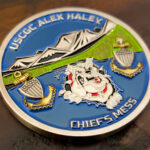
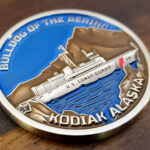
A Coast Guard cutter challenge coin is almost always ordered by the Chief’s Mess rather than by the command, and that one fact shapes the design. The mess is a continuing body with its own funds and its own traditions, so the coin belongs to the chiefs rather than to a commanding officer’s tour. This one was made for the Chief’s Mess aboard USCGC Alex Haley, homeported at Kodiak, Alaska: the cutter embossed over an etched Alaskan coastline on a blue field, with the ship’s bulldog mascot on the reverse.
The Chief’s Mess Is the Buyer
The chief petty officers’ mess is a shared sea service tradition, and aboard ship it is a physical space as well as a body of people. By custom it is reserved for chiefs, and everyone else, officers and the commanding officer included, asks permission to enter. The older name for it is the goat locker, which goes back to wooden sailing ships that carried live goats for milk and to eat the refuse, and kept them in the chiefs’ quarters.
For anyone trying to get a coin made, three things follow from the mess being the customer.
- It has its own money and its own calendar. A mess orders when it decides to, not when a command budget allows, which is why these coins appear outside the usual unit coin cycle.
- The quantity is the mess plus the people they host. Not the ship’s company. Chiefs present coins to visiting chiefs, to partner crews, to people who helped the ship, and at advancements and transfers.
- It outlives any one tour. The mess is permanent in a way a particular crew is not, so a mess coin is built around the ship and the mess rather than around a current roster or commanding officer.
One point of language worth getting right, because chiefs will notice. The Coast Guard is its own armed service, not part of the Navy, and it sits under the Department of Homeland Security. Its senior enlisted leader is the Master Chief Petty Officer of the Coast Guard. Naval traditions are shared, the chain of command is not.
Who the Ship Is Named For
This is the part of the coin’s story worth leading with, and it is specific to this vessel.
USCGC Alex Haley is named for Alex Haley, who served twenty years in the Coast Guard, became the service’s first chief journalist, was the first African American to reach chief petty officer in the Coast Guard, and went on to write the Pulitzer Prize-winning Roots: The Saga of an American Family.
So a Chief’s Mess aboard this particular cutter is ordering a coin from a ship named after a chief. Very few ships’ coins have that kind of connection available to them, and it is the strongest argument this design has for carrying the ship rather than a generic service device. If your ship’s namesake has a link to your community, use it, because it is the one thing no other coin can borrow.
The cutter herself began as a Navy vessel, USS Edenton, an Edenton-class salvage and rescue ship, and was recommissioned into the Coast Guard on 10 July 1999. She is a little over 280 feet, homeported at Kodiak, and her primary missions are fishery law enforcement and search and rescue. Her nickname is the Bulldog of the Bering.
Fitting a Ship Onto a Round Coin
Ships are the most awkward subject in coin design, and the reason is geometry rather than detail.
A vessel in profile is roughly five or six times longer than it is tall. A coin is a circle. Put one inside the other and you have a choice between drawing the ship small enough that its length fits the diameter, which wastes most of the coin, or drawing it large and leaving two empty arcs above and below it.
Three approaches work, and the right one depends on what else the coin has to carry.
Run the ship across the full diameter and fill the arcs. The ship sits on the widest line of the circle, water occupies the arc below, and sky or coastline occupies the arc above. This is the approach on this coin, and it is why the Alaskan scenery is there: not as decoration but because something has to live in the space a ship cannot reach.
Turn the vessel to a three-quarter view. Seen from forward of the beam, a ship occupies a shape much closer to square, so it fills a circle far more efficiently than a side profile does. It costs you the clean recognizable silhouette.
Change the outline. An oval or a rectangle with rounded corners matches a ship’s proportions far better than a circle does, which is worth considering before defaulting to round.
Scenery as Background, Not Subject
The Alaskan coastline on this coin is etched while the ship is embossed, and keeping those two in the right relationship is the difference between a ship coin and a landscape coin with a boat in it.
A background has one job, which is to establish where you are and then stop. That means it should be reduced to the fewest shapes that read as the place: a ridgeline, a treeline, a horizon. Detail in a background is actively harmful, because detail reads as importance and the viewer’s eye goes to it.
Etching the background and raising the subject does the separating automatically. The ship sits above the surface and catches light, the coastline sits below it and holds shadow, and no amount of looking confuses which one you are meant to be looking at. Attempting the same hierarchy with both elements at the same height, separated only by drawing, almost never survives reduction to coin size.
Blue Fields and Metal Ships
Blue is the default on a maritime coin, and the honest objection to it is that it makes every ship coin resemble every other ship coin.
It earns its place here for a literal reason. With a blue field behind her, the cutter can stay in bare metal and read as a metal object on water, which is what she is. Paint the ship and you lose that, and you also lose the light: a bare metal vessel changes as the coin moves in the hand, where a painted one looks the same from every angle.
The rule that follows is simple and gets broken constantly. If the field is blue, the ship must not be. The most common failure on ship coins is a blue-grey hull on a blue sea, which is accurate to life and invisible on metal.
The Mascot on the Reverse
The bulldog on the reverse is the crew’s own, in a way a hull number or a service emblem never is.
Mascots and nicknames are generated inside a unit rather than assigned to it, which makes them the element of a coin that people actually feel ownership of. A hull number identifies a ship. A nickname says something about what the ship does and how the crew sees it, and the Bulldog of the Bering does both at once for a cutter working northern waters.
Giving the mascot the whole reverse is the right call. Mascots are character drawings, which means they need room for expression and lose their appeal faster than any other subject when shrunk. Crowded in beside lettering and insignia, a mascot stops being funny or fierce and becomes a smudge.
Design a Coin for Your Cutter or Mess
Send the ship’s name and hull number, your mascot or nickname artwork if you have it, and tell us whether the mess or the command is ordering. If you want the vessel in profile, say so, because it affects whether a round coin is the right outline.
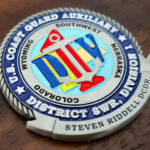
Professional artwork is free with unlimited revisions, and nothing goes into production until you approve a digital proof. Standard production runs about 45 to 50 days after final artwork approval, rush production is available on many projects, and shipping within the continental United States is included. Embleholics is veteran-owned, SDVOSB and registered in SAM.gov. See more Coast Guard challenge coins, another US Coast Guard coin project, or a Coast Guard Auxiliary coin.
Finished Coin (Front)
Finished Coin (Back)
Frequently Asked Questions
What is a Coast Guard cutter challenge coin?
A Coast Guard cutter challenge coin is a coin made for a specific commissioned cutter, usually carrying the vessel herself, her name and hull number, and her mascot or nickname. Most are ordered by the ship’s Chief’s Mess rather than by the command, because the mess has its own funds and its own presentation traditions.
What is a Chief’s Mess?
The chief petty officers’ mess is both the body of chiefs at a command and, aboard ship, the space reserved for them, traditionally entered by others only with permission. It is also called the goat locker, a name that goes back to sailing ships that carried live goats and kept them in the chiefs’ quarters. It is a tradition shared across the sea services.
Is the Coast Guard part of the Navy?
No. The Coast Guard is one of the United States armed services in its own right and sits under the Department of Homeland Security, with the Master Chief Petty Officer of the Coast Guard as its senior enlisted leader. It shares many naval traditions, including the chief petty officers’ mess, but not the Navy’s chain of command.
Who was USCGC Alex Haley named after?
The cutter is named for Alex Haley, who served twenty years in the Coast Guard, became the service’s first chief journalist and the first African American to reach chief petty officer in the Coast Guard, and wrote the Pulitzer Prize-winning Roots: The Saga of an American Family. The vessel was formerly the Navy salvage and rescue ship USS Edenton and was recommissioned into the Coast Guard on 10 July 1999.
How do you fit a ship onto a round challenge coin?
A ship in profile is five or six times longer than it is tall, so it does not fit a circle well. The three solutions are to run the vessel across the full diameter and fill the arcs above and below with sky, coastline and water, to draw her in a three-quarter view which occupies a shape closer to square, or to choose an oval or rounded rectangle outline that matches a ship’s proportions in the first place.
Should background scenery be etched or raised on a coin?
Etched, with the subject raised above it. Putting the background below the surface and the subject above it separates them by light and shadow rather than by drawing, which is the only separation that reliably survives reduction to coin size. A background should also be reduced to the fewest shapes that identify the place, because detail in a background pulls the eye away from the subject.
Is blue the best base color for a ship coin?
Blue works well because it lets the vessel stay in bare metal and read as a metal object on water, and bare metal changes as the coin moves in the hand where paint does not. The one rule is that if the field is blue, the ship must not be. A blue-grey hull on a blue sea is accurate to life and nearly invisible at coin size.
Should a ship’s mascot go on the coin?
Yes, and it is worth giving it a whole side. A mascot or nickname comes from inside the crew rather than being assigned, so it is the element people feel ownership of. Mascots are character drawings and they lose their expression faster than any other subject when shrunk, so crowding one in beside lettering and insignia tends to waste it.
More Coast Guard Projects