A belt buckle is not a flat object. It is curved along its width so it sits against the body, and that single fact changes how artwork has to be laid out on it. A coin is struck on a flat plane. A buckle is struck on a bend.
The Face Is Curved
This is the technical difference that matters most, and nobody mentions it.
Only the centre of a buckle is seen square on. The left and right thirds curve away from the viewer, so anything placed there is seen at an angle and foreshortened. The further out an element sits, the more it is compressed.
Four consequences for the layout:
The subject belongs in the middle. Whatever has to be recognized goes in the centre third, where the surface faces the viewer. On this buckle the rattlesnake head sits there, which is why it reads immediately.
A straight line across the face is not straight. Drawn straight on a flat artboard and struck onto a curve, a horizontal rule reads as bowed. Either accept the curve as part of the design or compensate for it in the artwork, but do not assume a flat drawing will look flat.
Lettering across the full width distorts at the ends. Letters near the edges lean away and narrow. Short text in the centre is safe; a long line spanning the whole buckle is not, and the fix is to shorten it rather than to shrink it.
Relief reads differently across the span. The same depth of modelling casts less visible shadow at the edges than at the centre, because the surface there is already angled away. Detail at the outer thirds needs to be bolder than detail in the middle to read at all.
For the broader differences between a buckle and a coin, see our Navy belt buckle page.
One Subject, Cut Large
The squadron asked for something bold, and the design is a single element: an embossed rattlesnake head with the name inscribed in front of it.
That is the right instinct for a buckle and it follows directly from the curve. A buckle is read from a few feet away, at a fixed orientation, by people walking past. It gets one subject and one line of text, and anything more becomes decoration that nobody resolves.
Two notes on an animal head specifically. A head has to be recognizable from its outline before any detail is seen, which means the silhouette, the jaw and the shape of the snout do the identifying. And a snake’s head in particular depends on its triangular form and the line of the mouth rather than on scale texture, so the modelling belongs in those planes and the surface texture can be coarse.
Gold and Red on Glossy Black
The buckle is finished in gold and red over a glossy black background, and it is worth noting that this is the opposite choice from the one we usually recommend for a worn piece.
Gloss shows wear, and a buckle collects wear. A glossy black field on something worn daily will pick up fine scratches and show them, where a matte or antique field would absorb them.
It also gives the strongest possible contrast. Gold and red on glossy black is as bright and legible as a buckle gets, and for a squadron that asked for bold, that is exactly the trade they chose: maximum presence now, visible wear later.
That trade is worth stating when a customer is deciding. If the piece is for a ceremonial belt or a presentation, gloss is the right answer. If it is going on a working belt every day, matte or antique will age better. Neither is wrong, but the decision should be made deliberately rather than by default.
See antique and polished finishes and plating options.
A Mascot Rather Than an Emblem
The squadron’s official insignia exists, and this buckle does not use it. It uses the mascot instead, cut large.
That is a legitimate and often better choice on a buckle, for the reasons above. An official squadron insignia is a detailed heraldic design built to be reproduced at patch size with lettering inside it. Shrunk onto a curved face and read from a few feet away, most of that detail is lost. A mascot reduced to one strong form survives the format.
The general rule: a coin can carry the emblem, a buckle wants the mascot. If a unit wants both, the emblem goes on the coin and the mascot goes on the buckle, and the pair works better than either object trying to do both jobs.
About VFA-102
Strike Fighter Squadron 102, the Diamondbacks, flies the F/A-18F Super Hornet and is based in Japan. Its call sign is Diamond and its tail code is NF.
The squadron was established in 1955 as VF-102 at Naval Air Station Cecil Field, Florida, flying the F2H-4 Banshee. Its aircraft, its home and its people have changed many times since. The rattlesnake has not, which is the point worth making on a page about a buckle: a mascot that has outlasted four or five airframes is a better long-term subject than any of them.
See more Navy projects and another Navy custom buckle.
Order a Squadron Belt Buckle
Free professional artwork, unlimited revisions and a digital proof before anything is produced. Free shipping within the continental US, and rush production available. Embleholics is veteran-owned, an SDVOSB, and registered in SAM.gov.
Minimums on belt buckles are set separately from coins, so see minimum orders for belt buckles before planning a quantity.
Two things worth sending with a quote request. The belt width the buckle has to fit, and the one subject you want in the centre, because the curve decides that there is only room for one.
Finished Buckle (Front)
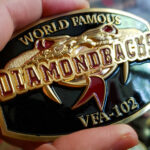
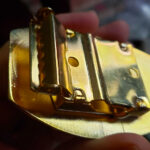
Finished Buckle (Back)
Frequently Asked Questions
What is a squadron belt buckle?
A squadron belt buckle is a custom buckle carrying a squadron’s mascot, emblem or designation, made to be worn rather than carried. Aviation squadrons order them alongside coins, and the two formats suit different artwork.
Is a belt buckle flat like a coin?
No. A buckle is curved along its width so it sits against the body, which means only the centre is seen square on and the outer thirds curve away from the viewer and are foreshortened.
Where should the main subject go on a buckle?
In the centre third, where the surface faces the viewer directly. Anything placed toward the edges is seen at an angle and compressed, so the element that has to be recognized belongs in the middle.
Does lettering distort on a belt buckle?
Toward the edges, yes. Letters near the ends of a curved face lean away and narrow, so short text in the centre is safe while a long line spanning the full width is not. The fix is fewer words rather than smaller type.
Do straight lines stay straight on a buckle?
Not visually. A horizontal rule drawn straight on a flat artboard reads as bowed once struck onto a curve, so it is either accepted as part of the design or compensated for in the artwork.
Should a buckle carry the unit emblem or the mascot?
Usually the mascot. An official emblem is detailed and built to be reproduced at patch size with lettering inside it, which is lost on a curved face read from a few feet away, while a mascot reduced to one strong form survives.
Is a glossy finish a good idea on a buckle?
It gives the strongest contrast and it shows wear. Gloss suits a ceremonial or presentation piece, while matte and antique finishes age better on a buckle worn daily, and the choice is worth making deliberately.
What aircraft does VFA-102 fly?
VFA-102 flies the F/A-18F Super Hornet. The squadron, the Diamondbacks, is based in Japan and was established in 1955 as VF-102 at Naval Air Station Cecil Field, Florida.
What is the minimum order for a belt buckle?
Buckle minimums are set separately from coin minimums, so check the belt buckle minimum order page rather than assuming the 50-piece coin figure applies. Artwork, revisions and a proof are included either way.
More Coast Guard Projects