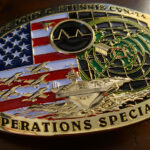
A belt buckle is not a large coin. It is worn rather than carried, which changes the size, the shape, the finish and what makes a good subject. This one was made for an Operations Specialist aboard USS John C. Stennis, with the carrier engraved across the face over a flag background.
Worn, Not Carried
Almost everything that makes a buckle different comes from this one fact.
A coin is looked at occasionally. A buckle is on display constantly. It is seen in daylight, from a few feet away, by everyone the wearer passes, and always at the same orientation. A coin is turned over in the hand, examined up close, then put away.
Four things follow:
It is only ever viewed one way up. A coin has to work in any rotation and both faces have to be designed. A buckle has one face that matters and one fixed orientation, which is a real advantage: the composition can be built for a single viewing angle rather than compromised for several.
It is read at a distance. Detail that rewards close inspection on a coin is wasted on a buckle. What works is one strong subject filling the face, which is exactly what an engraved ship across the whole surface is doing here.
It takes constant abrasion. A buckle rubs against clothing, desks, car seats and door frames every day. A coin in a drawer does not. That makes finish a durability decision rather than only an appearance one.
The size is not a preference. A buckle has to fit the belt it goes on, so the width is set by the belt and the proportions follow from that. You cannot simply make it bigger because the artwork needs room.
See custom belt buckles for the format options.
A Wide Face Suits a Wide Subject
The classic military buckle shape is a rectangle with curved top and bottom edges, which is what this one uses. It is wider than it is tall, and that is the whole reason a ship works on it.
A hull seen from the side or at an angle is a long, low shape. On a round coin it either shrinks to a detail or runs off the edges and loses its bow and stern. On a wide rectangle it sits along the long axis with room to spare.
The general rule holds across formats. Wide subjects suit a wide face: ships, bridges, aircraft in profile, vehicles, skylines. Tall subjects want a tall or round format. A subject with no strong axis, such as an emblem or a seal, belongs on a round coin, which is why emblems have always been on round coins.
The curved top and bottom earn their keep too. They give the composition a soft boundary at the edges where a hard rectangle would crop the artwork, and they are where the eye expects a buckle to end.
A Flag Behind a Ship
Two layered subjects on one face, which is harder than it sounds. A flag is a large area of pattern and a ship is a detailed silhouette, and if they sit at the same depth they fight.
What resolves it is relief height rather than outline. Put the ship forward and the flag back. The hull sits at the top of the relief with clear edges, and the flag is cut lower and shallower so it reads as a field behind rather than as a second subject beside.
Two practical notes. A flag in motion is folds, and folds on struck metal are relief rather than color, so the fabric reads from the light before any paint does. And a flag used as a background should lose detail deliberately: fewer, broader folds, and no attempt at individual stars, because that detail competes with the subject it is supposed to be supporting.
Finish Is a Durability Decision
This is where buckles and coins genuinely part company.
A polished mirror finish looks striking on a coin that lives in a box. On something worn daily it is the worst choice available, because a mirror shows every scratch it collects, and it will collect them from the first week.
Matte, brushed and antique finishes age better on a worn piece. They scatter light rather than reflecting it, which means small marks blend into the surface instead of standing out against it. An antique finish in particular is already dark in the recesses, so wear tends to look like use rather than damage.
The other half of the same decision is where the artwork sits. Raised detail on a buckle is what rubs first, so the strongest designs keep their fine work recessed and let the broad raised areas take the contact. On this buckle the engraved treatment does exactly that: the detail is cut into the surface rather than standing on top of it.
See antique and polished finishes for how each one behaves.
The Back Is Hardware
The reverse of a buckle is not a design surface. It carries the attachment: the hook and bar that hold the belt, and the mechanism that lets the belt be tightened and released.
That is worth saying plainly because people arriving from coins expect two faces. A buckle has one face and a fitting, and the fitting is a functional choice rather than an artistic one. It has to suit the belt width, it has to hold under load, and it has to be comfortable against the body.
Which means the decision list for a buckle is shorter than for a coin but less forgiving: the shape, the belt width, the mechanism, the finish, and one strong subject for the face.
Made in the Yard
This buckle was made while the ship was in refueling and overhaul at Newport News Shipbuilding, which is a long yard period rather than a deployment.
That is a common moment for a piece like this and the reason is straightforward. A yard period is measured in years, the crew is ashore or aboard a ship that is not going anywhere, and it is the one stretch of a career with time to organize something. Plenty of keepsakes get made in yard periods and very few get made underway.
USS John C. Stennis is CVN 74, a Nimitz-class aircraft carrier, named for a United States senator from Mississippi. The buckle was made for the ship’s Operations Specialist, a rating whose work has almost nothing physical to show, which is covered on our Operations Specialist coin page.
See also another Navy custom buckle.
Order a Custom Belt Buckle
Free professional artwork, unlimited revisions and a digital proof before anything is produced. Free shipping within the continental US, and rush production available. Embleholics is veteran-owned, an SDVOSB, and registered in SAM.gov.
Minimums on belt buckles are not the same as on coins, so see minimum orders for belt buckles before you plan a quantity.
Two things worth sending with a quote request. The belt width the buckle has to fit, and the one subject you want on the face, because a buckle holds one subject well and two badly.
See more Navy projects.
Frequently Asked Questions
What is a Navy belt buckle?
A Navy belt buckle is a custom buckle carrying a ship, unit, rating or command identity, made to be worn rather than carried. It is a different object from a challenge coin: one face, a fixed orientation, and a fitting on the back rather than a second design.
How is a belt buckle different from a challenge coin?
A buckle is on display constantly and viewed from a few feet away at one fixed orientation, while a coin is examined up close and then put away. That means a buckle wants one strong subject filling the face rather than fine detail, and its finish has to survive daily abrasion.
What size is a custom belt buckle?
The width is set by the belt it has to fit rather than chosen for the artwork, and the proportions follow from that. It is the one dimension that cannot be increased to make room for a design, which is why the subject is chosen to suit the face.
Can a ship be shown on a belt buckle?
Yes, and a buckle suits a ship better than a round coin does. A hull is a long low shape and a buckle face is wider than it is tall, so the ship can run along the long axis with its bow and stern intact.
What finish is best for a belt buckle?
Matte, brushed or antique finishes hold up best on something worn daily, because they scatter light and small scratches blend into the surface. A polished mirror finish looks striking but shows every mark it collects, and a worn piece collects them quickly.
What goes on the back of a belt buckle?
The attachment hardware: the hook and bar that hold the belt and the mechanism that tightens and releases it. The back is a functional fitting rather than a design surface, which is the main structural difference from a two-sided coin.
How do you put two subjects on one buckle face?
Separate them by relief height rather than by position. Put the main subject forward at the top of the relief with clear edges and set the second element lower and shallower so it reads as a background, as the flag does behind the ship on this buckle.
What is the minimum order for a belt buckle?
Buckle minimums are set separately from coin minimums, so check the belt buckle minimum order page rather than assuming the 50-piece coin figure applies. Artwork, revisions and a proof are included either way.
What ship is USS John C. Stennis?
USS John C. Stennis is CVN 74, a Nimitz-class aircraft carrier named for a United States senator from Mississippi. This buckle was made during a refueling and overhaul period at Newport News Shipbuilding.
More Navy Projects