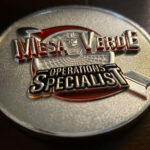
Some jobs are easy to put on a coin. An aviator has an aircraft, a gunner has a weapon, a corpsman has a caduceus. An Operations Specialist works at a screen in a darkened compartment, and there is no obvious object to draw. This coin for USS Mesa Verde’s Operations Specialists solves that by making the equipment the subject: an engraved operations console on the reverse, with the ship’s emblem and the rating badge embossed on the front against a plain sandblasted field.
A Coin for Work With Nothing to Show
This problem comes up more than people expect, and it is worth naming because the usual response to it is a coin that falls back on generic service devices and says nothing specific at all.
A great many military and technical specialties have no photogenic object attached to them. Operations specialists, cryptologic and information systems technicians, controllers, analysts, logisticians, planners, communicators and watchstanders of every kind do work that is real, demanding and completely invisible. There is no vehicle, no tool and no distinctive piece of kit to put in the middle of the design.
There are three honest ways out, and this coin uses the first.
- Show the equipment. A console, a scope, a rack, a headset, a plotting board. The thing the person actually sits at.
- Show the output. A plot, a track, a waveform, a radar sweep, a grid. The shape the work produces rather than the apparatus.
- Show the setting. The compartment, the watch, the dark room with lit screens. Harder to do well, and powerful when it lands.
What does not work is falling back on an anchor and the ship’s name, which produces a coin indistinguishable from every other coin on that ship.
The Console Is the Identity
Putting a workstation on a coin sounds unglamorous and it is the opposite. For anyone who has stood that watch, the console is instantly recognizable and nobody else’s. It is the single most specific object available.
Equipment also happens to be excellent coin artwork. A console is made of rectangles, screens, switch panels and a frame: straight lines, hard edges, repeated modules and no organic detail to lose at size. It engraves cleanly in a way a human figure or an animal does not.
Two things to get right. Draw the generation of equipment the people receiving the coin actually used, because a console dates a coin to a period and getting it wrong is the one thing they will notice. And keep it to the recognizable silhouette rather than every switch, since the shape is what carries the recognition.
Paint Used as Shadow, Not as Color
The front of this coin has the emblem and the rating badge embossed, with color applied only as shadows rather than filled in as color. That is an unusual and underused technique.
Normally paint fills an enclosed area to make it a color: a red field, a blue chevron. Used as shadow instead, the paint goes only into the recesses and the shaded side of raised elements, which exaggerates the depth the relief already has. The effect is that the metal looks more deeply sculpted than it physically is.
Three reasons to reach for it:
It keeps the coin metallic. The surfaces you actually see are still bare metal, so the coin reads as a struck object rather than a painted one, and it still changes as it tilts in the hand.
It rescues shallow relief. If a design cannot be struck deeply, darkening the shadow side of each element produces the appearance of depth without the tooling cost or the thickness that real high relief requires.
It does not date. A color scheme can look of its moment. Shadow is just shadow.
The limitation is that it needs relief to work with. On a flat engraved design there are no shadows to deepen, so the technique has nothing to do.
Texture Where You Deliberately Put Nothing
The rest of the front is left as a sandy, sandblasted field with no decoration or graphics at all. That is a specific decision and a good one.
Every coin design reaches a point where part of the face should hold nothing. The trouble is that a polished blank area looks unfinished, as though an element was meant to go there and was forgotten. A texture fixes it. A sandblasted or matte field reads as a deliberately treated surface rather than as leftover space, so the emptiness becomes intentional.
This is a different job from a patterned background. A pattern such as diamond plate or hex mesh is there to mean something or to add interest. A sandblasted field is there to mean nothing, convincingly. It also helps the subject: a matte surround scatters light, so the embossed emblem stays the brightest thing on the face.
A Smooth Rim Reads Modern
The edge and rim were left completely plain, with no pattern, specifically to make the coin look contemporary. That instinct is correct, and it is worth knowing why.
Ornamented edges carry history. A rope edge, a reeded edge or a beaded rim all reference older objects, coinage, ships and medals, which is exactly why they suit traditional designs. Remove the pattern and the coin loses those references, and what is left reads as current.
So the edge is a dial rather than a detail. Turn it toward pattern for heritage and formality, turn it toward plain for a modern piece. Neither is a default. See challenge coin plating options for the finishes that pair with each.
About the Operations Specialist Rating
Operations Specialist, abbreviated OS, is an occupational rating in both the United States Navy and the United States Coast Guard. Operations specialists work in a ship’s Combat Information Center, maintaining the displays and the plot that the command uses to understand what is around the ship.
This coin was made for the operations specialists aboard USS Mesa Verde. Because the rating exists in two services, an OS coin is one of the pieces that travels, so see also Coast Guard challenge coins, an EOD career field coin, and more Navy challenge coins.
Order a Rating or Specialty Coin
Send your rating badge and your ship or command emblem, and tell us what object represents the work. If there is no obvious one, say so, and we will look at the equipment, the output or the setting instead.
Professional artwork is free with unlimited revisions, the minimum order is 50 coins, and nothing goes into production until you approve a digital proof. Standard production runs about 45 to 50 days after final artwork approval, rush production is available on many projects, and shipping within the continental United States is included. Embleholics is veteran-owned, SDVOSB and registered in SAM.gov.
Frequently Asked Questions
What is an Operations Specialist challenge coin?
An Operations Specialist challenge coin is a coin for sailors in the OS rating, which exists in both the Navy and the Coast Guard. Because the work happens at a console rather than with a vehicle or a weapon, these coins typically use the equipment, the plot or the watch itself as the subject rather than a generic service device.
What does a Navy Operations Specialist do?
An Operations Specialist works in a ship’s Combat Information Center, maintaining the displays and the plot the command relies on to understand the picture around the ship. It is an occupational rating in both the United States Navy and the United States Coast Guard.
How do you design a coin for a job with no visible equipment?
Use one of three substitutes. Show the equipment the person works at, such as a console, scope, rack or headset. Show the output of the work, such as a plot, a track, a waveform or a grid. Or show the setting, such as the compartment or the watch. Falling back on a service device and the command name produces a coin indistinguishable from every other coin at that command.
Can equipment or a workstation go on a challenge coin?
Yes, and it engraves unusually well. Equipment is made of straight lines, hard edges and repeated panels with no organic detail to lose at coin size. Draw the generation of equipment the recipients actually used, since it dates the coin to a period, and keep to the recognizable silhouette rather than every switch.
Can paint be used for shading rather than as color?
Yes. Applying color only to the recesses and the shaded side of raised elements exaggerates the depth the relief already has, so the coin looks more deeply sculpted than it is. The visible surfaces stay bare metal, so the piece still reads as struck rather than painted, and it is a way to rescue shallow relief without the tooling cost of real high relief. It needs relief to work with, so it does nothing on a flat engraved design.
What is a sandblasted or matte texture used for on a coin?
To make an intentionally empty area look intentional. A polished blank field looks as though something was meant to be there, while a sandblasted field reads as a treated surface. It is a different job from a patterned background such as diamond plate, which exists to add meaning or interest, and it also scatters light so the raised subject stays the brightest element.
Should a coin have a patterned edge or a smooth one?
It depends on the register you want. Patterned edges such as rope, reeded or beaded rims reference older objects and read as traditional and formal. A completely plain edge removes those references and reads as contemporary. Treat the edge as a deliberate choice rather than a default.
Can sailors in a rating order their own coin?
Yes, and rating or division coins are commonly ordered by the people in them rather than by the command. That is why they tend to be more specific than a command coin, since the group buying it knows exactly which equipment, motto or detail will mean something to everyone who receives one.
More Navy Projects