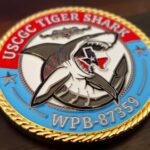
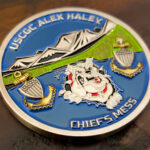
The U.S. Coast Guard Auxiliary (USCG Auxiliary) is the uniformed, all-volunteer component of the United States Coast Guard. Its members support Coast Guard missions across the country, in everything the service does except law enforcement and military operations.
What Is the Coast Guard Auxiliary?
The U.S. Coast Guard Auxiliary is the Coast Guard’s volunteer arm. Members wear the uniform, train to Coast Guard standards and hold formal qualifications, but they are unpaid civilians and they do not carry out law enforcement or military duties. That boundary is what defines the organization: everything else the Coast Guard does on the water and in the air is open to them.
Congress authorized it in 1939, and the Auxiliary took its present form under the Auxiliary and Reserve Act of 1941, which separated the civilian volunteers from the military Reserve. It now operates under the Department of Homeland Security through the Commandant of the Coast Guard, with members and units in all fifty states, Puerto Rico, the Virgin Islands, American Samoa and Guam.
The day-to-day work is broad. Auxiliarists run safety patrols on local waterways, support search and rescue, verify aids to navigation, teach boating safety courses and carry out free vessel safety checks for the public. Beyond recreational boating safety, they serve as communications watchstanders, vessel examiners, training resources for air and sea operations, and support environmental protection and homeland security work.
Membership is open to anyone seventeen or older, and there are close to two dozen qualifications an Auxiliarist can earn.
How Is the Coast Guard Auxiliary Organized?
The Auxiliary runs on four levels, and knowing which one you belong to matters when you order coins, because each level orders its own.
The Flotilla is the basic unit and the one every member belongs to. A flotilla has at least fifteen qualified members and does the day-to-day work.
The Division groups the flotillas in one geographic area, providing administrative, training and supervisory support to them.
The District supports the divisions within it and carries the policy of the district commander and the national committee.
National handles policy and administration for the organization as a whole.
Units are led by elected officers: flotilla commanders, division commanders, district commodores and the national commodore. In practical terms, the Auxiliary is organized into sixteen districts, roughly a hundred and seventy-one divisions, and approximately nine hundred and eighty flotillas. That is a great many named units, each with its own identity, and each of them is a potential coin order in its own right.
How Volunteer Organizations Buy Challenge Coins
Most challenge coin companies write for a commander with a budget line. Volunteer organizations do not work that way, and pretending otherwise wastes everybody’s time.
A command coin comes out of unit funds. A volunteer unit’s coin comes out of member dues, a fundraiser, or somebody’s own pocket. That changes every part of the conversation.
The minimum matters. Fifty coins is a real number for a flotilla with thirty members, not a formality. It usually means either ordering for more than the current roster, sharing an order across a division, or planning the design so that leftover stock still makes sense next year. Worth thinking about before the artwork rather than after.
Many volunteer units sell coins rather than give them away. Coins become a fundraising item, sold to members, at events, or to the public. That changes the design brief fundamentally: a coin someone has to pay for has to be worth buying. It needs to look good enough that a member wants one without being asked, which usually means spending the design effort on the front face and keeping the reverse simple.
Approval runs through a committee. A command coin gets signed off by one officer. A volunteer unit’s coin gets discussed at a meeting, which means the digital proof is doing more work: it has to be something a group can look at together and agree on. Unlimited revisions matter more here than anywhere else.
The occasions are different too. Volunteer orders tend to be driven by a unit anniversary, a service-hour milestone, a recruiting drive, or an end-of-year awards night, rather than by a change of command or a deployment.
The same holds across the wider volunteer world. Volunteer fire and rescue coins, CERT team coins, sheriff’s reserves, search and rescue groups and Civil Air Patrol squadrons all buy on the same terms.
What Goes on a Coast Guard Auxiliary Coin?
Auxiliary designs draw on a settled maritime vocabulary, which is part of why they tend to look coherent even when the unit designing them has no design experience.
The Auxiliary insignia is the anchor of most designs, usually on the reverse where a service seal would normally sit. Flotilla and division numbers carry the identity, often paired with a district identifier, and those numbers matter more to members than any motto does.
Vessels and aircraft appear frequently, particularly where a unit runs a specific facility. Rope borders, ship’s wheels, compass roses and anchors are the recurring devices, and a rope edge is close to a default choice for good reason.
Color convention runs blue and white, matching Coast Guard and Auxiliary usage, and both read well against brushed or polished metal without needing a third color. You can see how these conventions play out across our Coast Guard unit coins and the wider custom Coast Guard challenge coins in the gallery.
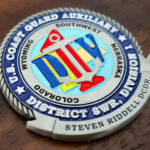
Finished Coin (Front)
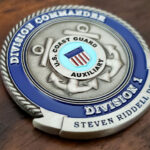
Finished Coin (Back)
About This Auxiliary Division Coin
One of the Auxiliary’s Divisions came to us wanting something restrained. Not plain, and not cheap, but a design that did its job without shouting.
That was the right call, and it is worth saying so rather than treating it as a limitation. The unit emblem sits on the front and the Auxiliary insignia on the reverse, each ringed in blue carrying white lettering. An etched rope pattern runs the edge of the coin.
Two things make it work at coin scale.
The first is the two-color scheme. Blue and white against the metal gives you three tones in total, which is about the limit for a design that has to stay legible at coin size. Every additional color needs its own metal wall to sit inside, and those walls take up space that the lettering needs. A busier version of this coin would have carried the same information less clearly.
The second is the rope edge. It is the correct device for a maritime organization, and it also solves a practical problem: it gives the eye a boundary, so the ringed lettering has something to sit against rather than running out to a bare edge. Etching it rather than raising it keeps the coin comfortable in a pocket, since a raised rope pattern catches on fabric.
Design a Coin for Your Flotilla or Volunteer Unit
Artwork is free and revisions are unlimited, which matters when the design has to go back to a committee more than once. You receive a digital proof and nothing goes into production until it is approved.
Orders start at 50 coins, shipping within the continental United States is included, and most orders are complete in 45 to 50 days after artwork approval. Rush production is available if you are working to an anniversary or an awards night. If you are ordering for a unit smaller than the minimum, say so when you get in touch and we will talk through the options.
Embleholics is veteran-owned, based in Port Orchard, Washington, and registered in SAM as a Service-Disabled Veteran-Owned Small Business under UEI F3AGRUW5RT53. Request a quote and you will hear back within 24 hours.
Frequently Asked Questions
What is the U.S. Coast Guard Auxiliary?
The U.S. Coast Guard Auxiliary is the uniformed, all-volunteer component of the United States Coast Guard. Members are unpaid civilians who support Coast Guard missions in everything except law enforcement and military operations.
Is the Coast Guard Auxiliary part of the military?
No. Auxiliarists wear the uniform and train to Coast Guard standards, but they are civilian volunteers rather than military members, and they do not perform law enforcement or military duties.
How is the Coast Guard Auxiliary organized?
The Auxiliary operates on four levels: Flotilla, Division, District and National. There are sixteen districts nationwide, containing around 171 divisions and approximately 980 flotillas.
What is a flotilla?
A flotilla is the basic organizational unit of the Coast Guard Auxiliary. It has at least fifteen qualified members and carries out the day-to-day work. Every Auxiliary member belongs to one.
Can a flotilla or division order its own challenge coins?
Yes. Flotillas, divisions and districts all order their own coins, usually carrying the unit number alongside the Auxiliary insignia. The minimum order is 50 coins.
What goes on a Coast Guard Auxiliary challenge coin?
The Auxiliary insignia, flotilla and division numbers, district identifiers, vessel or aircraft motifs, and maritime devices such as rope borders, anchors and compass roses. Blue and white against brushed or polished metal is the usual color convention.
Can volunteer organizations sell challenge coins to raise funds?
Many do. Coins are commonly sold to members or at events rather than given away, which makes the design a product. A coin people pay for needs to be worth buying, so the design effort usually goes into the front face.
Can you use the Auxiliary insignia on a coin?
Insignia and seals are protected, and use requires authorization from the organization. Most orders are placed by the unit itself, so approval is an internal step. We work from artwork the customer is authorized to supply.
What is the minimum order?
The minimum order on coins is 50. Most orders are complete in 45 to 50 days after artwork approval, and rush production is available if you are working to an anniversary or an awards night.
More Coast Guard Projects