A Correctional Emergency Response Team is a specially trained unit within a state department of corrections. It shares its abbreviation with the Community Emergency Response Team, the volunteer disaster programme, but the two are unrelated, and this page is about the corrections one.
What Is a Correctional Emergency Response Team?
A Correctional Emergency Response Team, usually abbreviated CERT, is a specially trained unit that operates within a department of corrections. Members are correctional officers who take on the role alongside their regular duties and train for it separately.
The acronym is worth clearing up immediately, because two entirely different organizations use it and both are searched for constantly.
A Community Emergency Response Team is a FEMA-affiliated volunteer programme in which civilians are trained in basic disaster response for their own neighbourhoods. A Correctional Emergency Response Team is a unit inside a prison system. The abbreviation is identical, the organizations have nothing in common, and anyone arriving here looking for the volunteer programme is in the wrong place.
That collision matters for coins too. A community CERT coin and a correctional CERT coin look nothing alike and serve completely different groups, so it is worth being explicit about which one you are ordering when you get in touch.
Why Corrections Gets Left Out
Correctional officers are law enforcement. They are sworn, they work in a custody environment every shift, and they carry the same obligations and much of the same risk as any other branch of the profession.
They also get a fraction of the recognition. Police and fire departments have public ceremonies, community programmes, memorial events, parades and a settled place in how a town understands itself. Corrections works behind a wall. There is no ride-along, no open house, no fire truck at the school fair. The public rarely sees the job, and what recognition exists tends to stay inside the department.
That is stated here as a fact rather than a campaign, because the people who work in corrections already know it and do not need it explained to them.
But it is the reason a coin carries weight in this environment. In a profession with plenty of formal recognition, a coin is one more object among many. In one with very little, a coin from a warden, a team commander or an academy is frequently the only physical thing an officer receives for years of work. That changes what the object is worth, and it is why corrections coins tend to be kept rather than traded.
Who Orders Corrections Challenge Coins?
Departments of correction and individual facilities. State systems, county jails and federal institutions, ordering at department or facility level.
Specialist teams. Emergency response teams, transport units, K9, tactical and investigative units within a department, each with its own identity and its own reasons for a coin of its own.
Training academies and graduating classes. This is the recurring order in corrections, and it is under-served. Academies run classes on a schedule, every class wants something to mark completion, and the pattern is the same as police and fire academies, which suppliers pay far more attention to.
Wardens and superintendents. Senior leadership coins for presentation, working the same way a commander’s coin does elsewhere.
Officer associations and unions, which order the way any self-funded membership organization does.
Retirements and long-service recognition, often after twenty-five or thirty years in the same system.
For related audiences, see our pages on sheriff’s office and county coins, law enforcement associations and lodges, and police K9 coins.
What Goes on a Corrections Coin?
The department or facility emblem, which is the primary identifier and usually the front of the coin.
The unit device, for teams within the department.
A badge number or shield, on coins made for an individual.
Years of service, particularly on retirement and long-service pieces.
A motto, usually the department’s own.
Restrained finishes. Corrections designs tend toward dark bases, brass and antique tones rather than bright plating and full colour. That is a consistent preference across this community and it is worth following rather than fighting.
Memorial coins for officers lost in the line of duty follow the same conventions as any memorial design, which are covered on our memorial and remembrance coins page.
Taking the Colors From the Insignia
The design decision on this coin is one worth naming, because it is a discipline rather than a limitation, and any customer can ask for it.
The palette was not chosen. It was inherited. Black for the base, and otherwise only the colors that already appear in the unit’s own insignia. Nothing was added because it would look good, and no accent color was introduced to liven up a face.
Two things come of that.
The coin looks like it belongs to the organization. When every color on a piece comes from the insignia, the object reads as an extension of the unit’s existing identity rather than as something a designer produced for it. Coins that introduce new colors, however well chosen, always look slightly like they came from outside.
It removes an argument from the approval process. This matters more than it sounds. A coin design usually goes past several people, and color is what everyone has an opinion about. If the answer to “why is that red” is “because it is the red in our patch,” the discussion ends. If the answer is “the designer thought it worked,” it does not. On a committee sign-off, an inherited palette can be the difference between one revision and five.
It is a good default for any organization with an established insignia, and it is worth asking for by name.
About This CERT Coin
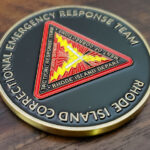
This coin was made for a Correctional Emergency Response Team within a state department of corrections.
The base metal is brass-colored. One face carries the unit insignia, the other carries crossed rifles and a commander’s rank insignia. The only colors used are black and the colors already present in the insignia, and there is no additional patterning anywhere on the piece.
The restraint is a decision rather than a shortfall. A coin for a team like this one is going to be carried, kept in a locker or a drawer, handed over without ceremony, and looked at by people who are not impressed by decoration. A clean brass base with the unit’s own device and nothing surplus is the version that survives that scrutiny. Adding texture, a patterned field or an extra accent color would have made it busier without making it better.
The same department appears on our page for another Rhode Island CERT coin, which is a separate project with a very different treatment, and the two are worth comparing if you are deciding how far to take a design.
Can We Use Our Department’s Insignia on a Coin?
Most departments can, but the authorization has to come from the department, not from us. Department emblems, facility devices, badge designs and unit insignia are controlled by the agencies that own them, and state department seals are often restricted by law.
The practical version is straightforward. Clear the artwork through your own chain of command before you order, and send us artwork your agency is authorized to supply. We produce from what the customer provides and we do not grant permission on anyone’s behalf. If you are unsure who signs off, your department’s administrative office is usually the right place to ask.
Design a Coin for Your Facility or Team
Professional artwork is free with unlimited revisions, and nothing goes into production until you approve a digital proof. Send a photograph of the patch or badge and a designer will work from it, including matching the colors already in your insignia if that is the approach you want.
The minimum order is 50 coins, which suits a single team, shift or academy class rather than a whole department. Standard production runs about 45 to 50 days after final artwork approval, rush production is available on many projects, and shipping within the continental United States is included. Embleholics is veteran-owned, SDVOSB and registered in SAM.gov. See more custom law enforcement challenge coins or request a free quote.
Frequently Asked Questions
What is a Correctional Emergency Response Team?
A Correctional Emergency Response Team, abbreviated CERT, is a specially trained unit operating within a department of corrections. Members are correctional officers who take on the role alongside their regular duties and train for it separately.
What is the difference between a correctional CERT and a community CERT?
They share an abbreviation and nothing else. A Correctional Emergency Response Team is a unit inside a prison system. A Community Emergency Response Team is a FEMA-affiliated volunteer programme training civilians in basic disaster response for their own neighbourhoods.
Do correctional officers get challenge coins?
Yes, though far less often than police and fire personnel. Corrections receives much less public recognition than other branches of law enforcement, which is precisely why a coin from a warden, a team or an academy tends to be kept rather than traded.
Who orders coins for a department of corrections?
Departments and individual facilities, specialist teams such as emergency response and transport units, training academies and graduating classes, wardens and superintendents for presentation, officer associations, and individuals marking a retirement after long service.
What goes on a corrections challenge coin?
A corrections coin usually carries the department or facility emblem, a unit device for specialist teams, a badge number or shield, years of service, and the department motto. Finishes tend toward dark bases, brass and antique tones rather than bright plating.
Can a coin use only the colors from our insignia?
Yes, and it is a good default. Taking every color from the existing insignia makes the coin read as part of the organization’s identity rather than as something designed for it, and it removes the most common source of disagreement when a design goes through approval.
Can we use our department’s insignia on a coin?
Department emblems, badge designs and unit insignia are controlled by the agencies that own them, and state seals are often restricted by law, so permission comes from your department rather than from a manufacturer. Clear the artwork through your chain of command before ordering.
What is the minimum order for corrections coins?
The minimum order for custom challenge coins is 50 coins. That suits a single team, shift or academy class rather than an entire department, and larger quantities reduce the cost per coin.
More Corporate Projects