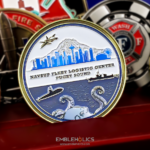
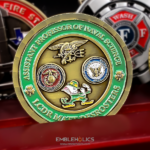
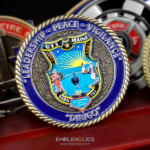
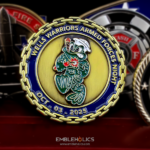
A change of command challenge coin marks the ceremony in which one officer formally relieves another. This one was made for the attack submarine USS Topeka (SSN 754) to commemorate a change of command held in 2021 at the USS Parche Memorial on Joint Base Pearl Harbor-Hickam. The coin is struck in a brass-colored metal with sculpted lettering and black paint on the front, and a colored submarine graphic on the reverse.
A change of command coin is dated the moment it is struck
Unlike a unit coin, a ceremony coin is not meant to outlive its occasion, and that changes how you order it. A standing unit coin can be reordered for years from the same die. A change of command coin records a single afternoon. Once the ceremony is over, the batch is finished, and whatever is left becomes a keepsake rather than working stock.
This has two practical consequences. The first is quantity: count the people who will actually be at the ceremony and in the receiving line, add a reasonable margin for the incoming and outgoing officers’ own distribution, and stop there. Overordering a ceremony coin produces a box nobody can use. The second is lead time. A change of command date is usually set well in advance, so there is rarely an excuse for a rush order, but the artwork often waits on the incoming officer’s details and that is what compresses the schedule. Start the design before the final wording is settled and leave the variable text for last.
What belongs on one, and what to think twice about
The ship, the date, and the ceremony are the safe core. Hull number, ship’s name, the date, and the words marking the change of command will all still make sense to someone holding the coin in twenty years.
Names are the decision point. Putting both officers’ names on the coin makes it unambiguously about that ceremony, and many commands do exactly that. It also means every recipient is carrying two individuals’ names, which some officers would rather avoid, and it rules out any reuse of the die. The alternative is to carry the offices rather than the people, so the coin reads as the change of command for that ship on that date without naming anyone. We have written separately about the same trade-off on a commanding officer’s coin, where naming the officer caps the coin’s life at one tour.
Keep the ceremony location in mind as a design element. The Topeka’s ceremony was held at the USS Parche Memorial, a submarine memorial at Pearl Harbor, which is the kind of detail that gives a ceremony coin a sense of place without adding names or dates to the artwork.
Designing for a submarine
A submarine is a hard shape to put on a coin, because it is long and almost featureless. A hull rendered at full length across a round coin ends up as a thin dark line. Three approaches work better.
- Angle the hull. Setting the boat on a diagonal with the bow toward the viewer gives the sail and the hull some depth and uses the coin’s full diameter.
- Color the boat, not the background. On this coin the submarine is the only colored element on its face, which is why it reads immediately against the metal. A colored sea behind a dark hull does the opposite.
- Lean on the hull number. For a submarine crew, SSN 754 does more identifying work than any silhouette. Sculpted numerals with a paint fill, as on this coin’s front, carry further than a drawing of the boat.
USS Topeka, and why the coin outlasted the boat
USS Topeka was a Los Angeles-class fast attack submarine, commissioned on 21 October 1989 and about 360 feet long. She served across the Indo-Pacific for more than three decades, homeported at Pearl Harbor, then San Diego, then Guam, and finally at Joint Base Pearl Harbor-Hickam from December 2020, which is where the 2021 change of command took place.
By the time she finished, Topeka was the oldest Los Angeles-class fast attack submarine in the Pacific Fleet. She arrived at Puget Sound Naval Shipyard in Bremerton, Washington, in December 2024 for inactivation, and was decommissioned there on 3 June 2026. The ceremony coin now outlasts the ship it was made for, which is true of most ceremony coins eventually and is a large part of why crews order them.
Bremerton is our own backyard. We are a veteran-owned shop in Port Orchard, across the water from Puget Sound Naval Shipyard, so a good number of the boats and crews we make coins for end their service a few miles from where the coins are designed.
Ordering a change of command coin
Bring the ship or unit crest, the ceremony date, and a decision on names. Those three things settle the layout. We will show you the full design before striking, including how the date and any names sit against the crest, and we can hold the variable text open until the last practical moment if the incoming officer’s details are still being confirmed. You can see more Navy challenge coins, including the Submarine Development Squadron 5 coin, or send your details through the free quote form.
Frequently Asked Questions
What is a change of command challenge coin?
A change of command challenge coin commemorates the ceremony in which one commanding officer formally relieves another. It typically carries the ship or unit, the date, and wording marking the change of command, and it is handed out at or after the ceremony. Unlike a standing unit coin, it is tied to a single event, so the batch is ordered for that occasion and not reordered afterwards.
How many change of command coins should we order?
Count the attendees and the receiving line, then add a margin for the incoming and outgoing officers to distribute themselves. Because the coin records one ceremony, leftovers cannot be issued later as unit coins, so overordering produces a box that nobody has a use for. It is one of the few cases where ordering tight is the right call.
Should both officers’ names go on the coin?
It depends on how the command feels about distributing individuals’ names. Naming both officers makes the coin unmistakably about that ceremony, and plenty of commands do it. Carrying the offices instead, so the coin reads as the change of command for that ship on that date, keeps names off every recipient’s coin and is the better choice if anyone involved would prefer not to be named.
How do you put a submarine on a round coin?
Angle the hull rather than running it straight across, so the sail and bow give the shape some depth and the full diameter gets used. Color the boat and leave the background as bare metal, which makes the hull read immediately instead of disappearing into a colored sea. For most crews the hull number does more identifying work than the silhouette does, so sculpted numerals with a paint fill are worth the space.
What was USS Topeka?
USS Topeka (SSN 754) was a Los Angeles-class nuclear-powered fast attack submarine, commissioned on 21 October 1989 and roughly 360 feet long. She served across the Indo-Pacific for more than thirty-five years, with homeports at Pearl Harbor, San Diego, Guam, and finally Joint Base Pearl Harbor-Hickam. She arrived at Puget Sound Naval Shipyard in Bremerton, Washington, in December 2024 for inactivation and was decommissioned on 3 June 2026.
How far ahead should we order a ceremony coin?
As soon as the ceremony date is set, which is usually months out. The schedule is rarely compressed by production; it gets compressed by waiting on the incoming officer’s details before starting the artwork. Begin the design with the ship’s crest and layout, and leave the variable wording as the last thing to drop in.
Can we reuse the die for a future change of command?
Only if the artwork avoids the specifics. A die carrying a date or officers’ names cannot be reused, which is normally accepted as part of what a ceremony coin is. If a command expects to mark every change of command and wants to keep costs down, a design that carries only the ship and the words marking the occasion can be reordered, with the date added by engraving rather than struck into the die.
More Navy Projects