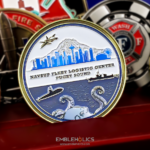
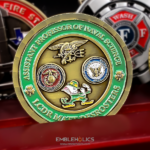
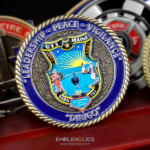
A commanding officer’s challenge coin is a coin issued in one officer’s name rather than in the unit’s name alone. This one was made for the commanding officer of Fleet Logistics Support Squadron Five Nine, the Navy reserve squadron known as the Lone Star Express, flying the C-40A Clipper out of Texas. The front carries the squadron emblem and the aircraft; the reverse carries the Navy commanding officer’s device with the officer’s title ringed around it in gold lettering on a blue field.
What a personal coin does that a unit coin cannot
A named coin makes the recognition specific. A unit coin says the squadron noticed. A commanding officer’s coin says the commanding officer noticed, and the recipient can point to whose hand it came from years later. That is the whole reason officers commission them. In a squadron where hundreds of unit coins are in circulation, a coin with the CO’s title on it is the one that gets kept on a desk rather than dropped in a drawer.
It also works as a formal calling card. Commanding officers hand these to visiting officers, to civilian partners, to foreign counterparts, and to the crews of other commands during exchanges. The coin travels as a credential, and the title on the reverse tells whoever receives it exactly who they met.
Naming the officer ties the coin to one tour
A personal coin has a shelf life, and the shelf life is the tour. This is the single most important thing to plan for. If the artwork carries a name, a signature, or dated tour information, the coin stops being usable the day the officer turns over command. Whatever is left in the box becomes a keepsake rather than a working stock of coins, and the relieving officer has to commission a new batch from scratch.
Three ways to handle that trade-off:
- Name it and order for the tour. Count the recognitions you expect to make over two or three years, add a margin, and accept that the batch ends with the tour. This gives the most personal coin and the clearest provenance.
- Use the title without the name. A reverse that reads only with the office and the unit stays correct through every change of command, so the next officer can reorder the same design. The coin is still visibly a CO’s coin without being tied to one person.
- Run two designs. A standing squadron coin for general distribution, and a smaller run of named coins for the recognitions the CO wants to put a name to. Most commands that do this order the unit coin in volume and the personal coin in a short run.
We work through this with officers before the artwork is finalized, because it is much cheaper to decide it at the design stage than to discover it when a relief is three months out.
Designing a reverse around the commanding officer’s device
A device at the center needs room to read. The Navy commanding officer’s device is a detailed emblem, and crowding it with a ring of lettering is where these designs most often go wrong. The lettering has to be set large enough to strike cleanly while leaving the device enough space to hold its own detail. On a coin this size, that usually means limiting the ring to the office and the unit, or the office and the name, but not all three plus a motto.
Gold against blue is doing real work here. The reverse uses a gold relief on a blue enamel field, which is the highest-contrast pairing available in a plated coin. The raised gold lettering and device read at arm’s length, and the recessed blue pushes them forward. A gold-on-gold reverse with no enamel would show the same artwork but would be far harder to read at a glance.
Squadron identity on the obverse
The front of the coin is where the squadron, not the officer, speaks. VR-59 flies the C-40A Clipper, a military variant of the Boeing 737-700C, on fleet logistics runs, and the aircraft is as much a part of the squadron’s identity as the emblem is. Putting the airframe and the emblem on the obverse keeps the squadron legible to anyone who receives the coin without knowing the unit designation, and it leaves the reverse free for the command device. Other fleet logistics commands have taken the same approach, including the NAVSUP Fleet Logistics Center coin.
Starting a commanding officer’s coin
Bring the squadron emblem, the device you want on the reverse, and your rotation date. The rotation date is the one most people leave out, and it decides the quantity and whether a name belongs on the artwork at all. From there we lay out both faces, show you how the lettering sits around the device, and adjust before anything is struck. You can see more Navy challenge coins we have produced, or send your artwork through the free quote form.
Frequently Asked Questions
What is a commanding officer’s challenge coin?
A commanding officer’s challenge coin is a coin issued in the name or office of the unit’s commanding officer rather than in the unit’s name alone. It usually carries the unit emblem on one face and the commanding officer’s device, title, and sometimes name on the other. Officers use them for personal recognition and as a formal calling card when meeting other commands.
Should my name go on the coin?
Only if you are comfortable with the batch ending when your tour does. A name fixes the coin to one person and one period, which is exactly what makes it meaningful, but it also means the remaining coins cannot be issued after a change of command. If you want a design the next officer can reorder, use the office and the unit on the reverse and leave the name off.
How many coins should a commanding officer order for a tour?
Estimate the recognitions you expect to make over the length of the tour and add a margin for visits and exchanges you cannot predict. Because a named coin cannot be passed on to your relief, the goal is to finish the tour with a small remainder rather than a large one. We can talk through quantities against your rotation date before you commit to a run.
What is VR-59?
VR-59 is Fleet Logistics Support Squadron Five Nine, a Navy reserve squadron nicknamed the Lone Star Express. It flies the C-40A Clipper, a military variant of the Boeing 737-700C, moving passengers and cargo for the fleet, and it belongs to the Fleet Logistics Support Wing.
Can you put an official Navy device on a coin?
Yes, and command devices are among the most common elements on officer coins. What matters at the design stage is scale: a detailed device needs enough clear space to strike properly, so the lettering around it has to be limited and sized carefully. We will show you the layout before striking and tell you if the ring of text is crowding the device.
Why gold and blue for a Navy coin?
Gold relief against blue enamel gives the strongest contrast available in a plated coin, which is why it is so common on Navy designs. The raised gold catches light and the recessed blue sits back, so lettering and emblems read clearly at arm’s length. An all-metal coin with no enamel shows the same artwork but relies entirely on relief, which is harder to read quickly.
Can the same design be reused by the next commanding officer?
Only if the artwork avoids anything specific to one person. A reverse that carries the office and the unit can be reordered indefinitely through successive changes of command. A reverse with a name, a signature, or tour dates has to be redrawn for each officer, which means new artwork and a new setup each time.
More Navy Projects