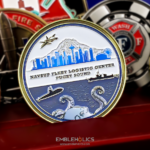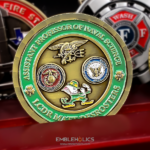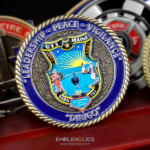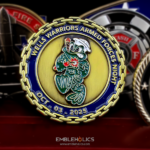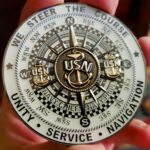
The CVN 70 Chief Petty Officer’s Mess wanted something prestigious and artistic for their personnel. The front is built on a navy compass. The reverse carries an engraved illustration of the ship in combat with a giant octopus.
What a Chiefs Mess Coin Is For
A CPO mess coin is a specific object inside a ship’s coin ecosystem, and it is different from the ship’s own coin.
The mess is a body, not a department. The chiefs aboard a ship form a mess with its own standards, its own traditions and its own authority. It is the senior enlisted leadership of the ship acting as a group, and a coin represents that group rather than a division or a rate.
It is presented, not issued. A mess coin is given deliberately by chiefs to recognize performance, which makes it a presentation piece rather than a membership token. That argues for something that feels like an object of consequence.
Which is why “prestigious” was the brief. It is the word that comes up most often on these, and it points the design toward restraint and craft rather than color and novelty. A mess coin that looks like merchandise undercuts the thing it is meant to convey.
And it is not tied to a deployment. The mess exists continuously, with members rotating through, so the coin should carry no dates and stay correct across several chief seasons. For the ship’s own coin, see our USS Carl Vinson Coin.
See also a submarine chiefs mess coin, a Navy chief challenge coin and a carrier challenge coin for the deployment-level piece.
A Compass as the Front Face
Building the front on a compass is a reliable choice for a round coin, and the reasons are geometric.
A compass rose is radially symmetrical, so it fills a circular face with no awkward gaps and no orientation to get wrong. Its points mark out natural positions around the rim, which gives the designer eight anchor points for supporting elements. And it converges on a center, so the design has a focus without anything having to be added.
It also means something useful on a senior enlisted coin. A compass reads as navigation, direction and judgment, which is the right register for a mess whose function is setting the ship’s standard. See a compass challenge coin for the same device as a whole design.
A Ship Fighting a Sea Monster
The reverse is the interesting half of this coin: the carrier in combat with a giant octopus, engraved.
That is a narrative image rather than a device, and narrative images are rare on military coins because they are harder to execute. Four things make this kind of artwork work.
It needs an action, not a scene. A ship and an octopus sitting near each other is a picture of two objects. The two engaged with each other is a story, and the engagement is what the eye reads first. Tentacles crossing the hull do more than either element alone.
Engraving suits it better than relief. A narrative image is a drawing, and recessed line work reads as a drawing. Sculpting a scene produces competing high points with nothing separating them, and the action gets lost in the topography.
Curved forms need a straight one. An octopus is all curves. The ship’s hull supplies the long horizontal line that organizes the composition, which is why the pairing works better than a sea monster alone would.
And it has to be legible as a silhouette. At coin size, detail inside each form disappears. What survives is the outline of the hull and the shape of the tentacles, so both have to be recognizable with no internal detail at all.
The wider point is worth making to any unit: a coin with something happening on it is more memorable than a coin with a crest on it. Sea monsters, mascots in action and local legends all give a mess something no insignia can.
About the Ship
USS Carl Vinson (CVN 70) is the third Nimitz-class nuclear-powered aircraft carrier, named for Congressman Carl Vinson of Georgia. Her keel was laid at Newport News Shipbuilding on 11 October 1975 and she was launched on 15 March 1980, with a design service life of 50 years.
Her deployments have included Operation Desert Strike, Operation Southern Watch, Operation Enduring Freedom and Operation Iraqi Freedom.
A ship with a fifty year service life is a good argument for an undated mess coin. The hull will outlast every chief currently aboard, and a design with no year on it can be reordered from the same die for decades. See more Navy challenge coins.
Order a Coin for Your Mess
Professional artwork is free with unlimited revisions, and nothing goes into production until you approve a digital proof. The challenge coin minimum is 50 pieces, standard production runs about 45 to 50 days after final artwork approval, rush production is available on many projects, and shipping within the continental United States is included. Embleholics is veteran-owned, SDVOSB and registered in SAM.gov.
Two suggestions. Leave the year off a mess coin, since the mess continues while its members rotate, and an undated design can be reordered from the same die for years. And if you want narrative artwork rather than a crest, say so at the start and send us the idea however rough it is; a scene is a different artwork approach from an insignia layout and it is the kind of coin people actually keep. Request a free quote to begin.
Frequently Asked Questions
What is a chiefs mess challenge coin?
It is a coin belonging to a ship’s Chief Petty Officer’s Mess, the senior enlisted leadership acting as a body. It is presented deliberately to recognize performance rather than issued to everyone, which makes it a presentation piece.
How is a mess coin different from a ship’s coin?
A ship’s coin represents the hull and everybody aboard. A mess coin represents the chiefs as a group, with their own standards and traditions, and it is given by them rather than issued by the command.
Should a mess coin carry a date?
No. The mess continues while its members rotate through, so an undated design stays correct across several chief seasons and can be reordered from the same die for years.
Why does a compass suit a round coin?
Because a compass rose is radially symmetrical, so it fills a circle with no awkward gaps and no orientation to get wrong. Its points also give the designer natural anchor positions around the rim and a built-in center.
Can a scene or story go on a challenge coin?
Yes, and it is more memorable than a crest. The key is that something has to be happening: two objects near each other is a picture, while two objects engaged with each other is a story, and the engagement is what the eye reads first.
Should narrative artwork be engraved or sculpted?
Engraved. A narrative image is a drawing, and recessed line work reads as one. Sculpting a scene produces competing high points with nothing separating them, and the action gets lost in the topography.
How do you keep a busy scene legible?
Design it to read as silhouettes. At coin size the detail inside each form disappears, so every element has to be recognizable from its outline alone. A composition of curves also needs at least one strong straight line to organize it.
Is unusual artwork appropriate on a senior enlisted coin?
It can be, provided the execution is serious. A mess coin needs to feel like an object of consequence, which comes from craft and restraint in the finish rather than from the subject being conventional.
More Navy Projects