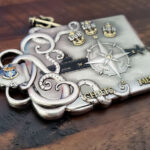
This is one of the most structurally ambitious coins we have made. The Chief’s Mess that ordered it asked for an octopus holding a trident, crawling over a bottle with a submarine inside it, and that is exactly what was produced: an organic sculpted body wrapped around a rectangular bottle, with insignia and submarine detail worked in at small scale. It is a useful example of what a custom outline can do, and of where the limits are.
What the Chief’s Mess is
Chief petty officers aboard a ship, squadron or command are organized into a mess: the space where they eat, meet and hold their own counsel. The word describes the group as much as the room. The Chief’s Mess carries weight throughout the Navy, and the institution matters to people at every rank, which is why its coins are among the most carefully specified we receive.
On a submarine the mess is a smaller and closer organization than on a surface ship, which shows in the coins. Boat messes tend to order more unusual designs, in smaller quantities, with more inside reference, because the audience is a few dozen people who all know each other. This coin is a good illustration: an octopus with a trident guarding a boat in a bottle is not a design anyone would propose for general distribution.
Combining an organic shape with a geometric one
The design problem here is that an octopus and a bottle are opposites. One is all curves, taper and irregular limbs. The other is straight lines and hard corners. Putting them in one silhouette is harder than either alone, because the eye reads the clean geometry as the reference and judges the organic form against it.
Three things make a combination like this work:
- Let one form dominate the outline. The octopus owns the silhouette and the bottle sits within it. If both had pushed to the edge, the coin would have read as two objects stuck together rather than one piece.
- Use limbs to connect, not to protrude. Tentacles that wrap across the bottle tie the two forms into a single shape. Tentacles reaching outward would be thin unsupported projections, which is how shaped coins get damaged.
- Keep the fine detail inboard. The submarine inside the bottle is the smallest element on the coin and it sits in the most protected part of it. Detail near a cut edge is detail at risk.
The limits of a custom outline
A shaped coin can do almost anything, but thin projections are where designs fail. Narrow limbs, spread wings, antennae, flag tips and points all share the same problem: they catch on things, they bend, and they are the first part to show damage. The fix is rarely to abandon the idea, and almost always to redraw the outline so that the extremities are either thickened slightly or folded back into the body.
Complexity also costs usable area. An irregular shape gives you less flat surface than a circle of the same width, so lettering and insignia need planning rather than placement. On a coin like this one, there is no rim to run text around, which means every inscription has to find a flat passage within the sculpture.
And it costs tooling. A custom profile needs a die cut to that outline, quoted separately from a round coin, with irregular shapes at the higher end of that range. For a mess of a few dozen people this is a real proportion of the order, which is worth knowing at the quote stage rather than at the end.
Submarine imagery that is not a submarine
A boat in a bottle is a better submarine coin than a drawing of a submarine. A hull rendered across a coin face is a long dark shape with few features. Putting it inside a bottle changes it from a vehicle into an object, gives it a frame, and adds a second idea on top of the first. The trident does similar work, carrying the strategic deterrent association without spelling anything out.
This is the general principle worth taking from the coin: the strongest unit coins usually show something adjacent to the subject rather than the subject itself. A literal depiction tells people what they already know. An oblique one gives them something to look at twice.
Ordering a mess coin
Bring the idea even if it sounds impractical. Most unusual shapes are achievable with adjustments our art team can make at the drawing stage, and the ones that genuinely cannot be done are better identified by us than ruled out by you. Tell us roughly how many people are in the mess, because quantity determines how the tooling cost lands on a custom outline. We will show you the profile and both faces before anything is cut. You can see more Navy challenge coins, including the Old Salts Chief’s Mess coin and the Boatswain’s Mate Chief coin, or send your idea through the free quote form.
Frequently Asked Questions
What is the Chief’s Mess?
The Chief’s Mess is the organization of chief petty officers aboard a ship, squadron or command, and also the space where they eat, meet and hold their own counsel. The word describes the group as much as the room. It is one of the most significant institutions in the Navy, which is why its coins tend to be specified with unusual care.
Can a challenge coin be shaped like an animal or an object?
Yes. A die can be cut to almost any outline, and organic shapes such as an octopus are well within what is possible. The practical limits are thin projections, which catch and bend, and usable flat area, which shrinks as the outline gets more irregular. Both are design problems to solve at the drawing stage rather than reasons to abandon an idea.
How do you combine an organic shape with a geometric one?
Let one form own the silhouette and place the other inside it, rather than having both push to the edge. Use connecting elements, such as tentacles wrapping a bottle, to tie the forms into a single shape instead of two objects joined together. Keep the smallest details in the most protected part of the coin, away from the cut edge.
Do complex shapes cost more?
Yes, because a custom profile requires a die cut to that outline, quoted separately from a standard round coin, and irregular shapes sit at the higher end of that range. For a small mess ordering a few dozen coins, the tooling is a meaningful share of the total, so it is worth establishing at the quote stage.
Where does lettering go on a shaped coin with no rim?
Into whatever flat passages exist within the sculpture, which has to be planned rather than placed afterwards. A round coin gives you a rim to run text around; an irregular shape does not, and it also offers less flat area overall. Decide what text is essential before the outline is finalized.
Is a drawing of a submarine the best way to show one on a coin?
Usually not. A hull rendered across a coin face is a long, featureless dark shape. Framing it, as with a boat in a bottle, turns it into an object with a setting and gives the design a second idea. Oblique imagery generally makes a stronger unit coin than a literal depiction, which only tells people what they already know.
How many coins does a submarine Chief’s Mess usually order?
Far fewer than a surface command, often a few dozen, because a boat’s mess is a small and closely knit group. That smaller run is also why boat messes tend to commission the more inventive designs: the audience all know each other, so the coin can carry inside reference that would not work for general distribution.
More Navy Chief Challenge Coins Projects