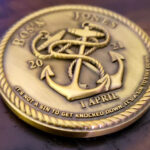
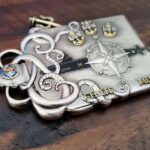
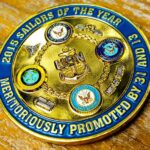
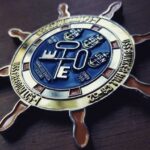
A Navy rating Chief coin is built around a Chief Petty Officer’s rating badge and warfare qualifications rather than a command emblem. It marks who someone is rather than where they are stationed, which is why the rating badge is usually the largest element on the face.
What Is a Navy Rating?
The Navy uses two words that sound interchangeable and are not, and it catches out almost everyone outside the service, including family members buying a coin.
A rank is how senior someone is. A rating is what they do. A Chief Petty Officer is a rank. Logistics Specialist is a rating. Put them together and you get the rate: Logistics Specialist Chief, written LSC, or LSCS at senior chief.
Each rating has its own rating badge, a small specialty mark worn above the chevrons, and every rating’s mark is different. The Boatswain’s Mate has crossed anchors. The Hospital Corpsman has a caduceus. The Logistics Specialist carries the crossed keys inherited from the Storekeeper rating.
There are roughly ninety enlisted ratings in the Navy, and sailors identify with theirs strongly. A Chief will tell you their rating before they tell you their command, because the command changes every few years and the rating usually does not.
That is why rating badges do so much work on a Chief’s coin, and why a Logistics Specialist Chief coin and a Boatswain’s Mate Chief coin should not look alike.
What Is a Logistics Specialist?
The Logistics Specialist (LS) is a U.S. Navy enlisted rating created on October 1, 2009 through the merger of the Storekeeper (SK) and Postal Clerk (PC) ratings. Logistics Specialists play an important role in maintaining the Navy’s supply system.
Their responsibilities can include purchasing and procurement, shipping and receiving, inventory management, and the distribution of equipment, repair parts, tools, consumable items, hazardous materials, and other supplies used throughout the Navy.
Why Rating Matters on a Chief’s Coin
A Chief’s coin has a small surface and a lot of competing claims on it, and how those get prioritised tells you what the coin is actually about.
Commands change. A Chief will serve at several ships and shore commands across a career, and a coin built around any one of them dates the moment they transfer. The rating does not change. Neither do the warfare qualifications, once earned, or the anchors.
So a Chief’s personal coin is usually built inward rather than outward: the rating badge at the centre, the anchors and the warfare pins around it, and the command placed as context rather than as the subject. A command coin says where someone serves. A rating coin says who they are.
The usual elements, in rough order of how much space they get:
- The rating badge. Almost always central, and almost always the element the customer cares most about getting right.
- The Chief’s anchors. The fouled anchor with USN, the mark of the Mess itself.
- Warfare qualifications. Surface warfare and air warfare pins, the SW and AW in LSCS (SW/AW). These are earned and worn, and Chiefs want them shown.
- Command and ship. Usually the reverse, and usually smaller than a command-focused coin would make it.
- Years of service or a date. On personal coins, frequently a retirement or pinning date.
Getting that hierarchy right is most of the design work. A coin that gives the command the centre and the rating a corner has been built the wrong way round for this buyer.
A Navy Logistics Specialist Chief Challenge Coin
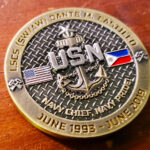
We were asked to design and produce this custom Navy Logistics Specialist Chief challenge coin for an LSCS (SW/AW).
The concept wasn’t intended to be extravagant. Instead, the goal was to create an elegant and distinguished Navy Chief coin that reflected his service and rating. That meant paying close attention to the placement of each design element, the lettering, metal finish, patterns, and use of color.
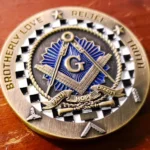
Rather than relying heavily on enamel, we kept the colors to a minimum so the metalwork itself could help create depth throughout the design. Different tones across the brushed metal surface allow individual elements to stand apart while maintaining a consistent appearance.
We also incorporated strong textures, including diamond plate and checkered patterns. These details give the coin additional contrast and character without taking attention away from the Navy and Logistics Specialist symbolism at the center of the design.
Working with minimal color is harder than working with enamel, not cheaper. Enamel separates elements for you: a red field beside a blue one needs no further explanation. Take that away and the separation has to come from tone and texture alone, which means every finish transition has to be deliberate and every one of them has to survive striking. There is no colour to cover a boundary that does not quite work.
Designing Custom Navy Chief Coins
Some of the strongest Navy Chief challenge coins don’t require complicated shapes or dozens of colors. Metal finishes, textures, raised and recessed details, warfare qualifications, rating symbols, and carefully positioned lettering can create a distinctive design while maintaining a traditional military appearance.
For a Logistics Specialist Chief coin, the design can also incorporate elements connected to the Supply Corps, command, ship, warfare qualifications, Chief Petty Officer heritage, or the individual receiving the coin.
Explore more of our custom Navy challenge coins to see additional designs we’ve created for Navy Chiefs, sailors, commands, and units, including Chief’s Mess coins and Navy Supply Corps coins.
Finished Coin (Front)
Finished Coin (Back)
When Do Chiefs Order Coins?
Chief coin orders run on a calendar rather than at random, and the calendar is the Navy’s.
- Selection and pinning season. CPO selection results come out on an annual cycle, followed by induction and then pinning. That period generates more Chief coin orders than the rest of the year combined, and the dates are known in advance.
- The end of induction. A season that ends with a new group of Chiefs who have been through something together, which is exactly the shape that produces a coin.
- Transfers. A Chief leaving a command often takes coins with them or leaves them behind, depending on which way the tradition runs at that command.
- Retirements. Usually the most personal coin a Chief will ever order, and frequently ordered by someone else on their behalf.
- Coins to hand out. Once a Chief has their own coin they give it away, which is the whole point. A personal coin is not a keepsake, it is a thing you carry so you have something to hand someone who earned it.
If you are ordering around pinning season, order early. Everyone else is working to the same dates.
Design a Coin for Your Rating or Mess
If you’re planning a Navy Chief coin for a promotion, retirement, Chief’s Mess, command, or individual recognition, Embleholics can help develop the artwork and turn your ideas into a finished design.
Free professional artwork, free shipping, 50 coin minimum, rush production available.
Request a free quote to get started on your custom Navy challenge coins.
Frequently Asked Questions
What is a Navy rating?
A rating is a sailor’s occupational specialty, such as Logistics Specialist or Boatswain’s Mate. Each rating has its own badge worn on the uniform, and there are roughly ninety enlisted ratings in the Navy.
What is the difference between a rating and a rank?
A rank is how senior someone is; a rating is what they do. Chief Petty Officer is a rank, Logistics Specialist is a rating, and combining them gives the rate, written as LSC or LSCS.
What is a Logistics Specialist in the Navy?
The Logistics Specialist rating was created on 1 October 2009 by merging the Storekeeper and Postal Clerk ratings. Logistics Specialists handle procurement, shipping and receiving, inventory and distribution across the Navy’s supply system.
What goes on a Navy Chief challenge coin?
The rating badge, the Chief’s fouled anchors, warfare qualification pins, command or ship, and years of service or a significant date. On a personal coin the rating badge usually takes the centre.
Can a rating badge and warfare qualifications go on the same coin?
Yes, and most Chief coins carry both. The rating badge usually sits central with warfare pins arranged around it, since both are earned and both are things a Chief wants shown.
Do coins have to use enamel colour?
No. Metal tones, textures, and raised and recessed detail can carry a design without enamel. Working this way is more demanding than using colour, because every separation between elements has to come from finish rather than fill.
When do Chiefs usually order coins?
Most orders cluster around CPO selection results, induction and pinning, which fall on a predictable annual cycle. Transfers and retirements account for most of the rest. Order early around pinning season.
What is the minimum order?
The minimum order on coins is 50. Artwork with unlimited revisions is free, shipping within the continental United States is included, and rush production is available.
More Navy Chief Challenge Coins Projects