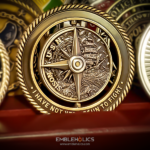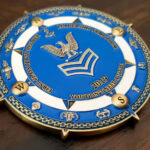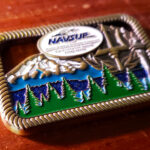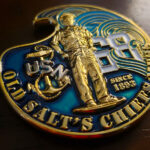
A Chiefs Mess challenge coin is bought by the chief petty officers of a command rather than by the command itself. The chiefs choose the design, pay for it out of their own pockets or their association’s funds, and present it on their own authority. It looks like a unit coin on a shelf and works nothing like one.
What a Chiefs Mess Actually Is
The chief petty officers aboard a ship or at a command form a body with its own space, its own standards and its own responsibility for the enlisted crew. That body is the Chiefs Mess. The traditional nickname for its quarters is the goat locker, usually explained by the goats kept aboard sailing ships in the chiefs’ berthing, which is a long-standing account rather than a documented origin.
The Mess is the deckplate leadership of a command. It is where a first class petty officer learns what will be expected of them, where a new chief is brought in, and where problems get solved before they reach the wardroom. Its members hold the same rank structure as everyone else in the Navy, and they also hold something that is not written down anywhere.
That is why a coin from the Mess carries different weight than a coin from the command. One comes from the officer who signs the awards. The other comes from the people who run the deckplates.
For the broader rank material, see Navy chief coins, and for the same institution in a different service, see a Coast Guard cutter’s Chiefs Mess coin.
Why a Mess Buys Its Own Coin
It is funded by its members. A unit coin comes out of a command fund or a commanding officer’s pocket. A Mess coin comes out of the chiefs’ own money, usually through their association, which is why the quantity is set by the size of the Mess and how often they present rather than by a crew headcount.
The design is decided by a group. Twenty people with opinions produce more revisions than one officer does. The practical fix is to nominate one chief to approve the proof before artwork starts, and to agree a figure per coin before anyone sees a design. Mess orders that stall almost always stall for one of those two reasons.
It carries both the unit and the rating. A chief’s identity sits in both, which is why Mess coins tend to divide the two faces rather than crowd one.
It outlasts everyone in it. The Mess continues after each member rotates out, so a design tied to one year’s roster or one commanding officer dates immediately. A good Mess coin is one the Mess is still happy to reorder in five years.
Cutting a Wave Into the Edge
The most unusual thing about this coin is not on either face. It is in the rim. A section of the edge has been cut and shaped into a wave, so the outline breaks out of a plain circle in one place and nowhere else.
That is a third kind of shape work and it is worth separating from the other two. A cutout removes metal from inside the coin. A custom shape changes the whole outline. A partial edge cut changes one section of the rim and leaves the rest alone.
What it gives you. The coin still reads as a round coin, still stacks, still sits flat, and still has a rim protecting the artwork across most of its circumference. But it has one feature that makes it identifiable in a pocket by touch, which no amount of artwork can do.
What it costs you. The cut section has no rim, so anything near it is exposed and will pick up wear first. The cut has to be deep enough to be noticed and shallow enough not to leave a thin span of metal behind it. And it breaks the coin’s symmetry, which means the coin now has a right way up and the artwork has to be set to match.
A wave is a well-judged choice for this treatment. It is made entirely of curves, so it reads as a deliberate shape rather than as damage, and it means the sea runs from the artwork on the face out into the metal of the rim. For shape work that changes the whole outline instead, see custom shaped challenge coins.
Gold on One Face, Silver on the Other
The front carries the Chief in gold relief, with the edge, the rim and the inscriptions in gold as well. The reverse carries the ship sculpted in silver. No paint anywhere.
Two platings separate two faces without a drop of color. Plate one face gold and the other silver and each side gets its own character, so turning the coin over feels like arriving somewhere rather than seeing the same object again. Paint would do it too, and paint sits in the recesses of fine engraving and softens it, which is the last thing a relief portrait and a sculpted hull need.
The one thing to get right when the faces are plated differently is weight. A dense gold face against a sparse silver one reads as a finished side and an unfinished side. Match the amount of work on each face, not the content. This coin does: a figure against waves on one side, a ship inside a ring of stars on the other.
See plating options for what each metal does, and antique and polished finishes for how the surface changes how relief reads.
Old Salt, the Nimitz and the Five Stars
Old Salt has two meanings here and both are in use. The general sense is an experienced sailor. In the Navy it is also the nickname of USS Nimitz, CVN 68, the lead ship of her class, commissioned in May 1975.
The five stars around the ship on the reverse are not decoration. The ship is named for Fleet Admiral Chester W. Nimitz, who held five-star rank, and the stars carry that rather than standing in for anything general. It is the kind of detail that only means something to the people receiving the coin, which is exactly what a Mess coin should carry.
For another project for the same ship, see this USS Nimitz coin.
Order a Coin for Your Mess
Free professional artwork, unlimited revisions and a digital proof before anything is produced. Free shipping within the continental US, a 50-coin minimum, and most orders complete 45 to 50 days after artwork approval, with rush production available. Embleholics is veteran-owned, an SDVOSB, and registered in SAM.gov.
One thing worth telling us when you ask for a quote: who in the Mess approves the proof. Group orders move quickly when one person has that job and slowly when nobody does.
See more Navy challenge coins.
Frequently Asked Questions
What is a Chiefs Mess challenge coin?
A Chiefs Mess challenge coin is a coin made by and for the chief petty officers of a command rather than by the command itself. The chiefs choose the design, fund it through their own association, and present it on their own authority, which makes it a different object from a unit or command coin.
How is a Mess coin different from a command coin?
A command coin is issued to everyone and paid for by the command, while a Mess coin is bought by the chiefs and given only to the people they choose. The difference changes the quantity, the funding, the approval route and the design, because a Mess coin has to represent a body rather than a whole crew.
What is the goat locker?
The goat locker is the traditional nickname for the chief petty officers’ quarters and, by extension, for the Chiefs Mess itself. The usual explanation is that goats kept aboard sailing ships were berthed in the chiefs’ quarters, which is a long-standing account rather than a documented origin.
Can part of a coin’s edge be cut into a shape?
Yes. A section of the rim can be cut and shaped while the rest of the coin stays round, which is different from a cutout through the body or a fully custom outline. It keeps the rim and the round format across most of the coin while giving it one feature you can find by touch.
Does cutting the edge weaken a challenge coin?
It can if the cut is too deep, because the span of metal left behind the cut becomes the thinnest part of the coin. The cut is kept shallow enough to leave solid metal behind it, and artwork is kept away from the cut section, since an edge with no rim takes wear first.
Can one side of a coin be gold and the other silver?
Yes, and it is a good way to give each face its own character without using any paint. The two platings separate the faces by metal rather than by color, which suits fine engraving and relief because paint tends to fill the recesses and soften the detail.
Why is USS Nimitz called Old Salt?
Old Salt is the ship’s nickname, alongside the general meaning of the term, which is an experienced sailor. USS Nimitz, CVN 68, is the lead ship of her class and was commissioned in May 1975.
Why are there five stars on the coin?
The five stars stand for the five-star rank held by Fleet Admiral Chester W. Nimitz, for whom the ship is named. They are a specific reference rather than a general decorative element, which is typical of coins made within a Mess for its own members.
How many coins does a Chiefs Mess usually order?
Most Mess orders start at the 50-coin minimum, because the quantity is set by the size of the Mess and how often it presents rather than by the size of the crew. Messes that present regularly tend to reorder the same design rather than order a larger run at once.
More Navy Officer Challenge Coins Projects