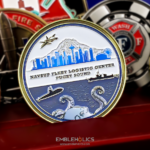
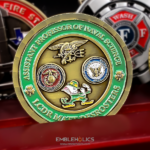
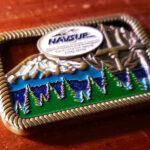
This coin was commissioned by Naval Supply Systems Command and the Navy Supply Corps and is presented by the Commanding Officer. It is built on a brass colored base with a brushed finish, with graphical detail across both faces and a small engraved insignia and lettering that had to stay legible at that size.
What a Commander’s Coin Has to Do
A coin presented personally by a commanding officer is a different object from a unit coin everybody gets, and the design has to account for that.
It is given one at a time, for a reason. A commander’s coin marks something: a job done well, a problem solved, a deployment finished. The recipient will remember the handshake, which means the coin needs to feel like an object worth that moment rather than merchandise.
That argues for restraint rather than decoration. The coins that read as serious are generally the ones with a quiet finish, a well placed device and little else. Bright multicolor enamel reads as commemorative; brushed metal with careful detail reads as a presentation piece.
It also has to represent the command, not the occasion. Because it is given for many different reasons over several years, a commander’s coin cannot be tied to a single event or date. The design has to still be correct for whatever the next presentation turns out to be.
And it is handled immediately. Unlike a coin that goes into a case, this one is examined in the hand within seconds of being received, so the quality of the surface and the crispness of the lettering are noticed. That is the argument for spending the budget on finish rather than on color count.
Brushed Brass as a Presentation Finish
A brass colored base with a brushed finish is one of the most reliable combinations for a formal piece, and it is worth knowing why.
Brass reads as traditional. A warm metal tone carries weight that a bright silver or a high polish does not. It looks like something that has been around rather than something newly manufactured, which is the correct impression for an institution.
A brushed surface is more forgiving than a mirror polish. A polished coin shows every fingerprint and every handling mark, and it will pick both up within minutes of being handed over. A brushed surface absorbs them, and it ages gracefully rather than looking scuffed.
It also kills glare. Fine engraved detail on a polished surface disappears under reflected light at certain angles. A brushed finish scatters the light instead, so the detail stays readable however the coin is held.
See plating and finish options for the alternatives.
Small Lettering and Patterned Faces
Both faces of this coin carry graphical detail across the background rather than sitting on a flat field, and the insignia and lettering on the front are small.
Those two decisions are related. A patterned background fills the face, which means the device on top of it does not have to be large to look like it belongs. On a plain field, a small device looks lost and tends to get scaled up to compensate, which is how coins end up with an oversized insignia and no breathing room.
The constraint is legibility, and it is the thing to watch on any coin with small lettering over a textured ground. Three rules keep it under control. The pattern has to be shallower than the lettering, so the two sit at clearly different depths. The area immediately around the text should be left plainer than the rest, which gives the type somewhere to sit. And the typeface needs enough stroke weight, because striking softens every edge slightly and type that looked right on screen often reads thin in metal.
Done properly, the result is a coin that looks detailed from a distance and stays readable up close. Done carelessly, the background eats the text. It is the single most common failure on this kind of design, and the proof stage is where you catch it, looked at coin size rather than enlarged.
About NAVSUP and the Supply Corps
Naval Supply Systems Command and the Navy Supply Corps share a mission to generate readiness and sustain naval forces worldwide. NAVSUP is headquartered in Mechanicsburg, Pennsylvania, and employs more than 22,500 military and civilian personnel.
A logistics organization is an interesting coin client, because its work is largely invisible when it is going well. A command coin is one of the few ways to acknowledge people whose success is measured by the absence of problems, which is probably why presentation coins are taken so seriously in that community.
See also a Supply Corps challenge coin and a classic Navy officer challenge coin.
Order a Command or Presentation Coin
Professional artwork is free with unlimited revisions, and nothing goes into production until you approve a digital proof. The challenge coin minimum is 50 pieces, standard production runs about 45 to 50 days after final artwork approval, rush production is available on many projects, and shipping within the continental United States is included. Embleholics is veteran-owned, SDVOSB and registered in SAM.gov.
Two things worth deciding early. If the coin is a commander’s presentation piece rather than a unit coin, say so, because it changes the design approach from the start: quieter finish, no event-specific content, more budget on surface and less on color. And order enough to outlast a tour, since a presentation coin issued over two or three years at a steady rate runs out faster than people expect. Request a free quote to begin.
Coin Front
Coin Back

Frequently Asked Questions
What is a Navy officer challenge coin?
It is a coin presented by an officer, usually a commanding officer, to recognize individual performance. It differs from a unit coin in that it is given one at a time for a specific reason rather than issued to everybody.
How is a commander’s coin different from a unit coin?
A commander’s coin marks an individual achievement and is handed over personally, so it needs to feel like a presentation object. It also has to work for many different occasions over several years, which means no dates or event-specific content.
What finish suits a formal presentation coin?
Brushed brass or another warm metal tone. It reads as traditional rather than newly manufactured, it hides fingerprints and handling marks where a mirror polish shows them, and it scatters light so engraved detail stays readable at any angle.
Why not use a mirror polish?
Because a polished coin picks up fingerprints and handling marks within minutes of being handed over, and reflected light hides fine engraved detail at certain angles. A brushed surface avoids both and ages better.
Can a coin have a patterned background on both faces?
Yes, and it helps. A patterned field fills the face, so the main device does not have to be oversized to look like it belongs. On a plain field a small device looks lost and usually gets scaled up to compensate.
How do you keep small text readable over a pattern?
Keep the pattern shallower than the lettering so the two sit at different depths, leave the area immediately around the text plainer than the rest, and increase the typeface weight. Striking softens edges, so type that looks right on screen often reads thin in metal.
Should a presentation coin have a date on it?
No, if it will be issued over a whole tour. A commander’s coin is given for many different reasons across several years, so anything tied to a single event or date dates the coin and limits when it can be used.
How many presentation coins should a command order?
More than feels necessary. A coin issued at a steady rate over a two or three year tour runs out faster than people expect, and reordering means another artwork cycle and another production lead time.
More Navy Projects