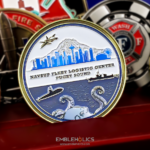
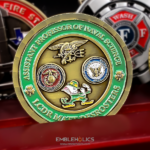
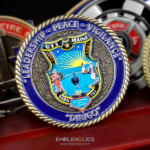
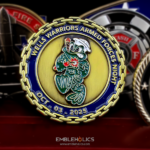
The defining custom of the challenge coin is the way it changes hands: palmed, pressed into the other person’s hand during a handshake, often without a word. That act is also a design constraint, and it is the one most coins are drawn without thinking about. This one was made for a US Navy officer who asked for something classic with a different touch, unpainted, so the finish had to carry it: a rope-pattern rim, naval insignia in raised relief, a circular opening through the field, and a compass with a quote on the front.
The handshake pass
The coin sits flat in the palm of the giving hand, held in place by the fingers, and is transferred during an ordinary handshake. The recipient feels it arrive and closes their hand around it. Nothing is announced, and usually nothing is said about it until afterwards.
Why it is done this way. It keeps the moment private in a room full of people, it removes any ceremony the recipient might find awkward, and it puts the coin directly into a hand rather than onto a table. For a senior officer recognizing someone quietly, it is the whole point.
A few conventions worth knowing:
- The giver initiates the handshake. The recipient does not reach for the coin or look at it mid-shake.
- Look at it afterwards, not during. Examining the coin while still shaking hands is the common mistake.
- Thank the person, not the coin. A short acknowledgement is right; a long one makes the exchange into the ceremony it was designed to avoid.
- Do not pass it on casually. A coin received this way is generally kept. Trading is its own separate custom.
The coin check is a different tradition entirely, with its own rules about who challenges whom and who buys. We cover that separately in our guide to challenge coin rules.
What the handshake asks of the design
A coin that will be passed this way has to be comfortable in a closed palm, and several common design choices work against that.
- Size. Too large and it cannot be concealed in the hand or transferred cleanly. Too small and it does not register as it arrives. A standard diameter exists partly because it is what a palm handles well.
- Weight. This is the one that matters most. The recipient’s first impression is tactile, not visual, and a coin with real weight registers as substantial before anyone has looked at it. Thickness is worth paying for on a presentation coin.
- Edges and points. Anything sharp is felt immediately and badly. Shaped coins with points, spread wings or thin extremities are poor handshake coins no matter how good they look photographed.
- Relief height. Very high relief on both faces makes a coin awkward to hold flat against the palm. One pronounced face and one calmer one handles better.
If a coin is primarily for this kind of presentation, say so when ordering. It changes the specification toward weight, a conventional outline and a smooth edge, and away from the features that make a coin photograph well on a shelf.
Carrying a design with no color at all
Taking paint off the table makes every other decision load-bearing. This coin uses four things in place of color, and they are the standard toolkit for an unpainted design.
A rope rim gives the design a boundary and a naval association, and stops a plain field looking unfinished. Raised relief at varying heights creates the light and shadow that color would otherwise provide. A circular opening through the field introduces a visual event that costs die work rather than consumables. And polishing is what makes the whole thing read: on an unpainted coin the finish is not a final step but the mechanism by which the design becomes visible.
A compass is a good central device for this treatment. It is geometric, symmetrical, cuts cleanly, and carries meaning without needing explanation. Devices built from line and geometry suit unpainted coins; devices that depend on color to distinguish their parts do not.
Quotes on coins
A quote is the most commonly requested element and the most commonly regretted one. Text takes a great deal of room, has to be large enough to read in the hand, and competes with whatever else is on that face.
Three things make a quote work: keep it short enough to set at a readable size, give it a face or a clear panel of its own rather than fitting it around artwork, and choose something that will still sound right in ten years. A line of naval tradition generally ages better than anything topical.
Ordering a presentation coin
Tell us how the coin will be given. A coin handed over in a handshake, a coin presented in a case at a ceremony and a coin handed out at an event are three different specifications, and only the first is constrained by what a palm can hold. If you want an unpainted design, say so early, because the relief, rim and finish have to be planned together rather than decided at the end. You can see more Navy challenge coins we have produced, including the Navy Captain coin, or send your details through the free quote form.
Finished Coin (Front)
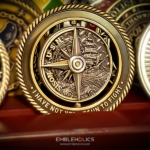
With its bold compass and powerful quote, this side pays tribute to naval tradition and forward resolve.
Finished Coin (Back)

Frequently Asked Questions
How do you present a challenge coin?
Palmed in a handshake. The coin sits flat in the giver’s palm, held by the fingers, and transfers during an ordinary handshake, with the recipient closing their hand around it. It is usually done without announcement, which keeps the moment private and avoids making a ceremony of it.
What is the etiquette for receiving a challenge coin?
Let the giver initiate the handshake, do not reach for the coin or inspect it mid-shake, and look at it afterwards rather than during. A short thank you is right; a lengthy one turns the exchange into the ceremony it was meant to avoid. A coin received this way is generally kept rather than passed on.
How does the handshake affect the coin’s design?
It constrains size, weight, edges and relief. The coin has to be concealable in a palm and transfer cleanly, so a standard diameter works best. Weight is the single most important element, since the first impression is tactile. Sharp edges and thin extremities are felt immediately and badly, and very high relief on both faces makes a coin awkward to hold flat.
Is the handshake the same as a coin check?
No, they are separate traditions. The handshake is how a coin is presented; the coin check is the game of challenging others to produce theirs, with its own conventions about who challenges and who buys. A coin can be involved in both but the customs are unrelated.
How do you design a coin with no paint at all?
By making the rim, the relief, the shape and the finish do the work. A rope or patterned rim gives the design a boundary, varying relief heights create the light and shadow that color would otherwise supply, a cutout or opening introduces a visual event at die cost rather than per-coin cost, and the polishing is what makes all of it visible. On an unpainted coin the finish is not a final step, it is the mechanism.
What imagery suits an unpainted coin?
Devices built from line and geometry. A compass, an anchor, a crest, crossed tools and architectural forms all cut cleanly and read through shadow alone. Devices that rely on color to distinguish their parts, such as a multi-colored heraldic shield or a landscape, lose most of their meaning without enamel.
Should a quote go on a challenge coin?
Only if it earns its space. Text takes a lot of room and has to be large enough to read in the hand, so keep it short, give it its own face or a clear panel rather than squeezing it around artwork, and pick something that will still sound right in a decade. A line of established tradition ages better than anything topical.
More Navy Projects