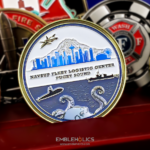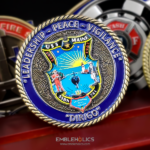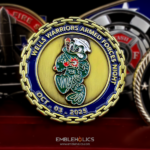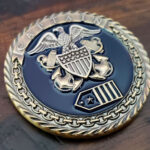
A Navy Captain is a senior officer at pay grade O-6, and that single fact decides what a coin for one should be. It marks a rank that takes most of a career to reach, so the coin was asked to be classic, elegant and heavily sculpted: the Navy’s device of twin anchors with a shield and eagle engraved on one side, and a warship with submarines sculpted in high relief on the other.
What Rank a Navy Captain Holds
This is worth stating precisely, because it is the most commonly confused rank comparison between the sea services and the land services.
- A Navy Captain is pay grade O-6. In the Army, Marine Corps, Air Force and Space Force, the equivalent rank is Colonel.
- It sits above Commander and below Rear Admiral (lower half).
- It is not equivalent to a Major. A Major is O-4, two pay grades lower, and the Navy equivalent of a Major is a Lieutenant Commander.
- An Army or Marine Corps captain is something else entirely. That rank is O-3, three pay grades below a Navy Captain. The shared word is the reason this comparison trips people up more than any other.
There is a second use of the word that is separate from rank. Every commanding officer of a commissioned US Navy warship or submarine is addressed as captain regardless of their actual rank, as a matter of naval tradition. So a Commander in command of a destroyer is the captain of that ship without holding the rank of Captain. If a coin is being made for someone, it is worth knowing which of the two you are marking, because the insignia differs.
For the Marine Corps rank of the same name, see the USMC Captain challenge coin.
A Coin for Reaching a Rank
A coin marking a promotion behaves differently from a unit coin, an award coin or a retirement coin, and the difference is useful.
A promotion is permanent and specific. That means the rank insignia is the correct content, which is not true of most coins. On an award coin, putting a specific badge level on the design excludes everyone who has not reached it. On a promotion coin, the whole point is the step that has just been taken, so the insignia is the subject rather than a complication.
It also sets the quantity. A promotion coin is for the people at the ceremony and the people who got the officer there, which is a small number. That matters because a short run is where it makes sense to spend more per coin on sculpting, weight and finish rather than less.
Unlike a unit coin, it is not trying to serve anyone else. It is for one person and one occasion, so it can be as specific as you like.
Heavily Sculpted Means High Relief
When a client asks for heavily sculpted graphics, what they are asking for is high relief, and it is worth knowing what that involves.
Relief is the difference in height between the highest and lowest points on a coin’s face. High relief means more of it, which is achieved by cutting deeper into the die and striking with greater pressure, sometimes with more than one strike.
What it buys you is shadow. A shallow coin looks much the same from every angle. A deeply sculpted one changes completely as it tilts in the hand, because the high points cast real shadows across the low ones. It also allows overlapping planes, so a ship can genuinely sit in front of water that sits in front of sky, rather than all three being drawn at the same level.
What it costs is thickness, weight, tooling and time. The metal displaced upward has to come from somewhere, so a high relief coin needs thicker stock. Thicker stock means a heavier coin, deeper dies cost more to cut, and higher pressure with multiple strikes slows production.
That weight is not a side effect worth apologizing for. A heavy, deeply sculpted coin reads as significant the moment it is handed over, which is exactly what you want from an object marking a career step. On a coin for one person at one ceremony, the extra cost per piece is spread across a small run and buys the thing most of its effect.
Two design rules come with it. High relief needs a subject that genuinely has depth, such as a ship, a figure, an animal or a landscape, because a flat heraldic device or a logo gains nothing from being pushed up off the surface. And it needs room, so a high relief coin usually carries fewer elements than a shallow one of the same diameter.
Engraved on One Side, Sculpted on the Other
This coin uses two different techniques on its two faces, and the reason is the dimensionality of each subject.
The Navy device of twin anchors, shield and eagle is flat artwork. It is a heraldic composition designed to be read as a two-dimensional emblem, so engraving it keeps it crisp and correct. Push it into deep relief and you have to invent depth the design never had, which makes it look like a plastic moulding of an emblem rather than the emblem itself.
A warship and submarines are three-dimensional objects. Engraving them flattens them into line drawings and loses the one thing that makes them impressive at coin size, which is bulk. They want sculpting.
The rule generalizes cleanly. Match the technique to what the subject actually is. Flat things, such as emblems, seals, flags, lettering and heraldry, are engraved. Solid things, such as ships, aircraft, vehicles, animals, figures and terrain, are sculpted. Coins that look wrong in a way people cannot name have usually got this the wrong way round.
Order a Coin for a Promotion
Tell us the rank and whether the coin is for a promotion, a change of command or a retirement, because each one wants a different emphasis. If you want heavy sculpting, say so early, since it affects the thickness, the weight and the tooling.
Professional artwork is free with unlimited revisions, the minimum order is 50 coins, and nothing goes into production until you approve a digital proof. Standard production runs about 45 to 50 days after final artwork approval, rush production is available on many projects, and shipping within the continental United States is included. Embleholics is veteran-owned, SDVOSB and registered in SAM.gov. See a classic Navy officer coin, a Navy Mustang coin, or more Navy challenge coins.
Frequently Asked Questions
Is a Navy Captain the same rank as a Colonel?
Yes. A Navy Captain is pay grade O-6, and the equivalent rank in the Army, Marine Corps, Air Force and Space Force is Colonel. It sits above Commander and below Rear Admiral (lower half).
Is a Navy Captain equivalent to a Major?
No. A Major is pay grade O-4, two grades below a Navy Captain, and the Navy equivalent of a Major is a Lieutenant Commander. A Navy Captain is equivalent to a Colonel.
Is an Army captain the same as a Navy Captain?
No, and this is the most confused rank comparison between the services. An Army or Marine Corps captain is pay grade O-3, three grades below a Navy Captain at O-6. The two ranks share a word and almost nothing else.
Why is a ship’s commanding officer called captain?
By naval tradition, every commanding officer of a commissioned US Navy warship or submarine is addressed as captain regardless of their actual rank. So an officer holding the rank of Commander can be the captain of a ship without being a Captain, which is worth clarifying before a coin is made for someone.
What is a promotion challenge coin?
A promotion challenge coin marks reaching a rank rather than completing a tour or earning an award. Because a promotion is permanent and specific, the rank insignia is appropriate content, which is not the case on award coins where a specific badge or level excludes everyone who has not reached it. The run is usually small, covering the ceremony.
What is high relief on a challenge coin?
High relief means a greater difference in height between the highest and lowest points of the design, produced by cutting deeper dies and striking at higher pressure, sometimes with multiple strikes. It gives the coin real shadow, so it changes as it tilts in the hand, and it allows elements to overlap in genuine depth.
Does high relief make a coin thicker and heavier?
Yes. The metal raised above the surface has to come from somewhere, so a high relief coin needs thicker stock and ends up heavier. Deeper dies also cost more to cut and higher striking pressure slows production. On a small run for a ceremony, that weight and presence is usually the reason to do it.
Which subjects suit high relief and which do not?
Subjects that genuinely have depth suit it: ships, aircraft, vehicles, animals, figures and terrain. Flat subjects do not, including emblems, seals, flags, heraldry and lettering, because pushing a two-dimensional device into deep relief means inventing depth it never had. Engrave the flat things and sculpt the solid ones.
More Navy Projects