A retirement challenge coin is made for one person. It carries their name, their rank and the span of a career rather than the identity of an organization, which makes it the only kind of coin where a name belongs on the face and where a single misspelled character cannot be fixed.
What Is a Retirement Challenge Coin?
Almost every coin on this site belongs to a group. A unit, a department, a post, a chapter, a class. A retirement coin belongs to an individual, and that one difference changes everything about how it is designed and ordered.
It is a biography compressed onto two faces. Where a unit coin says what an organization is, a retirement coin says what one person did for twenty or thirty years, which is a much harder brief and a much more personal one.
The same approach covers several related occasions: a promotion, a departing commander’s own coin, a career milestone, an award presented to one person, and a coin marking a civilian’s retirement after a long service. Coins made to remember someone who has died are a different thing again, handled on our page about memorial and remembrance coins.
Ordering Fifty Coins for One Person
This is the question everybody arrives with, so here it is first: the minimum order for custom challenge coins is 50 coins, and one person is retiring.
In practice this is much less of an obstacle than it sounds, because a retirement coin almost never goes to only the retiree.
A retirement ceremony has an audience. There are colleagues who served with the person across several assignments, a chain of command, guests from other organizations, and family. The coin is routinely handed to all of them, which is the point: it is the retiree’s coin, given out by the retiree or on their behalf, and the people receiving it are being thanked for having been part of that career. A fifty-coin order covers the ceremony, the immediate unit, the family, and a reserve for people who are missed on the day and ask afterwards.
The retiree usually keeps a handful and gives the rest away over the following years, which is its own good reason not to order the bare minimum.
If fifty is genuinely more than the situation needs, three things work:
- Let the unit or the mess fund it. A wardroom, a chief’s mess, a staff section or a squadron fund is the usual source, and the coin then belongs to the occasion rather than to one person’s wallet.
- Combine with another retirement in the same period, with a shared design and each name on its own run.
- Design it for the office rather than the person, so the same artwork serves the next retirement with only the name changed.
More on why the figure exists at all is on our page about why coins have a minimum order.
What Goes on an Individual’s Coin?
The name, in the form the person actually uses rather than the form on their records.
The rank, rendered correctly and in the right abbreviation for the service.
Years of service, usually as a span rather than a total.
The service or branch insignia.
Units served with, if there is room and if the person wants them.
A motto or a line chosen by the person or by the unit sending them off.
Now the part that matters more on this coin than on any other. Spelling and rank form are permanent.
A die is cut from approved artwork, and a name struck into metal cannot be corrected. A misspelled surname, a missing middle initial, a hyphen in the wrong place, a rank abbreviated the way the Army does it on a Marine’s coin — every one of those is a finished order that has to be thrown away or handed over anyway.
So send the wording exactly as it should appear, character for character, and check the proof against what you sent rather than against what you remember sending. Read the name aloud letter by letter. It is the least enjoyable five minutes of the process and it is the only part that cannot be undone.
Why a Name Needs a Quiet Background
This coin does something subtle and worth copying. The front carries a patterned background behind the insignia. The reverse, which carries the name, is plain black.
That is the right way round, and the reason is legibility. A patterned field competes with lettering in a way it does not compete with a device. An engraved insignia has mass and a strong outline, so it holds its own against texture behind it. A line of fine lettering does not. Put a flag pattern, a sunburst or a textured field behind a name and the name becomes something you have to work to read, which on a retirement coin is close to an insult.
There is a second reason, less obvious. A busy background behind a name reads as cheap. Not because texture is cheap, but because the eye interprets crowding as an attempt to fill space, and on an object commemorating thirty years of somebody’s life, restraint signals the opposite.
So the useful rule for any coin carrying a name: decorate the face with the device, and leave the face with the name alone.
About This Marine Corps Captain Coin
This coin was commissioned to be presented to a retiring Marine Corps captain.
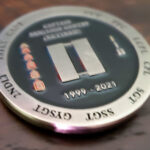
The front carries the USMC insignia engraved over an American flag pattern background. The reverse carries the captain’s rank insignia and the retiree’s name on a plain black field. Lettering encircles both faces.
The brief asked for something formal with nothing surplus on it, and that was the correct call rather than a missed opportunity. A coin marking the end of a career is going into a shadow box, a display case or a desk drawer, and it will be looked at occasionally for decades by people who already know what it means. It does not need a custom shape, a cutout or a novelty feature to earn its place, and any of those would date it.
What the design does need is to get the two faces’ jobs right, and it does: the service on one side, the individual on the other, with the quiet field reserved for the name.
For coins built around a rank rather than a person, see our officer rank coins. For a departing commander’s own coin, which is a related but different occasion, see our page on change of command coins.
Can We Use Service Insignia on a Retirement Coin?
Most organizations can, but the authorization has to come from the service or the unit rather than from us. Service emblems, rank devices, unit insignia and qualification badges are controlled by the organizations that own them.
In practice a retirement coin is usually ordered by the unit, which means the approval route is the same as for any unit coin. Where a family member or a group of colleagues is ordering privately, the unit is still the right place to ask about using its insignia.
Clear the artwork through the appropriate chain of command before you order, and send us artwork your organization is authorized to supply. We produce from what the customer provides and we do not grant permission on anyone’s behalf.
Design a Retirement Coin
Send three things: the name exactly as it should appear, the rank and its correct abbreviation, and the date of the ceremony.
Work back from that date. Standard production runs about 45 to 50 days after final artwork approval, with artwork development before that, so allow three months where you can. Professional artwork is free with unlimited revisions, and nothing goes into production until you approve a digital proof, which on this coin means checking a name character by character. The minimum order is 50 coins, rush production is available on many projects, and shipping within the continental United States is included. Embleholics is veteran-owned, SDVOSB and registered in SAM.gov. See more custom Marine Corps challenge coins or request a free quote.
Finished Coin (Front)
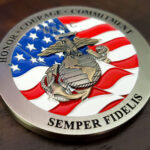
Finished Coin (Back)
Frequently Asked Questions
What is a retirement challenge coin?
A retirement challenge coin is made for one person rather than for an organization. It carries their name, rank and years of service, and it is presented at the retirement ceremony and usually given out to the colleagues, guests and family who attend.
Can a name be engraved on a challenge coin?
Yes, and a retirement coin is the one kind where a name belongs on the face. Send the wording exactly as it should appear and check it on the digital proof character by character, because a name struck into a die cannot be corrected afterwards.
Do I have to order 50 coins for one retirement?
The 50-coin minimum applies, but a retirement coin is rarely given only to the retiree. It is normally handed to colleagues, the chain of command, guests and family at the ceremony, with a reserve for people who ask later, which a fifty-coin order covers comfortably.
Who usually pays for a retirement coin?
Most often the unit, a wardroom, a chief’s mess, a staff section or a squadron fund. Colleagues sometimes organize one between them, and occasionally a family member orders it. The funding source does not change the design, but it does decide who the coins are distributed to.
What goes on a coin for an individual?
The name in the form the person actually uses, the rank correctly abbreviated for their service, years of service as a span, the branch insignia, and sometimes units served with or a chosen motto. Keep the face carrying the name free of background pattern.
Can years of service be included?
Yes, and a span such as the first and last year of service is the usual form rather than a total. It reads better than a number and it places the career in time, which is what somebody looking at the coin in twenty years will want to know.
Can we use service insignia on a coin?
Service emblems, rank devices and unit insignia are controlled by the organizations that own them, so permission comes from the service or unit rather than from a manufacturer. Where colleagues or family are ordering privately, the unit is still the right place to ask.
What is the minimum order for retirement coins?
The minimum order for custom challenge coins is 50 coins. For a retirement that typically covers the ceremony, the immediate unit, the family and a reserve, and the retiree usually gives coins away over the following years, so the minimum is rarely wasted.
More Marine Corps Projects