A change of command challenge coin is made when someone takes a post, rather than for the unit itself. It marks the handover, it is given at the ceremony, and it usually becomes the coin that person hands out for the rest of their tour.
What Is a Change of Command Coin?
The command already has a coin. This is a different object, and it exists because someone new is taking the job.
That distinction runs through the whole design. A unit coin says what the organization is, and it stays the same across years and personnel. A change of command coin says that a particular post has changed hands at a particular moment, and it belongs to whoever holds that post.
The occasion covers more than the formal change of command ceremony:
- Change of command, when a commanding officer relieves another
- Change of charge and assumption of responsibility, the equivalents in other services and at other levels
- Chief of the Boat and Command Master Chief turnovers, where the senior enlisted leader changes
- First sergeant and sergeant major changes, the Army and Marine Corps equivalents
- Relief and retirement of the outgoing holder, which is often marked at the same ceremony
- Coins struck for the new leader to hand out during their tour, which is frequently the main use
That last one is worth pausing on, because it is where most of the coins actually go. The ceremony accounts for a handful. The rest are given out over two or three years, one at a time, by a leader recognizing something. The coin is a tool of the job as much as a memento of the day.
Why These Coins Are Ordered in Advance
Changes of command are scheduled months ahead. That makes them almost unique among coin orders, because the deadline is known long before the coin is needed and there is real time to get the design right rather than rushing it.
It also means the order recurs. Posts turn over every two to three years, so a command that orders a change of command coin once will order another one, and the one after that. It is one of the few genuinely predictable reorder cycles in this business, alongside elected sheriffs and association officer terms.
The design has to serve two audiences at the same time, and this is the constraint that shapes it.
At the ceremony, the coin goes to visiting officers, senior officials, family members and representatives from other commands. These are outsiders, and for them the coin has to be formal, legible and clearly identified. This is the presentation problem, covered on our page about presentation and protocol coins.
Afterwards, it goes to the crew, one at a time, over the length of a tour. For them it is a recognition coin from their own leader, and something too stiff and diplomatic will not carry that weight.
So these coins sit between the two conventions. More formal than a unit coin, more personal than a pure presentation piece. Getting that balance is most of the design job.
What Goes on a Change of Command Coin?
The command or ship, usually with the hull number or unit designation, because it anchors the coin to a place.
The role itself. Commanding Officer, Chief of the Boat, Command Master Chief, First Sergeant. On these coins the post is the subject.
The dates of the tour, or the date of the ceremony.
Rank and warfare insignia, particularly for senior enlisted leaders, where the qualification badges are a substantial part of the identity.
A motto, either the command’s or one the incoming leader chooses.
The leader’s own device, if they have one. Some senior leaders carry a personal mark across postings.
What usually does not go on: the individual’s name. This surprises people, and the reasoning is sound. The coin outlives the tour. It stays in drawers and shadow boxes for decades, gets handed on, and turns up in collections long after everyone involved has moved. A coin naming the post is still legible in twenty years. A coin naming the person is a coin about someone the holder may not remember. Naming the post also means the artwork can be reused at the next turnover with only the dates changed, which is a real saving on a recurring order.
Why a Badge Shape Suits a Leadership Coin
A round coin is a disc. A shield or badge outline is an object with a specific set of associations: rank, office, authority, the thing pinned to a uniform. For a coin marking someone taking a position, that association is doing part of the work the words would otherwise have to do.
It is one of the clearest cases in the gallery of a shape carrying meaning rather than just being different. The same design struck round would say the same words and mean slightly less.
There are practical consequences worth knowing before committing to it.
A badge outline is wider at the top than the bottom, usually tapering to a point. That is a harder space to fill than a circle, because the usable area shrinks as you go down and any centred element has to be positioned by eye rather than geometrically.
Lettering has to follow a non-circular edge. Text curved around a disc is straightforward. Text following a shield’s shoulder and taper has to be set by hand, and it is the part most likely to look wrong if rushed.
Corners and points take the wear, the same trade-off as any shaped coin.
For more on shaping a coin to a crest or badge outline, see our page on coins cut to a crest or badge shape.
About This Chief of the Boat Coin
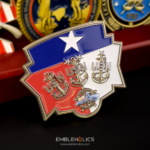
The Chief of the Boat is the senior enlisted sailor aboard a submarine, serving as the senior enlisted advisor to the commanding officer and the link between the wardroom and the crew. It is one of the most significant enlisted positions in the Navy, and this coin was made to mark a new Chief of the Boat taking the role aboard the USS Texas, SSN-775.
The coin is not round. It is shaped as a shield or badge, with a Navy anchor emblem embossed as the central device, and the graphic elements and lettering handled the way they would be on a Navy badge rather than on a medallion. Fine lettering runs across both faces and stays readable at size.
The choice of a badge shape for this particular post is well judged. A Chief of the Boat’s authority is not conferred by the boat, it is conferred by the anchors, and a badge-shaped coin carrying an anchor says that without needing a sentence to explain it.
For coins belonging to the Chief’s Mess rather than to the post, see our page on Chief’s Mess coins, and for the wider submarine force, submarine squadron coins.
Can We Use Navy Insignia on a Coin?
Most commands can, but the authorization has to come from the command, not from us. Ship crests, command insignia, rank devices, warfare badges and service marks are controlled by the organizations that own them, and the rules differ between branches and between commands.
The practical version is straightforward. Clear the artwork through your own chain of command before you order, and send us artwork your organization is authorized to supply. We produce from what the customer provides and we do not grant permission on anyone’s behalf. If you are unsure who signs off, your command’s public affairs office is usually the right place to ask.
Design a Change of Command Coin
Work backwards from the ceremony date. Standard production runs about 45 to 50 days after final artwork approval, and the clock starts at approval rather than at the first email, so the artwork stage is what has to start early. Rush production is available on many projects, but a change of command date is known months ahead and there is rarely a good reason to need it.
Professional artwork is free with unlimited revisions, and nothing goes into production until you approve a digital proof. The minimum order is 50 coins, shipping within the continental United States is included, and Embleholics is veteran-owned, SDVOSB and registered in SAM.gov. Browse more custom Navy challenge coins or request a free quote to get started.
Artwork
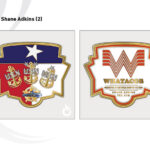
USS Texas Chief of the Boat Challenge Coin Artwork
Frequently Asked Questions
What is a change of command challenge coin?
A change of command challenge coin is made when someone takes a post, rather than for the unit as a whole. It is presented at the handover ceremony and then given out by the new leader during their tour, which is where most of the coins from an order end up.
What is a Chief of the Boat?
The Chief of the Boat is the senior enlisted sailor aboard a submarine. The role serves as senior enlisted advisor to the commanding officer and as the link between the officers and the crew.
Who orders change of command coins?
Change of command coins are usually ordered by the incoming leader or by the command’s administrative staff on their behalf, and sometimes by the outgoing holder as a handover gesture. Because turnover is scheduled, the order is often placed several months before the ceremony.
Should a change of command coin include the person’s name?
Most do not. The coin outlives the tour and ends up in drawers, shadow boxes and collections long afterwards, so naming the post rather than the person keeps it legible. It also means the artwork can be reused at the next turnover with only the dates changed.
Can a coin be made in the shape of a badge or shield?
Yes. A badge or shield outline is a common custom shape and it suits leadership coins, because the shape itself carries associations of rank and office. A tapered outline is harder to lay out than a circle, and lettering has to follow a non-circular edge.
How far ahead should a coin be ordered for a ceremony?
Allow at least three months before the ceremony. Standard production runs about 45 to 50 days from final artwork approval, and artwork development and revisions happen before that window opens. Changes of command are scheduled well in advance, so there is usually no need to rush.
Can we use Navy insignia on a coin?
Ship crests, command insignia, rank devices and warfare badges are controlled by the organizations that own them, so permission has to come from your command rather than from a manufacturer. Clear the artwork through your chain of command and supply artwork your organization is authorized to provide.
What is the minimum order for change of command coins?
The minimum order for custom challenge coins is 50 coins. For a change of command that usually covers ceremony guests plus a supply for the incoming leader to give out across a two or three year tour, and larger quantities reduce the cost per coin.
More Navy Projects