The brief was something resembling a compass, with a lot of small ornaments and details that read as Navy. The result is matte brass throughout, with the United States flag as the only element painted in color, set on a blue base with a white circle as an accent. It was made as a commemorative piece for a Leadership Symposium in Seattle for First Class Petty Officers.
Why a Compass Fits a Round Coin
Of all the devices you can put on a circular face, a compass rose is the one that fits best, and the reason is geometric rather than aesthetic.
It is radially symmetrical. A compass rose has points distributed evenly around a center, which means it fills a circle completely with no awkward gaps and no orientation to get wrong. Most devices are designed for a rectangle and have to be fitted into a round face; a compass was already round.
The points give you natural anchor positions. North, south, east and west mark out four positions around the rim, and the diagonals mark four more. That is eight places to put small elements, each one balanced against its opposite. A designer working on a plain circle has to invent that structure.
It has a built-in center. Every compass rose converges on a point, which gives the design a focus without anything having to be added.
And it carries meaning without explanation. A compass reads as navigation, direction and leadership in any context, which suits a coin for a leadership event without needing a motto to say so.
That last point is why this works for a petty officer symposium rather than only for a navigation rating. See also a navigation challenge coin for the same theme in a different form.
Many Small Details Without Clutter
The client asked for a lot of small ornaments. That request usually produces a crowded coin, and the compass structure is what prevented it here.
The mechanism is worth understanding. When a design has an underlying geometric framework, small elements placed on that framework read as a system rather than as clutter. Eight ornaments arranged symmetrically around a compass rose look deliberate. The same eight ornaments scattered on a plain field look like a coin that could not decide.
Three rules keep dense detail under control:
Place elements on the structure, not between it. If the design has axes, use them. Anything placed off-axis immediately looks like a mistake on a symmetrical coin.
Pair everything. On a radially symmetrical design each element should have a counterpart opposite it. Odd numbers of elements break the symmetry and are what makes a busy coin feel unbalanced.
And leave one ring empty. A design with concentric zones needs at least one that carries nothing. It reads as breathing room rather than as wasted space.
Matte Brass With One Painted Element
Everything on this coin except the flag is unpainted and finished in matte brass, which is a strong choice for a dense design.
A monochrome finish keeps a detailed coin readable. Add color to a design with many small elements and each color boundary becomes another edge competing for attention. In a single metal tone the only thing distinguishing elements is their relief, so the eye reads form rather than color and a dense design stays legible.
Matte rather than polished, for the same reason. A polished surface reflects light unevenly across fine detail and washes parts of it out at certain angles. A matte finish scatters light, so every ornament reads the same way wherever the coin is held. On a coin with this much small detail, that is the difference between a design that works and one that only works under a lamp.
And a single painted element becomes the focal point. The flag is the only color on the coin, so it draws the eye immediately. Painting two or three elements would have halved that effect; painting everything would have lost it entirely.
See finish and plating options and antique vs polished finishes.
Coins for a Leadership Event
A First Class Petty Officer is the third of the Navy’s petty officer grades and a non-commissioned officer, ranking sixth among the enlisted rates, above Petty Officer Second Class and below Chief Petty Officer. PO1s frequently serve as the Leading Petty Officer of a division, and that leadership experience is a significant factor in selection for Chief.
A symposium for that group is a well judged occasion for a coin, for three reasons.
The attendees come from different commands. They share a rate rather than a unit, so a coin is one of the few objects that can represent what they have in common.
It marks a stage rather than an achievement. These are people on the way to Chief, and a coin from the symposium becomes a marker of where they were at that point in a career.
And attendance is known in advance. An event with a registration list makes the quantity decision straightforward, which is rarely true of a unit coin.
See also a master chief petty officer coin and more Navy challenge coins.
Order a Coin for Your Event or Rate
Professional artwork is free with unlimited revisions, and nothing goes into production until you approve a digital proof. The challenge coin minimum is 50 pieces, standard production runs about 45 to 50 days after final artwork approval, rush production is available on many projects, and shipping within the continental United States is included. Embleholics is veteran-owned, SDVOSB and registered in SAM.gov.
Two suggestions. If you want a lot of detail on the coin, ask for a design with an underlying geometric structure to hang it on, because detail placed on a framework reads as a system where the same detail scattered reads as clutter. And on a dense design, choose a matte finish over a polish, since reflected light washes out fine relief at certain angles. Request a free quote to begin.
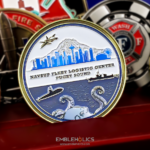
Finished Coin (Front)
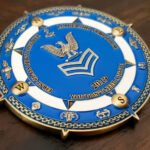
Finished Coin (Back)

Frequently Asked Questions
What is a compass challenge coin?
It is a coin built around a compass rose, either for a navigation specialty or as a general symbol of direction and leadership. It is one of the best-fitting devices for a round coin because a compass rose is already circular.
Why does a compass suit a round coin so well?
Because it is radially symmetrical, so it fills a circle with no awkward gaps and no orientation to get wrong. It also provides eight natural anchor positions around the rim and a built-in center point for the design to converge on.
Can a coin carry a lot of small details?
Yes, if there is an underlying structure to place them on. Small elements arranged on a geometric framework read as a system, where the same elements scattered on a plain field read as clutter.
How do you keep a detailed coin from looking cluttered?
Place elements on the design’s axes rather than between them, pair every element with a counterpart opposite it, and leave at least one concentric ring carrying nothing. The empty ring reads as breathing room rather than wasted space.
Should a detailed coin be painted?
Usually not, or only sparingly. Each color boundary on a dense design is another edge competing for attention. In a single metal tone the only thing distinguishing elements is their relief, so the eye reads form and the design stays legible.
Is matte or polished better for fine detail?
Matte. A polished surface reflects light unevenly across fine relief and washes parts of it out at certain angles, while a matte finish scatters light so every element reads the same way however the coin is held.
Why paint only one element?
Because it becomes the focal point. A single area of color on an otherwise monochrome coin draws the eye immediately. Painting two or three elements halves that effect and painting everything removes it.
Are coins a good fit for a conference or symposium?
Yes. Attendees usually come from different commands and share a rate rather than a unit, so a coin represents what they have in common, and a registration list makes the quantity decision straightforward.
More Navy Projects