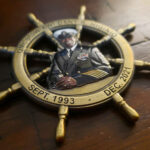
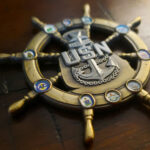
This coin is sculpted as a ship’s helm, with the spokes and handles of a wooden steering wheel taken from the real thing, and an illustration of the officer with the United States Navy insignia at the center. It was made for a Navy Quartermaster Chief.
Why the Helm Suits This Rating
Quartermasters in the Navy are navigation specialists. They operate and maintain the ship’s navigation equipment and report to the ship’s Navigator, normally a junior officer. A ship’s wheel is therefore not decoration on this coin, it is the job.
That matters more than it sounds. A great many unit coins carry imagery chosen because it looks naval: anchors, eagles, ropes. A device that describes what the recipient actually does is a different and better object, and people in the rating can tell the difference immediately.
The lesson generalizes. Before reaching for a service-wide symbol, ask what the specific rating, specialty or trade uses in its daily work. A helm, a sextant, a chart, a compass rose, a lead line: each of those says navigation where an anchor only says Navy. A maintenance force made the same choice with tools; see our Navy SurgeMain Challenge Coin.
One correction worth making, because the two are frequently confused: Navy quartermasters handle navigation, while Army quartermasters handle supply and distribution. The rating names are the same and the work is not, which is exactly the kind of detail to get right on a coin going to somebody in the rating.
Building a Wheel in Metal
A ship’s helm is a demanding shape for a specific structural reason: it is mostly holes.
A wheel is a hub, a rim, spokes between them, and handles projecting outward. The gaps between the spokes are what make it read as a wheel, and gaps are where a metal object becomes fragile.
Three ways the problem gets solved:
Cut the gaps through. The most striking option, with real openings between the spokes. It needs the spokes and rim thickened beyond their true proportions to stay rigid, which is a compromise on accuracy for the sake of durability.
Recess the gaps instead. Keep a solid backing and cut the areas between the spokes deeply so they read as shadow. Far sturdier, and at arm’s length almost indistinguishable from true openings. This is usually the right answer.
Or keep the wheel as a border. Let the rim, spokes and handles form a frame around a solid center, which is what this coin does with the officer’s illustration and the Navy insignia in the middle. The handles then project from the outline and give the piece its silhouette.
Whichever route, the handles are the fragile part, because they are projections. Rounding their tips and keeping them short relative to the rim is the standard precaution. See custom shaped challenge coins.
A Portrait at the Center
The middle of this coin carries an illustration of the officer, which is an unusual choice and a good use of a framed center.
Two notes if you want the same. A likeness has to be drawn from a clear photograph rather than described, and the conversion from photo to engraved line work is a drawing decision rather than a mechanical one, so a well lit image taken from the side or three quarters on gives a far better result than a casual snapshot.
And a portrait wants a plain surround. Set inside a busy pattern it disappears; set inside a frame that is itself the design, as the helm is here, it reads clearly because the frame is doing the decorative work and the center is left alone.
Coins for a Chief Petty Officer
A QMC is a Chief Petty Officer in the quartermaster rating, a non-commissioned officer reporting to a commanding officer. Making Chief is the milestone of an enlisted Navy career, and it is one of the most consistent reasons individual coins get ordered.
It is an individual achievement, not a unit event. Which means the coin can be about one person in a way a unit coin cannot.
It is usually ordered by others. The mess, the division or a group of colleagues typically arranges it rather than the person being recognized, which spreads the cost and keeps it a surprise.
And a rating device is the natural subject. The specialty insignia is what distinguishes one Chief from another, and it is the element the recipient has spent a career earning.
See also a Navy Chief challenge coin, a logistics specialist chief coin and a compass challenge coin.
Order a Coin for a Rating or Specialty
Professional artwork is free with unlimited revisions, and nothing goes into production until you approve a digital proof. The challenge coin minimum is 50 pieces, standard production runs about 45 to 50 days after final artwork approval, rush production is available on many projects, and shipping within the continental United States is included. Embleholics is veteran-owned, SDVOSB and registered in SAM.gov.
Two suggestions. Tell us the rating or specialty rather than just the service, because the equipment that specialty uses is almost always a better coin subject than a service-wide symbol. And if the design includes a shape with projections, like a wheel’s handles, expect those to be slightly shortened and rounded in artwork; it is the difference between a coin that survives a pocket and one that does not. Request a free quote to begin.
Finished Coin (Front)
Finished Coin (Back)
Frequently Asked Questions
What is a navigation challenge coin?
It is a coin built around navigation imagery, such as a ship’s helm, a compass rose, a sextant or a chart, usually made for a navigation rating or a ship’s navigation department rather than for a whole command.
What does a Navy quartermaster do?
Navy quartermasters are navigation specialists. They operate and maintain the ship’s navigation equipment and report to the ship’s Navigator. This differs from Army quartermasters, who handle supply and distribution, and the two are frequently confused.
Can a coin be shaped like a ship’s wheel?
Yes, and it is one of the better naval shapes because it is instantly recognizable. The design question is how to handle the gaps between the spokes, since those gaps are what make it read as a wheel and also where metal becomes fragile.
Should the gaps in a wheel be cut through?
Usually not. Recessing them deeply enough to read as shadow is far sturdier and almost indistinguishable at arm’s length. Cutting through is more striking but requires thickening the spokes and rim beyond their true proportions.
Are the handles on a helm shaped coin fragile?
They are the most vulnerable part, because they project beyond the outline. Rounding the tips and keeping them short relative to the rim is standard practice and is normally done during the artwork stage.
Can a person’s likeness go on a challenge coin?
Yes. Send a clear, well lit photograph taken from the side or three quarters on, since the engraving is drawn from it and that conversion into line and shadow is a drawing decision rather than a mechanical one.
Where should a portrait sit on a coin?
In a plain center with the decoration pushed to the border. A likeness set inside a busy pattern disappears, where one framed by the design itself reads clearly because the frame carries the detail.
Why do Chief Petty Officer coins get ordered?
Because making Chief is the milestone of an enlisted Navy career and an individual achievement rather than a unit event. They are usually arranged by the mess, the division or a group of colleagues rather than by the person being recognized.
More Navy Projects