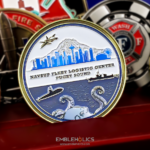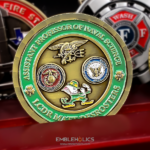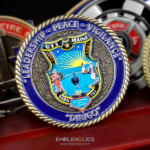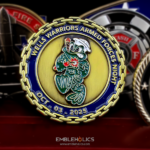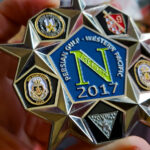
The client wanted something spectacular and out of the box. The outline is a polygon built from several stars set adjacent to one another until they merge into a single enclosing shape, cut and carved precisely, with etched graphics and inscriptions across the faces.
Merging Shapes Into One Outline
This is an unusual construction and a clever one, because it solves the main problem with star-shaped coins.
A single star has fragile points and no usable area. The tips bend, and the points themselves cannot carry artwork, so everything has to live in the center, which is a smaller field than the outline suggests.
Overlapping several stars fixes both. Where stars meet, their points are absorbed into the body of the shape rather than projecting, so the number of exposed tips drops sharply. And the merged interior is far larger and more regular than any one star’s center, which gives the design real room.
The result still reads as a star form. Enough points remain on the perimeter that the eye understands what it is looking at, which is the whole payoff: the association of a star without the structural weakness.
Two things to watch on any merged outline. Where two shapes join there is a concave notch, and concave notches concentrate stress during the strike, so they are usually softened slightly in artwork. And the perimeter becomes complex, which means no standard capsule or display will fit and packaging needs specifying separately.
See custom shaped challenge coins.
Etched Graphics on a Complex Shape
The faces carry a lot of etched graphics and inscriptions, and that pairing with an irregular outline needs managing.
An irregular perimeter has no reliable baseline. On a round coin, text follows the rim at a constant distance. On a merged polygon the distance from the center to the edge varies, so rim-following text will drift closer to and further from the edge as it travels. The usual solution is to set the text on a straight or gently curved line inside the shape rather than following the perimeter.
Balance has to be judged by eye. A symmetrical shape lets you measure. An irregular one does not, which makes the proof stage more important than usual.
And etching suits a busy face better than relief. Recessed line work sits at one depth, so a dense design stays organized. Sculpting the same amount of content would produce competing high points with nothing to separate them.
Coins for a Carrier Deployment
An aircraft carrier is a particular kind of coin client, and the scale is the thing to understand.
The crew is thousands of people. Which means a ship-wide coin is a much larger order than a unit coin, and in practice most carrier coins are ordered at department, squadron or division level rather than for the whole ship’s company. For how those layers fit together, see our USS Carl Vinson Coin.
Deployments are the natural occasion. A deployment has a start, an end and a defined set of people who were aboard for it. That makes it a better coin subject than the ship itself, which has been in commission for decades and will be there after everybody aboard has moved on.
Which argues for marking the year. This coin carries 2017, and that is correct: a deployment coin should say which deployment. It is the opposite of the advice for a standing unit coin, where a date limits the design’s usable life.
And a carrier’s coins accumulate. People who serve in several deployments collect a run of them, which is a reason to keep the format consistent and change only the year.
See also a ship anniversary challenge coin, a USS Nimitz challenge coin and the USS Nimitz decommissioning.
About the Ship and the Deployment
USS Nimitz is one of the largest warships in the world and was redesignated CVN 68 on 30 June 1975.
In 2017 three United States carrier strike groups were operating in the 7th Fleet area. The Nimitz strike group had left the 5th Fleet and was headed home to Naval Station Bremerton, Washington. The carrier deployed on 1 June that year, and her strike group began operations against ISIS on 1 August.
See more Navy challenge coins.
Order a Deployment Coin
Professional artwork is free with unlimited revisions, and nothing goes into production until you approve a digital proof. The challenge coin minimum is 50 pieces, standard production runs about 45 to 50 days after final artwork approval, rush production is available on many projects, and shipping within the continental United States is included. Embleholics is veteran-owned, SDVOSB and registered in SAM.gov.
Two things worth planning. Order while the ship is still deployed or shortly after returning, because a crew disperses quickly and headcounts and approvals get harder. And if you want an unusual outline, ask about merging shapes rather than cutting a single pointed form; it gives you the same visual association with far fewer fragile points and a much larger usable area. Request a free quote to begin.
Frequently Asked Questions
What is a carrier challenge coin?
It is a coin made for an aircraft carrier or one of its departments, squadrons or divisions. Because a carrier’s crew runs into thousands, most are ordered at sub-unit level rather than for the whole ship’s company.
Can a coin’s outline be built from several shapes?
Yes, and merging shapes is often better than cutting one. Where two stars overlap their points are absorbed into the body rather than projecting, so there are far fewer fragile tips and a much larger usable interior.
Why is a single star shape a problem?
Because the tips bend and the points cannot carry artwork, so everything has to fit in the center, which is a smaller field than the outline suggests. Merging several stars solves both issues at once.
What has to be watched on a merged outline?
The concave notches where shapes join, which concentrate stress during the strike and are usually softened slightly in artwork. The complex perimeter also means standard capsules and displays will not fit.
How should text be placed on an irregular shape?
On a straight or gently curved line inside the shape rather than following the perimeter. On an irregular outline the distance from center to edge varies, so rim-following text drifts closer to and further from the edge as it travels.
Should a busy coin face be etched or sculpted?
Etched. Recessed line work sits at a single depth, so a dense design stays organized, where sculpting the same content produces competing high points with nothing to separate them.
Should a deployment coin carry the year?
Yes. A deployment has a start, an end and a defined set of people who were aboard, so the year is what the coin records. That is the opposite of a standing unit coin, where a date limits how long the design stays usable.
When should a ship order its deployment coins?
While still deployed or shortly after returning. A crew disperses quickly once home, which makes headcounts and approvals considerably harder to get.
More Navy Projects