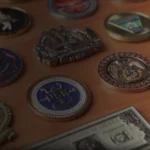
A challenge coin is a custom coin or medallion created to represent membership, achievement, or shared identity inside a group. The tradition is strongly rooted in military culture, where coins are carried as a symbol of belonging and presented as recognition for service. Today, many other organizations use challenge coins for the same core reasons: to honor a team, mark a milestone, and carry a story in a form that lasts.
Challenge coins are usually metal and sized to fit comfortably in the hand or pocket. Most are designed on both sides. One side often features an organization’s emblem or logo, while the other includes supporting artwork, a motto, dates, or commemorative details.
But what is a challenge coin for modern times? While commonly associated with the military, where the tradition began, modern challenge coins are for more than just unit formations. They represent camaraderie and membership in a corporation, law enforcement or first responder agency, or even a performing arts group.
What Are Challenge Coins?
Challenge coins are physical tokens tied to a specific community or moment in time. Some are issued to every member of a unit or organization, like a shared badge that says “you’re one of us.” Others are reserved for people who have done something noteworthy, completed a mission, reached a high standard, or contributed in a way the group wants to honor. That difference matters. A widely issued coin builds identity across the whole team, while a limited coin marks a particular achievement or role. These coins are often presented as gifts of respect or gratitude, so the timing and intent behind the presentation are part of what gives the coin its weight.
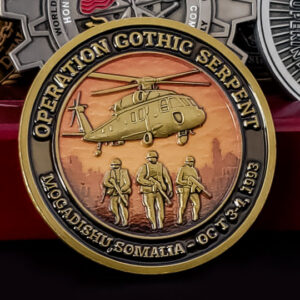
Operation Gothic Serpent challenge coin designed by Embleholics.
Because challenge coins are custom-made, they can be as unique as the organizations that create them. Size, shape, metal finishes, color enamel, edge text, and artwork all vary from project to project. Even within the same organization, coins often evolve over time. A unit might design a new coin for a deployment, an anniversary, a championship season, a major project launch, or a new era of leadership. Those choices turn the coin into a snapshot of when and why it was made.
Coins matter because they carry meaning that people can hold. A coin is not just a logo stamped in metal. It represents the team behind it, the values they share, and the memories tied to earning or receiving it. For many recipients, a challenge coin becomes a small reminder of a big experience, one that stays in a pocket, on a desk, or in a collection long after the moment has passed.
Challenge Coin Meaning
The meaning of a challenge coin comes from the purpose it carries for the group that issues it. In the military and other service communities, coins often symbolize trust, shared experience, and the bond formed through service. In civilian organizations, the meaning tends to be similar. A coin can recognize belonging, highlight excellence, or commemorate a shared win.
Why they are called “challenge” coins
The name comes from a tradition known as a coin check. A member can challenge others to produce their coin. If someone cannot, they owe a small forfeit, usually buying the first round or covering a tab. Every group has its own spin, but the spirit is the same: pride, camaraderie, and a little friendly competition.
A Brief History of Challenge Coins
The earliest origins of challenge coins are debated. Some historians point to ancient Rome, where soldiers were awarded coins to recognize exceptional performance.
Most modern accounts trace the recognizable challenge coin tradition to World War I. A commonly cited story describes an American lieutenant who commissioned medallions for members of his flying squadron. After one pilot was shot down and later escaped, the coin reportedly helped identify him to friendly forces. Whether every detail of that story is verifiable or not, it reflects the core role coins played early on: proof of belonging and a symbol of unit identity.
From there, challenge coins became a standard part of U.S. military culture and spread into allied militaries, law enforcement, fire service, and fraternal organizations.
What Is A Challenge Coin Used For?
Challenge coins are used in a few main ways.
- Membership and identity
A coin can mark that someone belongs to a unit, department, team, or organization. It also serves as a visible reminder of shared values and standards within that group. - Recognition and achievement
Coins are frequently given to recognize exemplary performance, completion of advanced training, successful missions, or contributions that rise above normal expectations. Because they are presented person to person, the recognition feels specific and lasting rather than generic. - Commemoration
Many organizations commission coins to mark anniversaries, major events, campaigns, championships, tours, or other milestones. A commemorative coin acts like a durable timestamp, letting members remember exactly what was achieved and when. - Connection and tradition
Since coins are often tied to experience, they naturally lead to conversation. People share the story of how they earned or received their coin, and what the coin represents to them, which strengthens culture and continuity across generations of members.
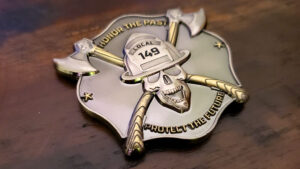
A fire department challenge coin designed by Embleholics.
The Coin Check Tradition and Challenge Coin Rules
Coin checks are part of the fun and part of the culture. The basics are simple. Someone brings out their coin and challenges everyone present to show theirs. If a person cannot produce a coin, they owe a small forfeit. If everyone produces one, the person who started the check might be the one buying.
Rules vary by group, but a few patterns show up often:
- Coins given by higher-ranking leaders typically outrank coins from lower-ranking leaders.
- Many groups expect you to carry the coin as issued. Drilling a hole in it or permanently attaching it to a keychain can count as disqualifying it in some circles.
- Coin checks are usually meant to be light and voluntary. The point is connection, not pressure.
Even for people who never do a coin check, the tradition helps explain why challenge coins carry weight. They are meant to be earned, given with intent, and kept close.
Challenge Coins in Military, Law Enforcement, and First Responders
Challenge coins remain most strongly associated with service communities. These groups established the tradition and still define its heart.
Military challenge coins
Military challenge coins are commissioned across all branches to recognize service, deployments, and mission milestones. A coin is often presented by a commander or senior leader and may be reserved for members who have served with distinction or completed a defining objective. Coins are also exchanged between units to honor visits, joint operations, or shared history.
Law enforcement challenge coins
Law enforcement agencies embraced coins as a way to reinforce unity and recognize excellence. Police challenge coins are used by local departments, specialized units, academies, and other law enforcement organizations to mark training completion, extraordinary service, promotions, retirements, and notable operations. Federal agencies use them for many of the same purposes, including organizations such as the U.S. Marshals Service. The purpose mirrors the military tradition: shared mission, shared pride.
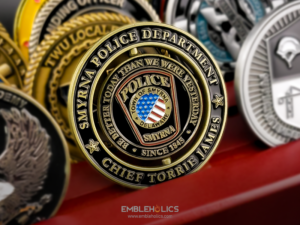
A police department challenge coin designed by Embleholics.
First responder challenge coins
First responder challenge coins represent crew identity, trust, and the bond formed through high-risk work in the field. Fire departments, EMS teams, rescue organizations, and related services commission coins showing their district, apparatus, mottos, or defining calls, so members carry a shared symbol of who they serve with and what they stand for. For fire departments specifically, our custom firefighter challenge coins page includes examples, design ideas, finishes, and common uses.
These coins are used for internal recognition, station and shift pride, and as meaningful gifts for supporters or partner agencies. Like their military counterparts, first responder coins often become part of local tradition, a small piece of metal that holds a big story.
Masonic coins and other heritage organizations
Fraternal organizations such as the Freemasons use coins because symbolism and brotherhood are central to their culture. Masonic challenge coins often feature traditional icons like the square and compass alongside lodge-specific imagery that reflects local identity.
Modern Challenge Coins for Civilian Organizations
Civilian groups use challenge coins for the same reasons service organizations do. A coin marks belonging, recognizes excellence, and preserves shared memories in a way that does not fade.
Corporate challenge coins
Companies use custom corporate challenge coins to recognize employee milestones, leadership awards, sales achievements, onboarding, and major project wins. Some organizations also give coins to clients or partners to mark a relationship or shared accomplishment. In professional environments, a coin works well because it feels personal and lasting without being flashy.
Embleholics has produced corporate and mission-focused coins for organizations like SpaceX, commemorating major aerospace milestones with detailed, story-driven artwork.
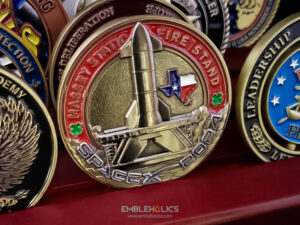
A SpaceX challenge coin designed by Embleholics.
We have also created coins for large defense and technology companies such as BAE Systems, where the coin acted as a formal symbol of team identity and achievement.
Sports teams
Sports organizations use coins to honor championships, special seasons, and standout contributions from players, staff, or donors. Coins are also popular as limited collectibles for fans because they combine symbolism, tradition, and memorabilia in a durable format.
Embleholics has created coins for sports franchises, including a project with the Dallas Mavericks. Coins like these typically feature team branding, season years, and imagery that ties the coin to a specific event or theme.
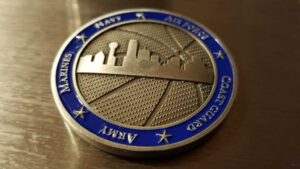
A challenge coin for Veterans working for the Dallas Mavericks designed by Embleholics.
College and youth sports programs often use coins for similar purposes. They can be presented on senior night, after a championship run, during a memorial tournament, or as a meaningful gift from a coach to a player who set the tone for the team.
Dance teams and performance troupes
Performance groups use coins to mark cast membership, touring milestones, anniversary seasons, and elite standards earned through training together. A coin becomes a small, permanent keepsake that carries the story of a production or company long after the curtain drops.
Embleholics recently produced a custom coin for the Radio City Rockettes. Their project shows how well challenge coins fit high performance civilian teams with strong internal culture and tradition.
Marching bands, theater casts, stage crews, and touring ensembles also use coins to honor a season, a show, or a shared standard of excellence. In these groups, a coin often becomes a quiet badge of pride that performers keep as a reminder of what they built together.
Schools, universities, and alumni communities
Educational institutions commission coins to commemorate graduating classes, academic societies, ROTC programs, or alumni milestones. Coins can also serve as recognition for donors or volunteers who contribute to the organization’s mission.
Embleholics has created coins for educational communities such as Hanscom University, where the coin served as a symbol of affiliation and shared identity.
Nonprofits, clubs, and community groups
Many nonprofits use challenge coins to recognize volunteers, mark fundraising campaigns, and build deeper connection among supporters. Clubs and hobby communities use coins as membership tokens and limited collectibles tied to events, tournaments, annual gatherings, or long-running traditions.
In each of these settings, the coin does the same job it has always done. It represents belonging to something that matters.
How to Design a Challenge Coin That Feels Meaningful
The best coins start with a clear purpose.
- Start with the story. Is the coin for membership, achievement, or commemoration?
- Pick a few strong symbols. Simple, meaningful elements usually carry more impact than crowded designs.
- Keep wording tight. A short motto, a date, or a unit name is often enough.
- Choose finishes that match the tone. Polished finishes feel formal, antique finishes feel historic, and color enamel can highlight key details.
- Use edge text only when it adds context. A mission name, coordinates, or a short phrase can be a strong finishing touch.
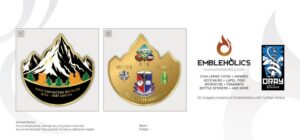
Example of an Embleholics challenge coin design in progress, with custom edge shape.
Popular options organizations choose
Many teams take advantage of modern coin features to make a design more functional or more memorable. Cutout shapes let you build a coin around a unique silhouette instead of a standard circle. Three-dimensional sculpting adds depth and realism to aircraft, mascots, logos, or stage imagery. Bottle opener coins are popular for units and teams that want a coin that doubles as a practical keepsake. These options work best when they support the story behind the coin, not when they are added just for flash. You can explore more challenge coin manufacturing options, including base metals, plating, enamel, 3D sculpting, cut-outs, edge engraving, UV printing, and other specialty features.
A well-designed coin should make sense to the holder even years later.
Veteran Owned, Veteran Operated
Challenge coins are closely tied to military and veteran culture, and we believe the best stewards of that tradition are the people who lived it. Embleholics is a veteran-owned company that employs veterans, including many with service-connected disabilities. Supporting veterans is part of our mission, and we take pride in carrying this tradition forward with respect.
Work With Embleholics
If someone ever asks you, “What is a challenge coin?” send them this guide. Whether your organization is rooted in service tradition or building a new kind of team culture, a challenge coin can be a lasting symbol of pride and shared achievement.
Embleholics designs and produces custom challenge coins for military units, law enforcement, fire service, Masons, corporate organizations, sports teams, and performance groups. If you are planning a coin, request a free challenge coin design and quote and tell us about your idea, organization, quantity, and timeline.
Recent Posts