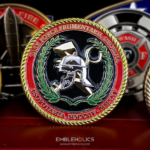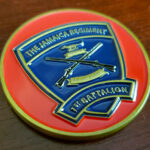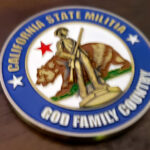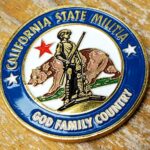
Every custom coin runs through the same six steps, whatever the design: artwork, proof, die, strike, finish, and packing. Knowing what happens at each one tells you where your decisions actually change the result and where they do not, which is the difference between an easy order and a frustrating one. We make coins for military units, fire departments, law enforcement agencies, corporate teams, nonprofits and civilian organizations, and the process is identical for all of them.
Step one: your material, whatever form it is in
You do not need finished artwork to start, and most people do not have it. A unit crest, a photograph of an existing patch, a sketch on paper, a logo from a letterhead, or a written description of what you have in mind are all workable starting points. What helps most is knowing what the coin is for and who is receiving it, because that answers more design questions than the artwork does.
Vector artwork is ideal where it exists, since it scales to the resolution a die requires without loss. If all you have is a low-resolution image or a photograph, our designers redraw it, which is included rather than billed.
Step two: the proof, which is where your time should go
Our artists produce a design for review and revise it on your feedback, as many times as it takes. There is no charge for revisions and no limit, and this is deliberate: it is far cheaper for everyone to resolve a question on a drawing than on a struck coin.
Three things to look at carefully on a proof, because they are the ones most often missed:
- Spelling and numbers. Unit designations, dates, hull numbers and names. Have someone who was not involved in the design read them back. This is the single most common cause of a reprint.
- Text at actual size. A proof on a screen is much larger than the coin. Ask to see the design at true size before approving anything with a motto or a long title on it.
- Whether anything is too small to survive. We will flag it, but you know your own artwork best. If a detail matters to you, say so, and we will tell you honestly whether it will hold.
Nothing moves to production until you approve the proof. Once you do, the design is cut into a die, and changes from that point mean starting again.
Step three: the die, and why it shapes the economics
The die is a steel tool carrying your design in reverse, and it is the main fixed cost of an order. That single fact explains most of how coin pricing behaves. Sculpted relief, fine detail and texture are cut into the die once and then reproduced across every coin in the run at no extra cost. Enamel colors, extra plating operations and packaging are paid for on each individual coin.
The practical takeaway: detail is cheap and consumables are not. A coin that gets its presence from depth and composition costs less than one that gets it from twelve colors and a presentation box, and it usually looks better.
It also explains why quantity matters so much. The die cost spreads across the run, so the unit price falls as the order grows. Our minimum is fifty coins, and the minimum order page covers how that works.
Steps four to six: strike, finish, pack
Striking presses the blank between dies under pressure, forming the relief. This is where the coin gets its weight and its depth, and it is why struck coins feel different from printed ones.
Finishing is where most of the visual character is decided. Plating sets the metal tone: gold, silver, nickel, copper, brass, or black. Antiquing darkens the recesses to make the coin look aged, or is left off to keep it bright and current. Enamel fills the recessed color areas, either soft, which sits slightly below the metal and gives visible depth, or hard, which is polished flush and wears better in a pocket. Edges are cut plain, reeded, or decoratively milled.
Packing is optional and worth a decision rather than a default. Clear capsules, velvet pouches, presentation boxes and acrylic cases are each a separate cost per coin. For coins going straight into pockets they add little. For a small number that will be presented formally, they add a lot.
Who orders custom coins, and what for
Coins began in the military and that remains the largest part of the work. Units use them for recognition, for welcoming new members, for marking deployments and ceremonies, and for exchange with other commands and visiting organizations.
The uses outside the military have grown considerably and follow the same logic:
- Fire departments and law enforcement, for recognition, memorials, academy graduations and mutual aid exchange.
- Corporate teams, for service milestones, safety records, project completions and partnership markers.
- Nonprofits and associations, for membership, fundraising and volunteer recognition.
- Civilian organizations of every kind, from sports leagues and schools to clubs and community groups, which account for a steadily larger share of what we make.
What they all have in common is the reason a coin works at all: it is small enough to carry, durable enough to last, and specific enough that the person holding it knows exactly what it was given for.
Starting an order
Send whatever you have and tell us three things: who the coins are for, roughly how many, and when you need them. Those three answers shape the design, the specification and the schedule, and they let us give you a realistic quote rather than a range. Artwork and revisions are free, as is shipping within the US. You can browse the full range of custom coins we have produced or send your details through the free quote form, and we will come back within a day.
Frequently Asked Questions
How are custom challenge coins made?
In six steps. Your material is turned into artwork, the artwork becomes a proof you review and revise, the approved design is cut into a steel die, blanks are struck between dies under pressure to form the relief, the struck coins are plated, antiqued and filled with enamel, and finally they are packed. Nothing goes into production until you have approved the proof.
Do I need finished artwork to order a custom coin?
No. A unit crest, a photograph of a patch, a sketch, a logo from a letterhead, or a written description are all workable starting points, and our designers produce the artwork from there at no charge. Vector artwork is ideal where you have it, since it scales without loss, but a low-resolution image can be redrawn.
How many design revisions do I get?
As many as you need, at no cost. Resolving a question on a drawing is far cheaper than discovering it on a struck coin, so there is no reason to limit revisions. The proof stage is where your time is best spent.
What should I check on a proof before approving it?
Spelling and numbers first, especially unit designations, dates, hull numbers and names, and ideally read back by someone who was not involved in the design. Then ask to see the design at actual size rather than on a screen, since proofs appear much larger than the finished coin. Finally, flag any small detail that matters to you so we can tell you whether it will survive striking.
Why does detail cost less than color on a coin?
Because detail lives in the die and color does not. Sculpted relief and texture are cut into the steel tool once and reproduced across the whole run at no additional cost per coin, whereas each enamel color area, each extra plating operation and each piece of packaging is paid for on every individual coin. Spending on depth and composition is usually better value than spending on color count.
What is the difference between soft and hard enamel?
Soft enamel sits slightly below the surrounding metal ridges, which gives the coin visible texture and depth and costs less. Hard enamel is polished flush with the metal, producing a smooth surface that wears considerably better. For a coin that will live in a pocket, hard enamel is the more durable choice; for display pieces, soft enamel is fine.
Who can order a custom challenge coin?
Anyone. Military units remain the largest group, followed by fire departments and law enforcement agencies, but corporate teams, nonprofits, associations, schools, sports leagues and community organizations all order them, and the civilian share keeps growing. The process is the same regardless of who you are.
How long does a custom coin order take?
It depends on how quickly the proof is approved, which is usually the variable rather than production. Tell us your deadline when you first make contact and we will tell you honestly whether it is achievable, and whether rush production is needed to meet it.
More Militias Projects