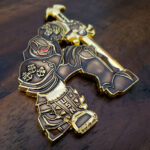
The VP-47 challenge coin is not a coin with a mascot on it. The coin is the mascot. It is cut to the outline of the squadron’s Golden Swordsman, with Navy insignia worked into the figure’s armor, a gold sword against dark brass, and a diamond plate texture on the reverse. A figure is the most demanding shape a coin can take, and it is worth understanding why before you ask for one.
A Coin Cut to the Shape of a Figure
Outlines get harder in a predictable order. A square or an oval is easy. A shield or a badge outline is easy. A country or an island is manageable if the proportions are compact. A figure is the hardest of all, for one reason: figures have extremities.
An arm, a raised weapon, a plume, a trailing cape, a separated leg. Each one is a narrow projection joined to the body at a point narrower still, and every one of them is somewhere the coin can bend or snap. The good news is that all of it is solvable at the drawing stage, and three of the four solutions cost nothing.
Pose the figure to close the silhouette. This is the one that matters most, and it is a structural decision disguised as an artistic one. A figure standing square with arms near the body and a weapon held vertically has almost no exposed extremities. The same figure in a dynamic open stance, arm thrown out, cloak flying, has four or five. Choose the pose for the metal, then make it look good.
Use the weapon as a strut. A sword held diagonally across the body can touch the shoulder at one end and the hip at the other, which turns what would have been a thin unsupported projection into a braced member carrying load between two thick sections. Capes, shields, staffs and scrolls all do the same job. The elements that look like the most fragile part of a figural coin are often the ones holding it together.
Thicken where the outline narrows. Extra material at a wrist, an ankle or the base of a plume adds strength without changing the silhouette anyone sees.
Or add a thin frame. If a pose genuinely cannot be closed, a slim outline border around the figure solves the whole problem at once. It costs some of the punch a true cut silhouette has, so treat it as the fallback rather than the plan. See custom shaped challenge coins for how these outlines are tooled.
Armor Is a Free Place to Put Insignia
Figural coins have a problem that round coins do not. There is no flat field. A disc has a background you can put a logo on; a swordsman does not, so unit and service devices have nowhere obvious to go.
A figure in armor solves it, and the solution is historically correct rather than a workaround. Armor is what people have always put devices on. A breastplate, a shield, a pauldron and a helmet are all surfaces built for heraldry, so placing the Navy insignia on the Swordsman’s armor reads as natural rather than as a sticker applied to a character.
The general rule for a figural coin is to find the surfaces the figure already carries. Armor plates, a shield, a banner, a sash, the side of a vehicle, a sail. If the figure has none of those, the reverse has to do all of the identifying work.
A Texture Instead of a Background
The reverse uses a diamond plate pattern as its base, and this is an underused idea that solves a common problem.
The reverse of a coin has to be filled with something. A scene competes with the inscriptions. A plain field looks unfinished. A texture does neither, for three reasons.
- It has no focal point. A uniform pattern is read as a surface, not as a subject, so it cannot pull attention away from the lettering sitting on it.
- It survives any reduction. Pattern is forgiving in a way pictures are not. If a repeat gets small, it simply becomes a finer texture.
- The material carries meaning. Diamond plate is the surface of decking, ramps and working floors. It says machinery and aircraft without drawing either, which is a lot of meaning for something that is technically a background.
Other textures that work the same way are knurling, hex mesh, a canvas or rope weave, a brushed directional grain and riveted plating. Two cautions: keep the relief shallow, because deep texture on a reverse catches on fabric and is unpleasant in the hand, and stop the texture where lettering begins, since text set directly on a pattern loses its contrast.
Two Metals on One Face, Done Right
The armor is dark brass and the sword is gold, which is two plating colors on a single face. That is the harder version of two tone plating, and this design happens to meet the conditions it needs.
Two metals on one face require areas that are reasonably large, clearly bounded, and separated by a hard edge the masking can follow. A sword is exactly that: one continuous element with a crisp outline running through the middle of the composition. What fails is two colors weaving in and out of each other at the scale of engraved detail, where there is nowhere clean to put a mask. The full range is in challenge coin plating options.
VP-47 and NAS Whidbey Island
Patrol Squadron 47, the Golden Swordsmen, is a United States Navy maritime patrol squadron at Naval Air Station Whidbey Island in Washington, flying the P-8A Poseidon. The squadron was established on 1 June 1944, originally as Patrol Squadron 27, and it moved to Whidbey Island from Hawaii when it transitioned to the P-8A in 2017.
That station history is a reason to build a squadron coin around the mascot rather than the base. Over eight decades VP-47 has been home at San Diego, Alameda, Moffett Field, Barbers Point, Kaneohe Bay and now Whidbey Island. The Golden Swordsman has been constant through all of it, which is what makes it the right subject for a coin that people will keep for the rest of their careers.
Embleholics is based in Port Orchard, so Whidbey Island is a short way up the water. See more challenge coins in Washington State, the VP-26 Tridents coin, and a VP-65 squadron coin.
Order a Coin for Your Squadron
Send your squadron insignia and your mascot artwork, and say whether you want the coin cut to the figure or kept to a conventional outline. If you want a figural shape, send the pose you have in mind early, because the pose decides whether the coin will be durable.
Professional artwork is free with unlimited revisions, and nothing goes into production until you approve a digital proof. Standard production runs about 45 to 50 days after final artwork approval, rush production is available on many projects, and shipping within the continental United States is included. Embleholics is veteran-owned, SDVOSB and registered in SAM.gov. See more Navy challenge coins.
Frequently Asked Questions
What is a VP-47 challenge coin?
A VP-47 challenge coin is a coin for Patrol Squadron 47, the Golden Swordsmen, a United States Navy maritime patrol squadron at Naval Air Station Whidbey Island in Washington. This one is cut to the outline of the squadron’s Golden Swordsman mascot, with Navy insignia on the figure’s armor and a diamond plate texture on the reverse.
Can a challenge coin be cut to the shape of a mascot or figure?
Yes, and it is the most striking option available, but it is also the most demanding. Figures have extremities such as arms, raised weapons, plumes and capes, and each one is a narrow projection joined at a narrower point. Those are the places a coin bends or breaks, so the shape has to be planned around them before tooling.
How do you stop a figural coin from breaking?
Four ways, in order of usefulness. Choose a pose that closes the silhouette, with arms near the body and any weapon held against it. Use a weapon, cape or staff as a strut that touches the body at two points, which turns a fragile projection into a braced member. Add thickness where the outline narrows. And if the pose cannot be closed, put a slim outline frame around the figure, which solves it completely at the cost of some of the silhouette’s impact.
Where do you put unit insignia on a figural coin?
On the surfaces the figure already has. A figure in armor gives you a breastplate, a shield, a pauldron and a helmet, all of which are historically where devices went, so insignia there looks natural rather than applied. If the figure carries no such surface, the reverse has to do the identifying work instead.
What is a diamond plate pattern on a coin for?
It fills the reverse without competing with anything. A uniform texture reads as a surface rather than a subject, so it cannot pull attention from the lettering, and it survives any reduction because a smaller repeat is simply a finer texture. Diamond plate also carries meaning, since it is the surface of decking and working floors, so it suggests machinery and aircraft without drawing either.
What other textures work as a coin background?
Knurling, hex mesh, canvas or rope weave, a brushed directional grain, and riveted plating all work. Keep the relief shallow, because deep texture catches on fabric and feels unpleasant in the hand, and stop the texture where lettering begins, since text set directly on a pattern loses contrast.
Can two different metals be used on the same side of a coin?
Yes, if the areas are large, clearly bounded and separated by a hard edge the masking can follow. A sword running through a figure in armor is a good example, because it is one continuous element with a crisp outline. What does not work is two colors interlocking at the scale of engraved detail, since there is nowhere clean to place a mask.
What aircraft does VP-47 fly?
VP-47 flies the Boeing P-8A Poseidon, having transitioned to the type in 2017 when the squadron moved to Naval Air Station Whidbey Island. The squadron was established on 1 June 1944, originally as Patrol Squadron 27.
More Navy Projects