An aircraft challenge coin renders the airframe in relief rather than as a flat image, and the view chosen decides everything. Side profile identifies a type fastest, three-quarter looks the most dynamic, and head-on is the hardest to pull off because an aircraft is least distinctive from the front.
Which View Should an Aircraft Be Shown From?
This is the first decision and most people make it by accident. There are three options and they are not interchangeable.
Side profile. The default, and the safest. A side view shows wing position, engine placement, tail configuration and fuselage proportion all at once, which is the full set of features people use to identify a type. If the priority is that the aircraft be instantly recognizable, this is the answer. The cost is that a profile is static. The aircraft looks parked.
Three-quarter. The most dynamic of the three, and the most common on aviation art generally. It keeps most of the identifying features while suggesting motion, and it fills a round coin face better than a profile does, because a profile leaves dead space above and below the fuselage. The cost is difficulty: foreshortening a wing correctly in relief is harder than drawing it flat, and a three-quarter view done badly looks bent rather than angled.
Head-on. The hardest, and the one on this coin. From the front, an aircraft is at its least distinctive. Most of the fuselage is hidden behind itself, the tail is largely invisible, and the wing is compressed to a line. What is left is the nose, the engine positions and the wing dihedral, which means the design has to do far more work to say which aircraft it is.
So why choose it? Because head-on is the view with presence. An aircraft coming at you is confrontational in a way a profile never is, and for squadrons whose self-image is about reach and pursuit, that reads correctly. It is a deliberate trade of recognizability for attitude, and it is only worth making when the squadron’s own people are the audience, because they will know the type from the engine layout alone.
Whichever view is chosen, protect the identifying features. Engine placement, wing position relative to the fuselage, and tail configuration. Aircrew check those three first, in that order. Everything else on an aircraft can be simplified.
How Aircraft Are Rendered in Metal
An aircraft on a coin is relief work, not an outline. The airframe is raised off the field with the surfaces sculpted so that light describes the shape, which is why a good aircraft coin looks different as you turn it and a flat one looks like a sticker.
The constraint is scale. An aircraft occupying an inch of a coin face cannot carry panel lines, individual windows, antennas or weapons stations. All of that has to go, and the question is what goes first.
Here is the difference between an aircraft and a logo, and it is the reason this is harder than it looks. A logo that loses detail is still the same logo. Simplify a company mark and it reads as a cleaner version of itself. An aircraft that loses the wrong detail becomes a different aircraft. Drop the engine pylons and a jet becomes a glider. Straighten a swept wing and a fast jet becomes a trainer. Shorten a tail and a patrol aircraft becomes an airliner. The features that identify a type are exactly the features a designer simplifying for scale is most tempted to remove, because they are small.
The practical answer is to decide the silhouette first and add detail second. If the outline alone reads as the right aircraft to someone who flies it, everything added afterward is a bonus. If the outline is wrong, no amount of surface detail will rescue it.
What Goes on a Squadron Coin?
The vocabulary is fairly settled: the squadron insignia, the aircraft type, the squadron number and tail code, the squadron nickname, home station, deployment or cruise dates, and the parent wing.
The pattern worth knowing is that squadron coins are almost always built around two elements, the aircraft and the insignia, and most of the design work is deciding which one leads.
Insignia leading suits squadrons with a strong, old, graphically distinctive badge. The aircraft becomes a supporting element, often small and often on the reverse. This ages well, because squadrons keep their insignia across decades and change aircraft several times.
Aircraft leading suits squadrons transitioning to a new type, marking a first deployment with it, or whose identity is currently bound up in the airframe. The insignia moves to the reverse or shrinks to a corner.
Both are legitimate. The mistake is giving them equal weight on the same face, which produces a crowded coin where neither element wins. Pick one to lead.
For the same squadron identity applied to a different product, see our page on squadron belt buckles. Aviation medical units have their own conventions, covered on our page about aeromedical squadron coins.
About This VP-26 Tridents Coin
VP-26, the Tridents, is a United States Navy maritime patrol squadron.
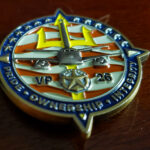
The coin takes its core design from the squadron insignia, a compass with a skull at its center. The four compass needles extend beyond the outline of the coin, so the finished piece is not a plain disc. On both faces, a Boeing P-8A is machined in relief and viewed head-on, with a trident embossed behind the aircraft, and the two faces carry different engraved backgrounds.
Two things here are worth pointing out.
The compass is an unusually good candidate for breaking the outline. A design that extends past the rim needs a reason to go outward, and most emblems do not have one. A compass has four needles already pointing away from the center, so pushing them past the edge follows the logic of the emblem rather than fighting it. The trade-off is durability: anything projecting past the rim takes the wear first and is the most vulnerable part of the coin, which is why this works better on four short needle tips than it would on something fine or elaborate. The same technique on a different emblem is covered on our page about designs that break the coin’s outline.
The same aircraft on both faces is unusual and it works here. Most coins vary the two sides precisely so that they are not repetitive. This one repeats the P-8A and changes the engraved background instead, which makes the aircraft the constant and the setting the variable. It reads as the same aircraft in two different places, which for a patrol squadron with a worldwide beat is the right implication.
This page is about aircraft depicted on a conventional coin. Coins cut to the shape of an aircraft are a different technique, covered on our page about coins shaped like aircraft.
Can We Use Our Squadron Insignia on a Coin?
Most squadrons can, but the authorization has to come from the squadron, not from us. Squadron insignia, unit emblems, tail markings and service marks are controlled by the organizations that own them, and the rules differ between branches and between commands.
The practical version is straightforward. Clear the artwork through your own chain of command before you order, and send us artwork your organization is authorized to supply. We produce from what the customer provides and we do not grant permission on anyone’s behalf. If you are unsure who signs off, your wing or command public affairs office is usually the right place to ask.
Design a Coin for Your Squadron
The single most useful thing you can send us is a photograph of the aircraft, or better, a three-view drawing. Most squadrons have both, and starting from an accurate reference is what prevents the silhouette problems described above. A scan of the squadron patch covers the insignia side.
Professional artwork is free with unlimited revisions, and nothing goes into production until you approve a digital proof. The minimum order is 50 coins, standard production runs about 45 to 50 days after final artwork approval, rush production is available on many projects, and shipping within the continental United States is included. Embleholics is veteran-owned, SDVOSB and registered in SAM.gov. Browse more custom Navy challenge coins or request a quote to get started.
Frequently Asked Questions
Can an aircraft be put on a challenge coin?
Yes. An aircraft is rendered in relief rather than as a flat image, with the surfaces sculpted so the shape is described by light rather than by outline. Send a photograph or a three-view drawing of the type and the airframe is drawn from that reference.
Which view of an aircraft works best on a coin?
Side profile identifies a type most easily because it shows wing position, engine placement and tail configuration at once. Three-quarter looks the most dynamic and fills a round face better. Head-on has the most presence but is the hardest to recognize, since an aircraft is least distinctive from the front.
How much aircraft detail survives at coin size?
At coin scale, panel lines, individual windows, antennas and small fittings are lost, and the design has to work from the silhouette and the major surfaces. The features to protect are engine placement, wing position and tail configuration, because those are what identify the type.
What goes on a squadron challenge coin?
A squadron coin usually carries the squadron insignia, the aircraft type, the squadron number or tail code, the nickname, and sometimes home station or deployment dates. Most designs are built around either the insignia or the aircraft leading, rather than giving both equal weight on one face.
Can a design extend past the edge of a coin?
Yes. Elements can project beyond the outline so the coin is not a plain disc, as with the compass needles on this design. Projecting elements take the most wear, so the technique suits short, solid shapes better than fine or elaborate ones.
Can both sides of a coin show the same aircraft?
Yes, and it can be a deliberate choice rather than a shortcut. Repeating the aircraft and changing the background makes the airframe the constant and the setting the variable, which suits squadrons that operate in many places. Most coins vary the two faces instead.
Can we use our squadron insignia on a coin?
Squadron insignia and unit emblems are controlled by the organizations that own them, so permission has to come from your squadron rather than from a manufacturer. Clear the artwork through your chain of command and send us artwork your organization is authorized to supply.
What is the minimum order for squadron coins?
The minimum order for custom challenge coins is 50 coins. That suits a single squadron, and larger quantities reduce the cost per coin, which matters for squadrons ordering enough to cover a full deployment cycle.
More Navy Projects